Snorkeling
Snorkeling in Martinique: turtle coves, a drowned mermaid, black sand
Martinique snorkels from shore better than any French island: the Anses d'Arlet coves, the turtle-approach law at Anse Dufour, Manman Dlo off Saint-Pierre, and the swell that decides the wild north.
We earn a commission on purchases made through links on this page, at no extra cost to you. It never affects which products we recommend.
On this page
- The Anses d’Arlet: four coves, one road
- Anse Dufour and Anse Noire: the turtle coves, and the law
- The south: Pointe Borgnèse and Anse Figuier
- Saint-Pierre: the mermaid, and the town the mountain took
- The wild north: Céron, Couleuvre, and a reserve with teeth
- What does not snorkel, so you stop wondering
- The boat day
- What the water is like now
- When to go, and how to move
- Martinique snorkeling FAQ
Martinique does the thing most Caribbean islands only advertise: real snorkeling you walk into off public beaches, no boat required. The Caribbean coast folds into a series of coves — the Anses d’Arlet — where green turtles graze seagrass a hundred meters off the sand, and further north a 20-ton concrete mermaid lies drowned off the town a volcano erased in 1902. Martinique is the rare opposite of oversold: barely marketed to Americans because it runs in French, and better from shore than islands twice its price.
Base in Les Anses-d’Arlet, snorkel the coves on foot, give Saint-Pierre a morning, and buy exactly one boat day.
The Anses d’Arlet: four coves, one road
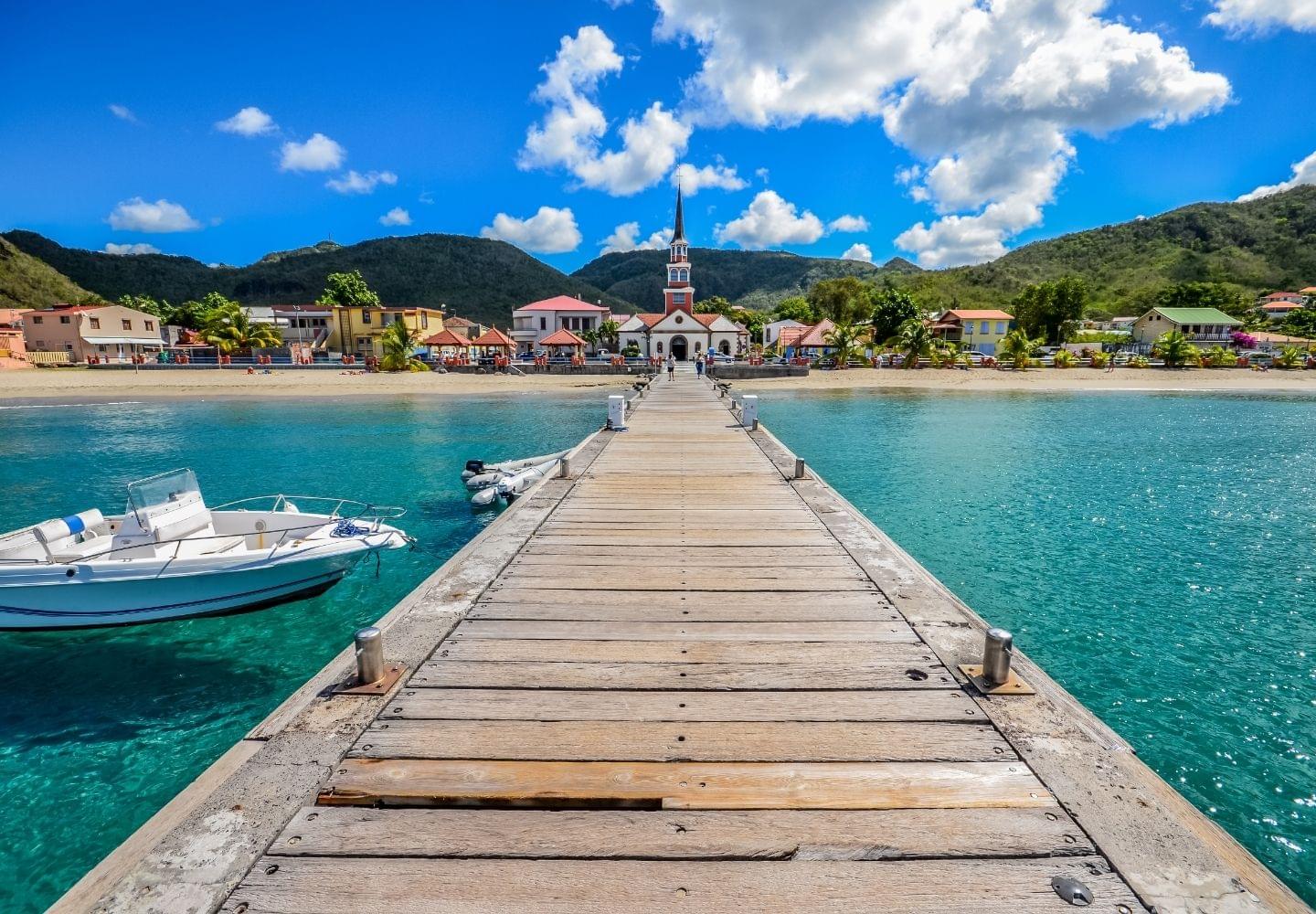
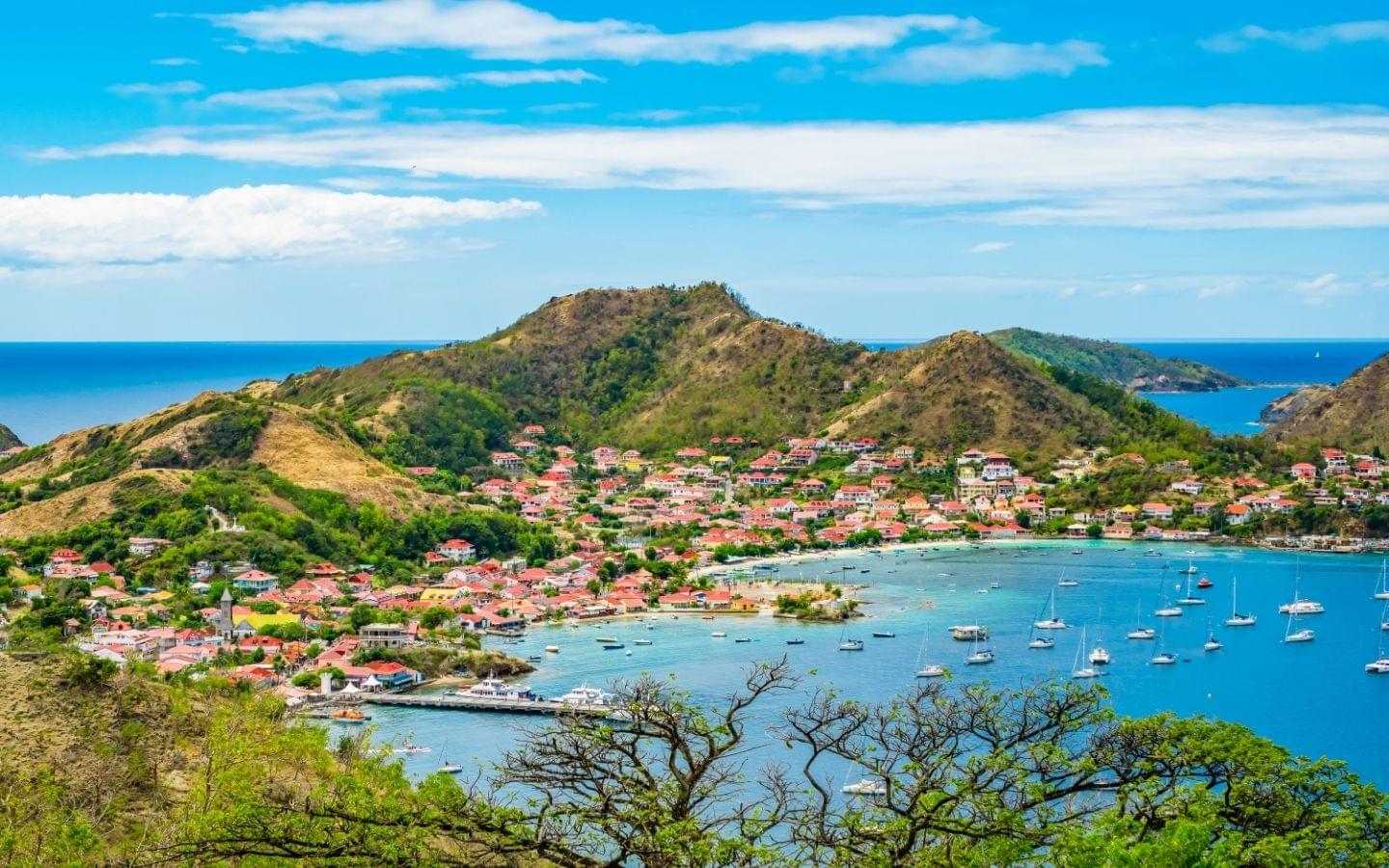
The village of Anse d’Arlet bourg is the anchor: a church facing a wooden pier, and an entry just north of it onto the Sentier Sous-Marin Lakay — a marked underwater trail with four information buoys over rock and coral patch in one to fourteen feet of water.1 Fish density is high for water this easy (sergeant majors, wrasse, trumpetfish), and the hazard is not the sea, it is the anchorage: small boats swing on moorings all through the bay, so tow a flag or bright buoy and surface looking up.
Petite Anse, the next cove south, is the quiet copy: enter at the rocks on the north end, work the shoreline in under twenty feet, and count cushion stars, morays and squid. Park behind Snack Fredo. Grande Anse d’Arlet, north of the bourg, is the reliable turtle water: they graze the seagrass fifty to a hundred meters out, from about three meters deep, and the entry is dead ahead of the Alpha Plongée dive shop. Boat traffic is heaviest here of the three; the buoy is not optional.
Anse Dufour and Anse Noire: the turtle coves, and the law
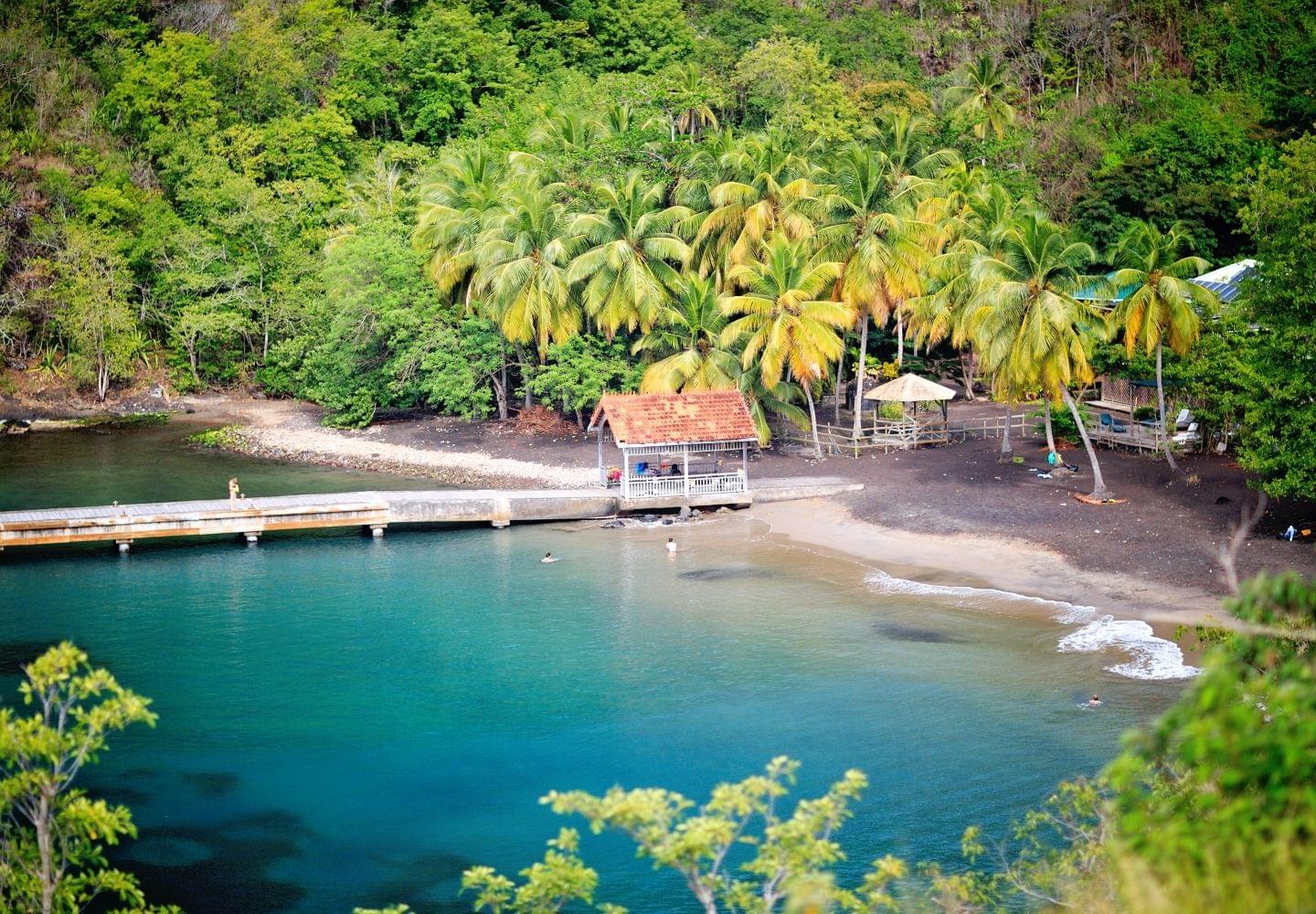
Two coves share one parking area on the cliff between them, and they are the island’s headline act: Anse Dufour, white sand and fishing boats, a flat walk from the lot; Anse Noire, volcanic black sand, down about 130 stairs. Green turtles hold the central seagrass of both bays at ten to twenty feet, close enough to the sand that a patient beginner will meet one within half an hour. Dufour’s easy access makes it the family pick, and a better one than any boat tour: the tour boats are precisely what these small coves do not need more of.
The rules are law, not etiquette. Sea turtles in the French Antilles are fully protected, and the ministerial decree of 10 November 2022 bans capture, pursuit, harassment and any intentional disturbance, with penalties running to €150,000.2 In the water that means about five meters of distance, no chasing, no flash, and never positioning yourself between a turtle and the surface: it has to breathe, and a snorkeler hovering overhead reads as a predator. The island ran a territory-wide Observons sans toucher campaign in 2025 because crowding here is real: on winter cruise days these two coves absorb vanloads, and the morning hours before ten are worth the alarm clock.
The south: Pointe Borgnèse and Anse Figuier
Pointe Borgnèse is the connoisseur’s walk-in at the mouth of the Baie du Marin, on the Rivière-Pilote side. Park in the lay-by on the N5 about 850 meters past the Anse Figuier roundabout, walk the 450-meter path down, and enter over sand into a protected shallow that rarely exceeds ten feet: near-zero current in settled weather, seagrass and coral patch, and lionfish common enough that you should know what they are before you put a hand on a rock. Strong snorkelers run the kilometer of coast from here to Anse Figuier as a drift; do it in a pair and read the current first.
Anse Figuier is the same water with a parking lot: rocky flanks holding fish in one to twelve feet, cushion stars on the sand, the Écomusée behind the palms, and half the commune on the towels by Sunday noon. Beginner-perfect on weekday mornings.
Saint-Pierre: the mermaid, and the town the mountain took

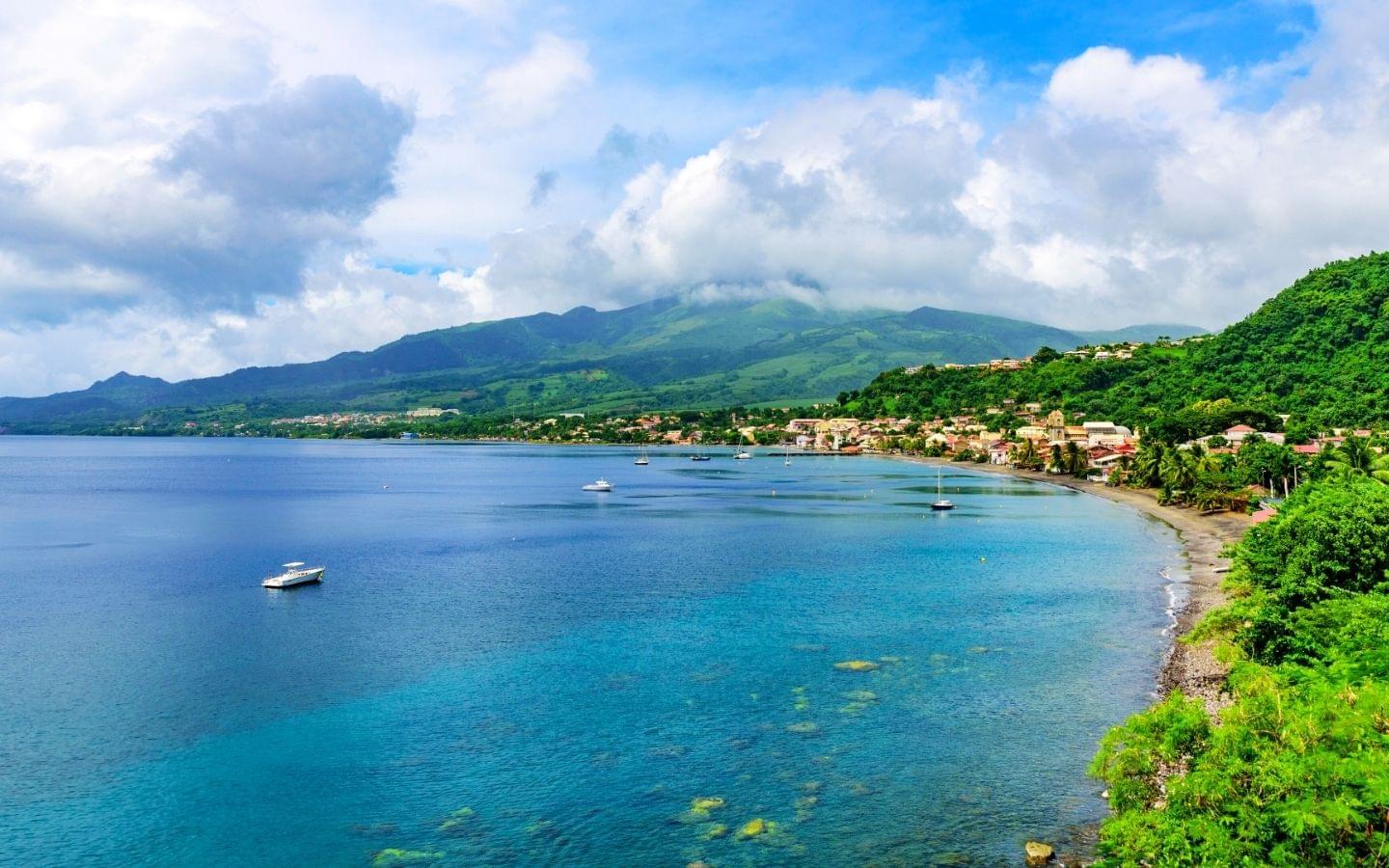
In 1902 Mont Pelée burned Saint-Pierre off the map in three minutes and put at least fifteen ships on the bottom of its bay. The wreck fleet, the Roraima at fifty meters among them, belongs to divers. What belongs to you is Manman Dlo: sculptor Laurent Valère’s 20-ton concrete water-mother, sunk in 2004, lying under a yellow buoy about sixty meters off the beach at the town’s southern entrance, opposite the Fish Bo Kay restaurant. Her face rests at about six meters — a clean free-dive or a good look from the surface on a clear day — with sergeant majors and squirrelfish schooling over the concrete and turtles and rays working the seagrass beside her.3 It is an intermediate swim: sixty meters each way in a working bay, dive boats often moored on the statue, black volcanic sand eating the light below. Go mid-morning for the sun angle.
Valère’s second piece, Yemaya (twelve meters and 37 tonnes, sunk in 2015), lies nearby at about nine meters and reads from the surface as a long shadow; treat her as a bonus, not the destination. And the black sand is the point of the place, not a defect: this is snorkeling inside a historical event, and nowhere else in the Caribbean feels like it.
The wild north: Céron, Couleuvre, and a reserve with teeth
Past Saint-Pierre the road narrows, the forest closes in, and the island ends at two black-sand coves under Pelée’s shoulder. Anse Céron has the facilities (tables, showers, no lifeguard), a seafloor that drops fast, and a right-hand rock line worth snorkeling on a flat day. Anse Couleuvre is the literal end of the road: a ten-car clearing, a ten-minute forest path past rum-distillery ruins, and the wildest swimmable water on the island. Both are Caribbean-coast: their enemy is not the Atlantic but the winter north swell, which arrives in episodes and closes them to everyone. When the swell runs, the north is a hiking day.4
La Perle, the islet off Couleuvre, sits inside the Prêcheur–Albert Falco marine reserve: no landing, no anchoring, spearfishing banned, the strictest zone in Martinique’s waters.5 Snorkeling from the beaches remains free and legal, and the reserve is why the fish life here is climbing; taking a boat out to explore the islet, though, is now a way to collect a fine.
What does not snorkel, so you stop wondering
Anse Mitan at Trois-Îlets is a pleasant ferry beach with incidental fish, not a destination; go for the restaurants and the crossing, not the mask. Rocher du Diamant is a protected seabird rock where landing is forbidden and in-water visits happen only under professional supervision; see it from a boat deck. And the Atlantic east coast takes the swell and the sargassum; leave it to the kitesurfers.
The boat day
One boat day rounds out a Martinique week, and the market runs from Pointe du Bout and Grande Anse. The benchmark is Kata Mambo, whose full-day catamaran north (dolphins along the coast, a Saint-Pierre stop, a snorkel at Fond Boucher) publishes at €98 for adults. Through Viator, the turtles-and-snorkeling half-day works the Anses d’Arlet coast with Diamond Rock on the horizon, the full catamaran snorkel day pairs snorkelers with divers on the same boat, and the dolphins-and-turtles full day is the greatest-hits version for first-timers and families. Morning departures get the flat water; the afternoon trades put chop on the return leg.
What the water is like now
Stony coral tissue loss disease has worked Martinique’s reefs since 2020, and the 2023 marine heatwave was the worst on the island’s record: heat stress past 20 degree heating weeks, bleaching on 86% of surveyed colonies at its October peak, and roughly a third of the island’s coral cover gone in one season.6 The 2024 season peaked nearly as high before 2025 eased and 2026 has run clean through mid-August.7 What that means in the water: the coves run on seagrass, rock, turtles and sculpture, none of which bleaches, and the coral patch you float over is thinner and browner than the five-year-old photos. Sargassum stays mostly on the Atlantic side, but 2026 is among the most intense seasons Météo-France has recorded, with rafts reaching as far round as Le Diamant in early summer; check the meteofrance.mq sargassum bulletin the week you fly.8
When to go, and how to move
February through May. The carême dry season holds the sea flat, the west coast runs clear, the north swell fades, and the sargassum has not peaked. December and January are dry but crowded: Fort-de-France logged 27 cruise calls in December 2026 alone, and ship days flood the turtle coves by 10 a.m.9 August through October is the wet season’s core and the storm window; the island stays open, but you are gambling your water days.
Rent a car: the coves are a driving itinerary, and the Couleuvre road wants confidence more than clearance. The Blue Lines ferry (the former Vedettes Tropicales) crosses Fort-de-France bay to Pointe du Bout and Anse à l’Âne in under 35 minutes for a few euros, the civilized way to reach the boat-day marinas without parking in the capital.10 Base in Les Anses-d’Arlet for walk-to-water density; Trois-Îlets trades snorkeling for restaurants and the ferry; Sainte-Anne’s beaches are beautiful and the wrong side of the island for snorkeling.
Martinique snorkeling FAQ
Frequently asked questions
Can you touch the turtles at Anse Dufour?
No, and it is a criminal offense, not a courtesy. French law (the ministerial decree of 10 November 2022) bans touching, chasing and any intentional disturbance of sea turtles, with penalties running to six figures. Keep about five meters back, stay off their path to the surface, and they will graze around you for as long as you float still.
When is the best time to snorkel in Martinique?
February through May. The carême dry season settles the sea, the west-coast coves run clear, and you are ahead of the sargassum peak and the storm season. December and January work too but bring cruise crowds and the winter swell that can close the northern beaches. August to October is the wet, stormy stretch to skip.
How do you snorkel to Manman Dlo?
From the beach at Saint-Pierre's southern entrance, opposite the Fish Bo Kay restaurant. Swim about 60 meters out to the yellow buoy; the statue's head lies around six meters down. It is an easy surface swim for a confident snorkeler, but watch for dive boats moored on the site and cross the boat lane with your head up.
Does the Atlantic side of Martinique have snorkeling?
Not really, and don't build a day around it. The east coast takes the ocean swell and, in season, the sargassum rafts. The snorkeling island is the Caribbean west and south (the Anses d'Arlet coves, the Sainte-Luce shore, Saint-Pierre), which is also where the calm water and the turtles are.
Resources
Footnotes
-
Anses d’Arlet snorkel trail, zones and conditions, snorkeling-report.com. ↩
-
Arrêté ministériel of 10 November 2022 protecting Antillean sea turtles; texts and observation rules at tortues-marines-antilles.org and martinique.gouv.fr. ↩
-
Manman Dlo position, depth and access, snorkeling-report.com; Yemaya, azmartinique.com. ↩
-
Anse Céron and Anse Couleuvre conditions and swell closures, plages.mq. ↩
-
Réserve naturelle régionale du Prêcheur – Albert Falco, ZPR1 rules around La Perle, martinique-tour.com. ↩
-
SCTLD in Martinique since 2020, DEAL Martinique; 2023 bleaching prevalence and ~35% cover loss, Coral Reefs (2025), springer.com. ↩
-
NOAA Coral Reef Watch 5 km Degree Heating Weeks, cell 14.475 N −61.125 W: 17.85 on 2023-10-30, 20.59 on 2024-11-14, 11.41 in 2025, near-zero through 2026-08-14; retrieved 16 August 2026 via PacIOOS ERDDAP. ↩
-
Météo-France sargassum stranding bulletins and the record 2026 season, meteofrance.mq. ↩
-
Fort-de-France cruise calendar, winter 2026–27, cruisetimetables.com. ↩
-
Blue Lines (ex-Vedettes Tropicales) bay-ferry routes and times, martinique-tour.com. ↩
Nick Brisson — Co-founder, OutsiderView
Nick was born in Florida and grew up in Puerto Rico. He spent over ten years in Key West working in the boat charter industry, put four to five years into snorkeling and spearfishing the Florida Keys reef, and lives in Jacksonville Beach now, where he surfs year-round.