Snorkeling
Kids snorkel sets: how to get the fit right before you buy
A child's snorkel set fails on fit, not features. How to size a mask and snorkel, what the research says about full-face masks, and when renting beats buying.
We earn a commission on purchases made through links on this page, at no extra cost to you. It never affects which products we recommend.
On this page
- Fit the face first
- What “size” means on a kids’ listing, and why it does not mean much
- The sets worth opening
- Full-face masks, and why we will not recommend one to a young child
- What has actually been recalled
- Age, weight, and supervision
- Fins are usually the wrong first purchase
- Rent it at the beach instead
- Frequently asked questions
A child’s snorkel set fails on fit, long before it fails on anything the listing is selling you. Tempered glass, dry tops, purge valves, mesh bags — all real, and none of it matters if the mask leaks at the bridge of a small nose. A leaking mask is not a minor annoyance to a seven-year-old. It is the reason they get out of the water and will not go back in. Fit is also the one thing a product page cannot sell you, so this page is built around it.
I fit children into rental masks, snorkels and fins on guided tours for a living, and everything below about fitting and leaking comes from that.
Fit the face first
Do this before you look at a single specification.
The suction test. Hold the mask against the child’s face with the strap out of the way, ask them to breathe in gently through the nose, then let go. A mask that fits holds itself there for a few seconds. One that drops will leak, and no strap tension will fix it. This works on a kitchen table with a box you have just opened — which is why the box should be opened weeks before the trip, not the night before.
Where children’s masks actually leak. Two places, over and over. The bridge of the nose, because a small nose gives the skirt very little to seal against and an adult-shaped skirt bridges the gap by pressing harder on the cheeks — fine on land, flooded the moment the child looks down. And the top lip, when the skirt is too tall for the face.
Hair. The most common cause of a leaking child’s mask on a tour, by a distance, is a fringe caught under the top of the skirt. A few strands are enough. Push it back before the strap goes on.
The strap does not hold the mask on. The seal does; the strap only stops it falling off. Everybody overtightens, which deforms the skirt and makes the leak worse. Snug, then stop.
A mask that fits at six will not fit at eight. Faces change faster than gear wears out. Budget for two or three seasons, and be sceptical of anything sold as growing with your child.
What “size” means on a kids’ listing, and why it does not mean much
Open these listings side by side and nobody agrees. Of the sets here, one is sold for ages 3 to 8, one for ages 8 to 141, one is described as 5 to 15 in its title and 7 to 15 in its own manufacturer bullet on the same page, and two give no age at all. That is not competing expertise about children. It is marketing copy written at different times by different people.
Fin sizes are given properly, in US and EU shoe sizes, because a foot is measurable. Masks — the part that has to seal — are sold as “S/M” and “L/XL” against no published chart at all. Which is why the suction test is not a nice extra: it is the only sizing information you are going to get.
One number is worth knowing, and it concerns the snorkel. BS EN 1972:2015, the European standard for snorkels, caps a snorkel intended for a user with small lung capacity at 350 mm in length and 150 cm³ of internal volume2. A child has less power to move air along a tube and less to blow a flooded barrel clear, so a longer, wider snorkel costs them on every breath and again after a mouthful of water. If a snorkel looks like an adult one, it is one.
The standard also matters for what it leaves out: it explicitly excludes combined face masks with integrated snorkels2. Full-face masks sit outside the snorkel standard entirely, which is where this page goes next.
The sets worth opening
All five could be bought on 31 July 2026, which is not a given in this category: two of the sets this page carried before that date had gone unbuyable, and both have been replaced rather than left as dead links.

Promate Youth Snorkel Combo Set
Mask, dry-top snorkel, open-heel adjustable fins and a mesh bag in one box. The listing gives no age range at all — only fin sizes — so it has to be matched to a child by foot size and a fit test rather than by age.
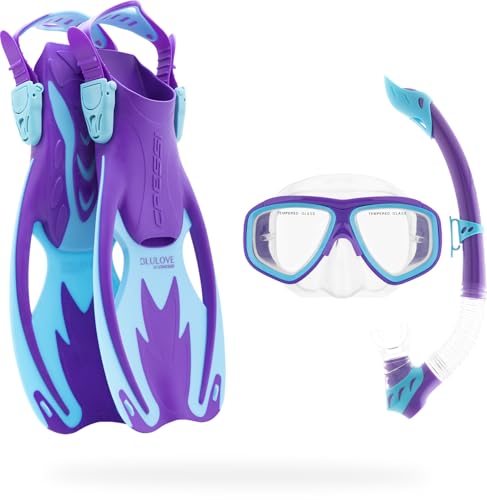
Cressi Rocks Kids Set
A twin-window tempered-glass mask, a snorkel with a splash guard and a bottom purge valve, short open-heel fins and a net bag, in two sizes. The listing title calls the snorkel a dry snorkel; every one of Cressi's own bullets on the same page calls it a splash guard.

Cressi Ocean Junior
A mask and dry-top snorkel with no fins, which is the right first purchase for most children. The listing contradicts itself on age — the title says 5 to 15, the manufacturer's own bullet on the same page says 7 to 15.
Promate Youth Snorkel Combo Set
Promate Youth Snorkel Combo Set
Promate
Mask, dry-top snorkel, open-heel adjustable fins and a mesh bag in one box. The listing gives no age range at all — only fin sizes — so it has to be matched to a child by foot size and a fit test rather than by age.
Check pricePros
- Pro: Everything in one box, so the mask, snorkel and fins are at least designed to be worn together
- Pro: Open-heel fins with an adjustable strap fit over neoprene socks, which buys a season or two of growth
- Pro: The snorkel carries a dry top, a purge valve and a signal whistle on the listing's own specification
- Pro: Adjustable buckles on a silicone skirt, so the strap can be reset without dismantling the mask
Cons
- Con: The listing states no age range, which makes it impossible to match to a child without measuring
- Con: This ASIN resolves to the Blue, L/XL-fins combination; the S/M-fins variant showed as unavailable when we opened it on 31 July 2026
- Con: An open-heel strap fin is the part a small child struggles with unaided, on a wet boat deck
The most complete of the five: mask, dry-top snorkel with a purge valve and a signal whistle, open-heel adjustable fins, and a mesh bag. Open-heel fins take a strap adjustment and a neoprene sock, the arrangement that survives a growing foot best.
Two things before you buy. The listing gives no age range whatsoever, only fin sizes. And on 31 July 2026 the ASIN resolved to the Blue, L/XL-fins combination, with the S/M-fins variant showing as unavailable — on a page about fit, buying the only size in stock is the mistake to avoid.
Cressi Rocks Kids Set
Cressi Rocks Kids Set
Cressi
A twin-window tempered-glass mask, a snorkel with a splash guard and a bottom purge valve, short open-heel fins and a net bag, in two sizes. The listing title calls the snorkel a dry snorkel; every one of Cressi's own bullets on the same page calls it a splash guard.
Check pricePros
- Pro: Cressi commits to an age range on the listing, 3 to 8, which most kids' sets do not
- Pro: Two sizes on the listing — S/M for US kid 9.5 to 13.5, L/XL for US youth 1 to 6 — so the fins are matched to a foot rather than guessed
- Pro: Cressi specifies a soft silicone skirt and a twin-window mask with a nose pocket the child can reach to equalize
- Pro: A bottom purge valve for blowing the tube clear, and a quick-release keeper that clips the snorkel to the mask strap
Cons
- Con: The listing title advertises a "Dry Snorkel" while Cressi's own bullets describe a splash guard — which reduces water entry but does not close when the tube goes under
- Con: A 3-to-8 range is very wide; a three-year-old and an eight-year-old do not have the same face
- Con: This ASIN resolves to the Blue/Orange, S/M combination; L/XL is a separate selection on the same listing
- Con: Cressi also sells a "Rocks Pro Dry Set" with an actual dry snorkel, which is a different product from this one and easy to confuse
A twin-window tempered-glass mask, a snorkel with a splash guard and a bottom purge valve, short open-heel fins and a net bag, in S/M (US kid 9.5–13.5) and L/XL (US youth 1–6). One of the few sets whose manufacturer commits to an age range on the listing — 3 to 8 — and although that span is too wide to size a child from, a stated range beats none. The listing carried 4.5 stars from 754 ratings when we opened it on 31 July 2026, which is a wide enough base to mean something.
Read the snorkel claim carefully, because the listing argues with itself. The title sells a “Dry Snorkel”; every one of Cressi’s own bullets on the same page describes a splash guard, which reduces water entry at the surface but does not close when the tube goes under. Take the bullets over the title: a purge valve at the bottom, which this has, is what a child clears a flooded barrel with. One naming trap, too — Cressi also sells a “Rocks Pro Dry Set” with an actual dry snorkel, which is a different product.
Note also which combination this ASIN buys. It resolves to Blue/Orange in S/M; L/XL is a separate selection on the same listing, and on a page about fit, the size is not the thing to let the link decide.
Cressi Ocean Junior
Cressi Ocean Junior
Cressi
A mask and dry-top snorkel with no fins, which is the right first purchase for most children. The listing contradicts itself on age — the title says 5 to 15, the manufacturer's own bullet on the same page says 7 to 15.
Check pricePros
- Pro: Mask and snorkel without fins, so one growth spurt does not retire the whole kit
- Pro: A dry top that closes when submerged, plus a bottom purge valve for clearing
- Pro: A quick-release keeper that clips the snorkel to the mask strap, which is what stops it being lost
- Pro: Soft hypoallergenic silicone on both mask and snorkel, with a tempered-glass lens
Cons
- Con: The listing gives two different age ranges for the same product on the same page
- Con: Either range spans eight to ten years of facial growth, which is no use for sizing
- Con: No fins, so it is not a complete kit if that is what you were buying
Mask and dry-top snorkel, no fins — which for most children is the correct first purchase, for reasons set out below. The snorkel closes when submerged, has a bottom purge valve, and clips to the mask strap on a quick-release keeper, the small part that stops it going overboard on day one.
Its age labeling illustrates the problem neatly: on 31 July 2026 the listing title read “for Kids Aged 5 to 15 Year Old” while the manufacturer’s own bullet on the same page read “aged from 7 to 15 years”. Size it on the face.
Head Youth Sea Pals

Head Youth Sea Pals
Head
A single-lens mask, short open-heel fins and a dry-top snorkel with a purge valve, packed in a sea-creature backpack with a vented base. Aimed squarely at a child who needs persuading into the water.
Check pricePros
- Pro: Short travel fins are easier for a small child to walk in and to control than a long blade
- Pro: The backpack has a roll-up closure and a vented bottom panel that drains sand and water
- Pro: A soft silicone skirt with easy-adjust buckles on a single-lens mask
- Pro: Designed to be appealing, which matters more than it should for a nervous child
Cons
- Con: The listing gives no age band of its own, so sizing rests entirely on the fit test
- Con: A single-lens mask has more skirt to seal and less adjustment than a twin-lens design
- Con: Novelty styling dates quickly and is not handed down to a sibling happily
Aimed at the youngest and most reluctant: a single-lens mask, short open-heel fins with a rubber-coated tip, a dry-top snorkel with a purge valve, and a sea-creature backpack whose vented base drains sand and water — the detail parents end up caring about. Short blades are the right call for a small child, easier to walk in and to control. The single-lens mask is the trade-off: more skirt to seal and less adjustment than a twin-lens design, on the faces least likely to match a standard shape.
Mares Combo Keewee Jr

Mares Combo Keewee Jr
Mares
A single-lens tempered-glass mask on a soft silicone skirt, plus a curved snorkel, and nothing else in the box. Mares states 8 to 14 on its own product page — the only set here that starts as late as eight, and the one to look at for a child who has outgrown a younger sibling's kit.
Check pricePros
- Pro: Mares states an age range on its own product page, 8 to 14, and it is the only set here with a floor that high
- Pro: Mask and snorkel only, so one growth spurt does not retire a pair of fins with it
- Pro: Mares specifies a wide-angle tempered-glass lens in a low-profile single-lens frame on a soft silicone skirt
- Pro: Sliding buckles on an elastic strap, which can be reset one-handed in the water
Cons
- Con: Mares claims no dry top, no splash guard and no purge valve — it describes a curved snorkel that is "easy to empty", which is a snorkel you clear by blowing
- Con: A single-lens mask has more skirt to seal and less adjustment than a twin-lens design
- Con: No fins and no bag, so it is not a complete kit if that is what you were buying
- Con: 8 to 14 is still six years of facial growth, and the mask is sold in one size
The one to look at for an older child, and the only set here that starts as late as eight: Mares’ own product page says “suitable for children aged 8 to 14 years”1. That matters less as a guarantee than as a floor — a set designed around a twelve-year-old’s face is a different object from one designed around a four-year-old’s, whatever either box says at the top of its range.
It is a mask and a snorkel, nothing else. Mares’ page describes a single-lens mask, durable and easy to wear1; the Amazon listing adds the detail — a wide-angle tempered-glass lens in a low-profile frame, a soft silicone skirt, and a sliding buckle system on an elastic strap. The snorkel is the plainest on this page and Mares does not pretend otherwise: an ergonomically curved tube with a silicone mouthpiece, described as easy to empty1 — no dry top, no splash guard, no purge valve claimed anywhere. A child who ducks under will come up with a mouthful, and clearing it is a hard blow rather than a valve. Whether that is a problem depends entirely on the child, which is the honest answer and also the reason the dry-top question is in the FAQ below rather than settled here.
It also carries the thinnest evidence of anything here: 4.6 stars from 74 ratings when we opened the listing on 31 July 2026, against 754 ratings on the Cressi. A high average off seventy-odd buyers is a small sample, not a verdict, and we would not lean on it.
Full-face masks, and why we will not recommend one to a young child
Google’s own “people also ask” box on this search asks whether full-face snorkels are better for kids. They are not, and the evidence is now specific enough to read rather than take on trust.
A full-face mask covers the whole face, and you breathe into the volume of the mask itself. That volume is the problem. A 2025 case series in Children measured the mechanical dead space of full-face snorkeling masks at 250 to 610 ml, rising to as much as 1,470 ml if the valves malfunction — against a tidal volume of only 140 to 200 ml in a young child3. Each breath pulls back a large fraction of the last one. Carbon dioxide accumulates, and its symptoms — dizziness, confusion, slowed movement — are the last things you want in a small person face-down in open water.
That paper describes three children, aged five, six and four. One was pulled out confused and cyanosed. One presented at 82% oxygen saturation with respiratory acidosis and went to intensive care. One slowed until she was unresponsive and suffered a cardiac arrest requiring CPR3. Three cases is a case series, not an incidence rate, and should not be read as one. What it establishes is a mechanism and a plausible route from a normal afternoon to an emergency department.
That mechanism has been measured separately in adults. A 2023 study in Diving and Hyperbaric Medicine put twenty healthy adults on two full-face masks and a conventional snorkel in a dry laboratory. Runs were stopped for exceeding the exhaled carbon dioxide threshold in 18 of 40 full-face trials (45%) at light exercise, against 4 of 20 (20%) with a conventional snorkel, and the authors concluded that full-face masks “may result in rebreathing due to non-unidirectional flow, leading to hypercapnia and hypoxaemia”4. Adults, on a stationary bike, in the dry — and it still happened in nearly half the trials.
In March 2026 the US Consumer Product Safety Commission told owners of OUSPT full-face snorkel masks to stop using them immediately, citing a drowning hazard and carbon-dioxide build-up that makes breathing harder. Around 84,000 had been sold on Amazon between March 2019 and February 20265.
What has actually been recalled
Two things, both from the US Consumer Product Safety Commission, neither visible anywhere in the shopping results for this search.
Tempered glass has failed in children’s masks before. In March 2013 U.S. Divers and Aqua Lung Sport recalled youth snorkeling masks because “notches in the tempered glass can cause the lens to break under certain water pressure, posing a laceration hazard”6. Tempered glass is still the right material — polycarbonate scratches — but it is not the automatically safer choice it is marketed as, and a chipped lens should be retired rather than handed to a younger sibling.
A dry top is a valve, and valves fail. In September 2021 Huish Outdoors recalled Oceanic dry-top snorkels because “the bottom purge valve on the recalled snorkels can leak, allowing unexpected water entry, posing a drowning hazard”7 — the exact failure a dry top is bought to prevent. Rinse in fresh water after every use, check the valve before each trip, and never treat a dry top as a reason to stand further away.
Age, weight, and supervision
No safety authority publishes an age at which a child may snorkel, and we are not going to invent one.
The closest thing to a defensible line comes from the case series above, whose authors argue that manufacturers should set a minimum weight of 25 to 30 kg rather than a minimum age — or both3. The logic generalises: rebreathing risk scales with a piece of equipment’s internal volume against a child’s lung volume, and lung volume tracks body size, not birthdays. A small eight-year-old and a large five-year-old are not interchangeable, however the box is labeled.
The supervision is not in dispute. The American Academy of Pediatrics’ 2026 policy statement on drowning prevention is direct: an adult with swimming skills should be within arm’s length, providing touch supervision, for any weak swimmer in or around water, and watching should be that adult’s only job8. A child face-down in the water is quieter and less visible than a child splashing — a reason to be closer, not further away.
If your child is a genuinely weak swimmer, the equipment question is flotation, not fins. Start with snorkel vest or life jacket, then the vests we recommend, and if the worry is broader than gear, snorkeling when you cannot swim.
Fins are usually the wrong first purchase
Fins give speed and range. A child new to this needs neither, and the range is arguably a hazard: a nervous swimmer who suddenly covers ground ends up further from an adult than they meant to be. They are also the part most likely to be wrong, sized against a shoe size rather than fitted to a foot, and a loose fin blisters a heel inside twenty minutes.
A mask that seals and a snorkel short enough to clear are what decide whether a child enjoys this. Add fins when they are swimming happily and asking for them — and when you do, short blades beat long ones for anyone under about twelve.
Rent it at the beach instead
There is a real category of family for whom buying this is the wrong decision, and saying so costs us a commission.
Rent if this is a one-off holiday, if your child has never had their face in the sea, or if they are between sizes — which children usually are. Rental gear is fitted by somebody who does it every day and, the part that matters, swapped on the spot when it leaks. A well-fitted rental mask beats a better mask that does not seal, and it is not close.
Buy if your child already snorkels happily, if you are going somewhere with no rental operation, or if the shared mouthpiece bothers you — a mouthpiece is the piece worth owning even if you rent the rest. If you are buying for yourself too, the travel snorkel gear guide covers adult kits, and what to wear snorkeling covers sun and staying warm, a bigger problem for a small body than for yours.
Frequently asked questions
What age can a child start snorkeling?
There is no published age rating from any safety authority, and anyone who quotes you a firm number has invented it. Manufacturers disagree with each other — of the sets on this page, one is sold for ages 3 to 8, one for ages 8 to 14, and one for ages 7 to 15. The most useful published guidance we have found comes from a 2025 paediatric case series on full-face masks, whose authors argue that a minimum weight of 25–30 kg is more defensible than a minimum age, because the risk scales with lung volume rather than with birthdays (case series in Children). That reasoning applies to breathing through any tube, not only to full-face masks. In practice the question is not the child's age but whether they are calm with their face in the water, can put the mask back on after it floods, and are being watched by an adult within arm's reach (AAP policy statement).
Are full-face snorkel masks better for kids?
No, and for young children we would not use one at all. A full-face mask holds far more stale air than a snorkel does — one 2025 case series measured the mechanical dead space of these masks at 250 to 610 ml, rising to as much as 1,470 ml if the valves fail, against a tidal volume of only 140 to 200 ml in a young child, and reported three children aged four, five and six who got into serious trouble in them (case series in Children). A 2023 laboratory study of twenty adults found that runs had to be stopped for excessive exhaled carbon dioxide in 45% of full-face mask trials at light exercise, against 20% with a conventional snorkel (Diving and Hyperbaric Medicine). In March 2026 the US Consumer Product Safety Commission told owners of one widely sold brand to stop using them immediately, citing a drowning hazard and carbon-dioxide build-up making breathing harder (CPSC warning).
Does my child need fins?
Usually not, and not on the first purchase. Fins add speed and range, which is the opposite of what a nervous six-year-old needs, and they are the part of any set most likely to be the wrong size, because they are sold in adult and child shoe sizes rather than fitted to a foot in a shop. A mask that seals and a snorkel short enough to clear are what decide whether a child enjoys the water. Buy fins later, when they are swimming confidently and asking for them.
Is a dry-top snorkel safer for a child?
It is more comfortable, which is not the same thing. A dry top closes the tube when it goes under, so a child who ducks below the surface does not come up with a mouthful of water — genuinely helpful for a child who panics at that. But the mechanism is a valve, and valves fail — in 2021 the US Consumer Product Safety Commission recalled a dry-top snorkel because its bottom purge valve could leak and let water in unexpectedly, a drowning hazard (CPSC recall). Treat a dry top as a convenience, never as a substitute for supervision.
What size mask does my child need?
No manufacturer publishes a mask sizing chart you can measure a child against, so the only reliable test is physical. Hold the mask against the face without the strap, have the child breathe in gently through the nose and let go — a mask that fits will hold itself there for a few seconds. If it drops, it will leak in the water, and no amount of strap tension will fix it. Do this the day the box arrives, not the morning of the trip.
Should we buy a set or rent at the beach?
Rent if this is a one-off holiday, if your child has never had their face in the sea, or if they are between sizes and about to grow out of whatever you buy. Rental gear is fitted by somebody who does it every day and swapped on the spot if it leaks, which is worth more than a better mask that does not seal. Buy if your child already snorkels happily, if you are going somewhere without a rental operation, or if hygiene matters to you — a mouthpiece is a personal item.
References
Footnotes
-
“BS EN 1972:2015 Diving equipment. Snorkels.” BSI, 29 Feb. 2016, en-standard.eu. ↩ ↩2
-
Trapani, L., et al. “Full-Face Snorkeling Masks Carry a Risk of Hypercapnia and Drowning in Younger Children: A Case Series.” Children, 12(9):1148, 2025, doi.org. ↩ ↩2 ↩3
-
Grundemann, J., et al. “Full-face snorkel masks increase the incidence of hypoxaemia and hypercapnia during simulated snorkeling compared to conventional snorkels.” Diving and Hyperbaric Medicine, 53(4):313–320, 2023, doi.org. ↩
-
“CPSC Warns Consumers to Stop Using OUSPT Full Face Snorkel Masks Immediately.” U.S. Consumer Product Safety Commission, 5 Mar. 2026, cpsc.gov. ↩
-
“U.S. Divers and Aqua Lung Sport Brand Youth Snorkeling Masks Recalled Due to Laceration Hazard.” CPSC, 7 Mar. 2013, cpsc.gov. ↩
-
“Huish Outdoors Recalls Oceanic Adult Dry Top Snorkels Due to Drowning Hazard.” CPSC, 22 Sept. 2021, cpsc.gov. ↩
-
“Prevention of Drowning: Policy Statement.” Pediatrics, 158(1):e2026077410, 2026, publications.aap.org. ↩

Rebecca Jambrovic — Snorkeling and kayaking guide
Rebecca lives next to the Adriatic Sea in Croatia, where she guides kayaking, stand up paddleboarding, and snorkeling tours. She is passionate about outdoor activities and enjoys writing pieces that inspire others to get outside.