Snorkeling
Best snorkel set: which bundle to buy, and when not to
A set is one purchase instead of three. But the mask decides whether the trip works, nobody looks at the snorkel, and the fins are where the box saves.
We earn a commission on purchases made through links on this page, at no extra cost to you. It never affects which products we recommend.
On this page
- What you are buying, and where the money went
- The snorkel is the part everyone treats as free
- The mask decides whether the trip works
- The fins are where a set economises
- What no set includes
- The sets
- When not to buy a set at all
- The pick we removed, and what took the slot
- Sizing, packing and the return window
- Frequently asked questions
A snorkel set is a decision you are paying somebody else to make. Instead of choosing a mask, then a snorkel that fits it, then fins that fit you, you buy one box and stop thinking about it. For a week on a reef that is usually the right call, and this page is not going to talk you out of it.
What it will do is tell you which part of the box actually matters, because the ranking most set roundups give you is upside down.
What you are buying, and where the money went
Every set here is three items and a bag: a mask, a snorkel, and fins. They are not equally important and they are not equally expensive to make.
The mask is the piece that decides whether you enjoy the swim. It either seals on your face or it does not, and nothing else in the box can compensate. The snorkel is the piece you breathe through, and it is the one nobody examines. The fins are the piece with the most visible engineering and the least consequence — they change how far you travel, not whether you can stay in the water.
Manufacturers know this, and the pricing reflects the opposite. Fins are the largest object in the box and the easiest thing to make look impressive, so a set will often pair a decent mask with fins that are the first component you replace. That is the single most useful thing to know before you compare boxes.
If you take one instruction from this page: buy the set whose mask you are most confident about, and treat the fins as a bonus.
The snorkel is the part everyone treats as free
This is the section no set roundup writes, and it is the reason to read this one.
Between 2012 and 2021 there were 204 snorkeling-related deaths in Hawai’i, 184 of them visitors.1 A study established by the Hawai’i State Department of Health and funded by the Hawai’i Tourism Authority reviewed them, and its conclusion was not the one anyone expected: most fatal and near-fatal snorkeling drownings are not caused by inhaling water. They are caused by hypoxia triggered by rapid onset pulmonary edema — fluid accumulating in the lungs — and the survivors it surveyed overwhelmingly reported calm water, good visibility and adequate swimming ability.1
One of the mechanisms the study identifies is breathing resistance. When inhalation is impaired, as it can be when you are breathing through a narrow tube, pressure in the lungs drops, and that pressure drop is part of how the edema starts.2 Its own equipment advice is blunt: choose snorkel devices thoughtfully, look for constrictions in mouthpiece calibre, and learn to use the simplest device safely before trying more complex models.2 The study’s principal investigator put it as preferring a straight snorkel and a mouthpiece that are both adequately sized, without various modifications.1
That has a direct consequence when you are comparing boxes.
A dry top is a feature, not an upgrade. A dry-top snorkel has a float valve that seals the tube when it goes under, which is genuinely useful if you duck-dive or swim in chop, and it is why beginners are so often steered toward one. It is also a moving part sitting on top of the tube you breathe through, and a mechanism that can jam with sand. A splash guard is the simpler version of the same idea. A plain tube is simpler still. We explain how the sealing mechanism actually works in our guide to dry snorkels; the point for a set buyer is that more mechanism is a trade, not a free improvement.
Bore and mouthpiece are worth more attention than brand. A wide tube and an unrestricted mouthpiece are what you want, and they are almost never on the listing. Where a set does state them, we have said so below.
One thing to be clear about, because the secondary coverage of this study is loose: it does not show that full-face masks are dangerous. Only four of the fifty masks the study examined were full-face, which the researchers say is too few to draw any conclusion about them as a risk factor.1 If you want a full-face mask, this page has no evidence against it.
The mask decides whether the trip works
There is one test, it takes five seconds, and it is the only thing about a mask that cannot be researched.
Hold the mask against your face without the strap. Breathe in gently through your nose. Let go. If it stays on your face by suction alone, it seals; if it slides off, it will leak, and tightening the strap will make it worse rather than better.3 Do this at home the week the box arrives, with dry skin and your hair off your forehead, and do it before the return window closes.
Two specification details are worth knowing because they show up in every set description.
Skirt material. Silicone skirts are more durable and more flexible than rubber.3 Every set on this page uses silicone; a very cheap set may not, and that is a reason to move on.
One window or two. This is mostly preference, but a twin-lens mask holds less air inside it, which makes it easier to clear when water gets in.3 A single large lens gives a wider, less interrupted view. Neither is better; they fail differently.
What follows is our own experience rather than anything you can look up. Guiding tours, the mask is the piece that comes back. People arrive with a mask they bought online, get in, and spend the swim emptying it — almost always because they never did the suction test, and occasionally because they have a moustache, which no mask will seal against without help. Almost nobody comes back complaining about their fins. That imbalance is why this page is ordered the way it is.
If you wear glasses, none of the above solves your problem and a set is probably the wrong purchase. Start with snorkeling in glasses and, if it comes to it, prescription snorkel masks.
The fins are where a set economises
Fins in a bundle are chosen to hit a price and a shipping box, and there are two decisions inside them.
Open heel or full foot. An open-heel fin has an adjustable strap and a foot pocket sized as a range — XS/S, L/XL — which means one pair fits several people and can be worn over neoprene socks. A full-foot fin is sized like a shoe and fits one person properly. Open heel is more forgiving to order online and more likely to rub; full foot is a better fit and a harder guess.
Short blade or full size. Short travel blades exist so the set fits a carry-on. They work. They also give up real propulsion, which you will notice the first time you swim against a current or try to keep up with a boat drop. Full-size vented blades do the job and go in checked baggage.
The trap in both cases is socks. If you plan to wear fin socks — and you should, if the pockets are bare rubber against your skin — order the fins with the socks on your feet in mind, because a pair that fits barefoot will not close over neoprene. This is the most common sizing mistake we see, and it is the one that cannot be fixed at the beach.
What no set includes
Worth knowing before you assume the box has you covered. No set here ships fin socks, and on bare rubber pockets they are the difference between a two-hour swim and a blister at forty minutes. None includes defog, and the sachet a mask sometimes arrives with runs out immediately. None includes flotation, which for a nervous swimmer is a more useful purchase than anything inside the box — that is a snorkel vest, and it is a separate decision. And none includes sun cover, which on a reef is the thing you will actually regret going without.

Cressi Palau SAF Set
A mask, dry snorkel, short adjustable open-heel fins and a bag. The short blades are the point: they fit a carry-on and take the sizing pressure off, because an open heel covers a range of feet rather than one size.

Aviatar Diving Dry Top Snorkel Set with Gear Bag
A single-lens tempered glass mask, a dry-top snorkel with a splash guard and purge valve, 16-inch open-pocket fins and a mesh bag. The listing states the packed set measures 17 by 11 by 7 inches and weighs two pounds.

U.S. Divers Cozumel Snorkeling Set
A two-window mask, a splash-top snorkel with a one-way purge valve, full-size vented-blade fins and a mesh bag. The counterweight to the travel sets — more to carry, and more to show for it once you are moving.
The sets
Five sets, chosen to cover different decisions rather than to fill a good, better, best ladder — including two Cressi travel sets that differ from each other in two specific ways, because that is the comparison most people on this page end up stuck on.
Cressi Palau SAF Set
Cressi Palau SAF Set
Cressi
A mask, dry snorkel, short adjustable open-heel fins and a bag. The short blades are the point: they fit a carry-on and take the sizing pressure off, because an open heel covers a range of feet rather than one size.
Check pricePros
- Pro: Open-heel fins adjust across a range of shoe sizes, so a household can share a pair
- Pro: Short blades pack into a carry-on, which is the whole argument for this set
- Pro: The Onda mask is a single tempered glass lens with a transparent silicone skirt, which lets more light in and feels less enclosed
- Pro: Quick-release buckles make the strap adjustable with wet hands
Cons
- Con: Open-heel fins are designed for bare feet or neoprene socks, so adding socks changes the size you need
- Con: Short blades trade propulsion for packing size and are hard work against any current
- Con: The listing this ASIN resolves to is a variation of a parent listing, so check you are on the size and color you meant to buy
- Con: A carry bag is not a mesh bag, and gear stored damp in a closed bag is how a set starts to smell
The Palau SAF is the short-fin travel set most people mean when they say travel set. It pairs Cressi’s Onda mask — a single tempered glass lens with a transparent silicone skirt and quick-release buckles — with a dry-top snorkel, short adjustable open-heel fins and a carry bag.
The transparent skirt is a small thing that matters more than it sounds. It lets light in from the sides, and first-time snorkelers who find a black-skirted mask claustrophobic often get on with a clear one immediately.
The open-heel fins are the reason this set travels well and the reason to read the sizing twice. Each size covers a range of feet, which is forgiving; they are also designed for bare feet or neoprene socks, so the socks decision has to be made before you order rather than after.
Cressi has been designing and building in Genoa since 1946 and still is,4 which is worth exactly as much as any pedigree — it means spare straps and mouthpieces are easy to find in five years, and no more than that. One practical note: this ASIN resolves to a variation of a parent listing, so check the size and color on the page you actually land on.
Aviatar Diving Dry Top Snorkel Set, by Seavenger
Aviatar Diving Dry Top Snorkel Set with Gear Bag
Seavenger
A single-lens tempered glass mask, a dry-top snorkel with a splash guard and purge valve, 16-inch open-pocket fins and a mesh bag. The listing states the packed set measures 17 by 11 by 7 inches and weighs two pounds.
Check pricePros
- Pro: The lightest and smallest packed set here, per the manufacturer's own stated dimensions
- Pro: A mesh bag rather than a closed one, so the set can be rinsed and dried in it
- Pro: Sizes run down to XXS, so one set covers more of a family than most adult bundles
- Pro: A purge valve at the base of the tube means water that does get in can be blown clear without surfacing
Cons
- Con: A dry top and a purge valve are two moving parts on the component you breathe through
- Con: 16-inch blades are short even by travel standards and give up real propulsion
- Con: Open foot pockets against bare skin are the classic blister point, and fin socks then change the fit
- Con: Budget single-lens masks are the ones we most often see come back leaking on a tour
The cheapest complete route here, and the one to buy if you are genuinely unsure how much snorkeling you will do. It is a single-lens tempered glass mask, a dry-top snorkel with a splash guard and a purge valve, 16-inch open-pocket fins and a mesh bag.
Two things in the listing are worth having. Seavenger states the packed set measures 17 by 11 by 7 inches and weighs two pounds, which is small enough that the packing question stops being a question. And sizes run down to XXS, so it covers teenagers and larger children as well as adults — though if you are buying specifically for a child, our kids’ snorkel gear guide is the page to read instead.
The mesh bag deserves a sentence of its own. A closed nylon bag is where gear goes to stay damp; a mesh one lets you rinse the set and hang it up without unpacking.
The compromises are where you would expect them. Sixteen-inch blades are short even for travel fins. The dry top and purge valve are two mechanisms on the tube. And budget single-lens masks are, in our experience on the water, the ones most likely to come back leaking — which brings you back to doing the suction test the day the box arrives.
U.S. Divers Cozumel Snorkeling Set
U.S. Divers Cozumel Snorkeling Set
U.S. Divers
A two-window mask, a splash-top snorkel with a one-way purge valve, full-size vented-blade fins and a mesh bag. The counterweight to the travel sets — more to carry, and more to show for it once you are moving.
Check pricePros
- Pro: Full-size vented blades move you against current and chop in a way short travel fins do not
- Pro: A splash top rather than a sealing dry top, which is the simpler mechanism
- Pro: A two-window mask holds less air than a single large lens, which makes clearing it easier
- Pro: Aqua Lung's house snorkeling brand, so replacement straps and mouthpieces are easy to find
Cons
- Con: Full-size fins do not fit a carry-on and are the reason this set is checked baggage
- Con: A splash top will let water in if you duck-dive, so you have to be willing to clear the tube
- Con: Sized by shoe size rather than a range, so a household needs a pair each
- Con: The two-window frame gives a narrower field of view than a single lens
The counterweight. Where the two sets above optimize for luggage, the Cozumel optimises for actually moving through water: full-size vented-blade fins, a two-window mask, a splash-top snorkel with a one-way purge valve, and a mesh bag.
The two-window mask is a deliberate difference rather than a downgrade. A twin-lens frame holds less air than one big lens, so clearing it takes less breath.3 You give up some peripheral view for that.
The snorkel is a splash top, not a sealing dry top — a guard that keeps chop out of the opening, with a purge valve at the bottom to blow clear whatever gets in. That is the simpler mechanism, and after the section above you may consider that a feature. It does mean the tube will flood if you duck-dive, so you need to be comfortable clearing it. If you are not yet, that is a learnable skill and we cover it in snorkeling without swallowing water.
These fins do not go in a carry-on. That is the trade, and it is the right one if you are snorkeling somewhere with current, or several times a year, or from a boat.
Cressi Bonete Pro Dry Set

Cressi Bonete Pro Dry Set
Cressi
A two-lens tempered glass mask, a dry snorkel with a purge valve, short open-heel fins and a mesh bag. The same short-fin travel argument as the Palau SAF, made with a twin-lens mask and a bag you can rinse the set inside.
Check pricePros
- Pro: A twin-lens mask holds less air than one large lens, which makes it easier to clear
- Pro: A mesh bag rather than a closed one, so the set can be rinsed, dried and stored without unpacking
- Pro: Short open-heel fins on an adjustable strap, so one pair covers a range of feet
- Pro: Sold by Amazon itself rather than a marketplace seller when we read the listing on 31 July 2026, which keeps the return route simple
Cons
- Con: A sealing top valve and a purge valve are two moving parts on the component you breathe through
- Con: Short blades pack well and give up real propulsion against a current
- Con: Cressi states a rubber foot pocket, and bare rubber against skin is where blisters start — fin socks then change the size you need
- Con: The listing is headed "Ocean Set" while its own description and Cressi's catalogue both call it the Bonete Pro Dry Set
- Con: This ASIN is one child of a four-way parent listing and lands on S/M in aquamarine, so set the size and color before you buy
The other Cressi travel set, and the one to read against the Palau SAF rather than against anything else on this page. Cressi’s own catalogue describes it as a tempered glass mask with two lenses and a soft silicone skirt, a snorkel with a valve on top that closes the tube when it goes under and a one-way purge valve to clear what gets in, short open-heel fins with a rubber foot pocket and an adjustable strap, and a mesh bag.5
Two of those details are the reason it is on the page. The mask has two windows rather than one large lens, which holds less air and so takes less breath to clear3 — the same trade the Cozumel makes, in a set that still packs. And the bag is mesh, so the set can be rinsed and hung up in it; the Palau SAF’s bag is a closed one, which is the single most avoidable way to make gear smell. What you give up going this way is the Palau SAF’s wider single-lens view and its transparent skirt.
The snorkel carries the caveat the whole page carries. A sealing top valve plus a purge valve is two mechanisms on the tube you breathe through, and after the Hawai’i section that is a trade rather than an upgrade.
One naming warning, because this page has been caught by exactly this before. The Amazon listing is headed “Cressi Adult Snorkel Set … Ocean Set”, while its own description and Cressi’s catalogue both call the product the Bonete Pro Dry Set.5 The ASIN we link is one child of a parent listing offering two sizes and two colors, and it lands on S/M in translucent aquamarine — so read the box name, the size and the color on the page you arrive at. When we read that listing on 31 July 2026 it was in stock and sold by Amazon itself rather than by a marketplace seller, and it showed 4.2 out of 5 stars across 778 ratings.
Cressi Pano 3 and Supernova Dry
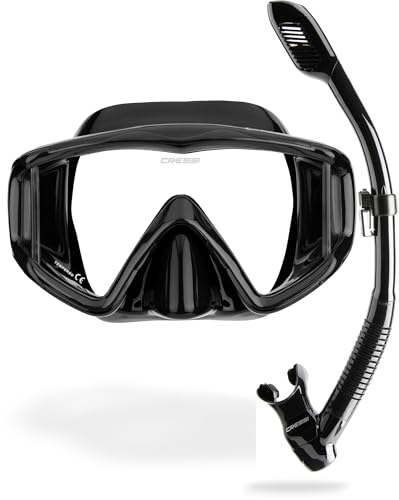
Cressi Pano 3 and Supernova Dry mask and snorkel kit
Cressi
A panoramic mask and Cressi's Supernova Dry snorkel, with no fins and no bag. For a great many holiday snorkelers this is the right purchase and the fins in a full set are the part that never leaves the cupboard.
Check pricePros
- Pro: Buys the two components that decide whether the swim works and skips the one you can rent
- Pro: Fits in hand luggage with room to spare, with no sizing question at all
- Pro: The mask has a soft silicone nose pocket, so you can pinch your nose to equalize if you duck-dive
- Pro: Push-button buckles adjust the strap one-handed in the water
Cons
- Con: No fins, so you either rent them, own them already, or accept covering less ground
- Con: No bag, which sounds trivial until a wet mask is loose in a suitcase
- Con: The Supernova is a dry-top snorkel, so it carries the same moving-part caveat as any sealing tube
- Con: Costs more than the cheapest complete set while giving you fewer items
Not a set at all — a mask and a snorkel, no fins, no bag. It is here because for a lot of people it is the correct purchase and no roundup ever says so.
The Pano 3 is a panoramic mask with tempered glass lenses, a soft hypoallergenic silicone skirt and a soft nose pocket, so you can pinch your nose to equalize if you go under. The buckles are push-button, which means you can adjust the strap one-handed with wet hands. The Supernova Dry is Cressi’s dry-top tube, with a sealing valve at the top, a soft silicone mouthpiece and a purge valve at the base. Both are designed in Italy and made in Taiwan, per Cressi’s own listing.
The case for it is simple arithmetic. Fins are the bulkiest item in any set, the most likely to be sized wrong, and the easiest thing to rent at any dive shop or resort. A mask is the thing you least want to rent, because a rental mask fits whoever had it last. Buying the mask and snorkel and renting the fins gets you the part that matters, in hand luggage, with no sizing gamble.
When not to buy a set at all
Two honest cases, and we would rather name them than sell around them.
Rent it at the resort if you are snorkeling once. If this is a single afternoon off a boat, the operator’s gear will be adequate and you will not have carried anything. The reason a lot of gear pages skip this: we earn a small commission when you buy through Amazon and nothing at all when you don’t, and the referral window is 24 hours, so nothing on this page is worth misleading you for. Bring your own mask if you are fussy about fit, and rent the rest.
Buy the mask separately if you already own anything. The moment you own a mask you like, a set stops making sense — you are buying a second mask to get a snorkel and fins. Buy the pieces.
And buy a set if you are going to snorkel more than twice. That is the actual threshold. Rental gear is fine once and tiresome by the fourth time, sizing is never quite right, and a set that fits you is the difference between a swim you enjoy and a swim you manage.
The pick we removed, and what took the slot
This page used to recommend a third Cressi set as its high-end option. On 31 July 2026 that listing reads “Currently unavailable. We don’t know when or if this item will be back in stock,” so it has been removed from the recommendations rather than left in place with a dead link. The Bonete Pro Dry Set above now occupies the slot.
It is not a like-for-like replacement and we are not going to pretend it is. What the old pick had was long adjustable blades, and the separate long-fin Cressi set this page also used to link — a Palau Long with an Onda mask and a purge dry top — returns the same unavailable message on the same date. So the long-blade option is not something we can point you at today, and the honest version of that is a set that packs rather than a set that pushes.
Checking it turned up a second problem worth recording. The listing we were linking was a Palau Long set with an SPE Liberty mask, while the description on this page was of a different Cressi set entirely — a page describing one product and linking another. Both are fixed. We are noting it here because a roundup that silently swaps its picks is a roundup you have no way to check.
Sizing, packing and the return window
Four practical things, in the order they cost people their first day.
Order fins by the feet that will be in them. Shoe size if the fins are full foot; the size range if they are open heel; and if you are wearing neoprene socks, size for the socks.
Do the mask test the day the box arrives. Suction, no strap, gentle inhale.3 If it slides, send it back. Nothing else in the box is worth keeping if the mask does not seal.
Check the return window before you check anything else. Sizing is not consistent between brands and a mask is the one component with no workaround.
Rinse in fresh water and dry it out of the sun. The failure order is predictable — the mask strap goes first, the skirt second, and tears in the snorkel mouthpiece or hose after that6 — and straps and mouthpieces are usually replaceable on their own, which is worth knowing before you replace a whole set over a small part. Our guide to cleaning and storing snorkeling gear has the routine.
One last thing that is not in the box: what you wear over the top of it. A rash guard does more for a long swim than any upgrade inside a set, and what to wear snorkeling covers it.
Frequently asked questions
Is a snorkel set actually cheaper than buying the pieces separately?
Usually yes, and that is the honest reason most people should buy one. Manufacturers bundle a mask and snorkel that already fit each other, throw in fins and a bag, and price the box below the sum of its parts.
What you give up is the ability to choose each piece. If you have a face that is hard to seal, a strong preference in fins, or you already own a mask you like, the bundle stops being a saving and starts being two items you did not want.
Which part of a snorkel set matters most?
The mask, because a leaking mask ends the swim, and then the snorkel, because it is the part you breathe through. Fins matter least — they change how far you travel, not whether you can stay in the water.
That is the reverse of how sets are usually sold, and it is why a set with modest fins and a mask that fits you is a better buy than a set with impressive fins and a mask that does not.
Dry top, semi-dry or plain snorkel — which should I choose?
A dry top seals when the tube goes under, which is genuinely useful if you duck-dive or swim in chop. It is also a moving part, and the Hawai'i Snorkel Safety Study's advice is to choose snorkel devices thoughtfully and watch for constrictions in mouthpiece calibre, because impaired inhalation is part of how snorkelers get into trouble.
If you are new to this, a plain or splash-guarded tube with a wide bore and an unrestricted mouthpiece is a defensible choice, and it is one fewer thing to fail. We cover the mechanism in more detail in our guide to what a dry snorkel is and how it works.
How do I know the mask will fit before I get in the water?
Hold the mask against your face without the strap, breathe in gently through your nose and let go. If it stays put on its own, the seal is good; if it slides off, no amount of strap tension will fix it.
Do that test at home the week the box arrives, not at the beach on day one. Check the return window while you are at it, because sizing across brands is not consistent and a mask that does not seal is the one component you genuinely cannot work around.
How long will a snorkel set last?
Longer than most people expect, if it is rinsed in fresh water and dried out of the sun. The parts that go first are predictable: PADI puts the mask strap first, the mask skirt second, and tears in the snorkel mouthpiece or hose as the likely failure points.
Straps and mouthpieces are usually replaceable on their own, which is worth knowing before you replace a whole set over a five-dollar part. Our guide to cleaning and storing snorkeling gear covers the routine that gets you there.
References
Footnotes
-
Nathan Eagle. “Snorkel Safety Study Sheds Light On Unexplained Drownings In Hawaii.” Honolulu Civil Beat, 25 July 2022, civilbeat.org. ↩ ↩2 ↩3 ↩4
-
“FAQs.” Snorkel Safety Study, Hawai’i State Department of Health Snorkel Safety Sub-Committee, snorkelsafetystudy.com. ↩ ↩2
-
“Selecting the Perfect Mask.” Divers Direct, diversdirect.com. ↩ ↩2 ↩3 ↩4 ↩5 ↩6
-
“Who We Are.” Cressi, cressiamerica.com. ↩
-
“Bonete Pro Dry Snorkeling Set — Complete Snorkel Gear.” Cressi, cressiusa.com. ↩ ↩2
-
“How to Know When to Replace Your Dive Gear.” PADI, blog.padi.com. ↩

Rebecca Jambrovic — Snorkeling and kayaking guide
Rebecca lives next to the Adriatic Sea in Croatia, where she guides kayaking, stand up paddleboarding, and snorkeling tours. She is passionate about outdoor activities and enjoys writing pieces that inspire others to get outside.