Snorkeling
Snorkel vests: what they do, and which one to buy
A snorkel vest holds you flat and face-down. It is not a life jacket and will not turn you face-up. What it does do, which style suits whom, and when not to.
We earn a commission on purchases made through links on this page, at no extra cost to you. It never affects which products we recommend.
On this page
- What you are actually buying
- The one thing it is not
- What the drowning data actually says
- What we would buy, and for whom
- Horse collar or jacket, which is the only real fork
- The four vests
- What each listing actually buys
- Fit is the whole thing
- Using it in the water
- When not to buy one
- Frequently asked questions
Most people arrive at this page with a shopping question and a safety question fused together, and the retail results only answer the first one. So this page answers the second one first, because it changes which vest you should buy and, for some readers, whether you should buy one at all.
What you are actually buying
An inflatable jacket or collar with a tube on the front. You put air in with your mouth and let it out through the same valve, and that is the whole mechanism — no cartridge, no automatic inflation, and on all four of these, no published buoyancy rating.
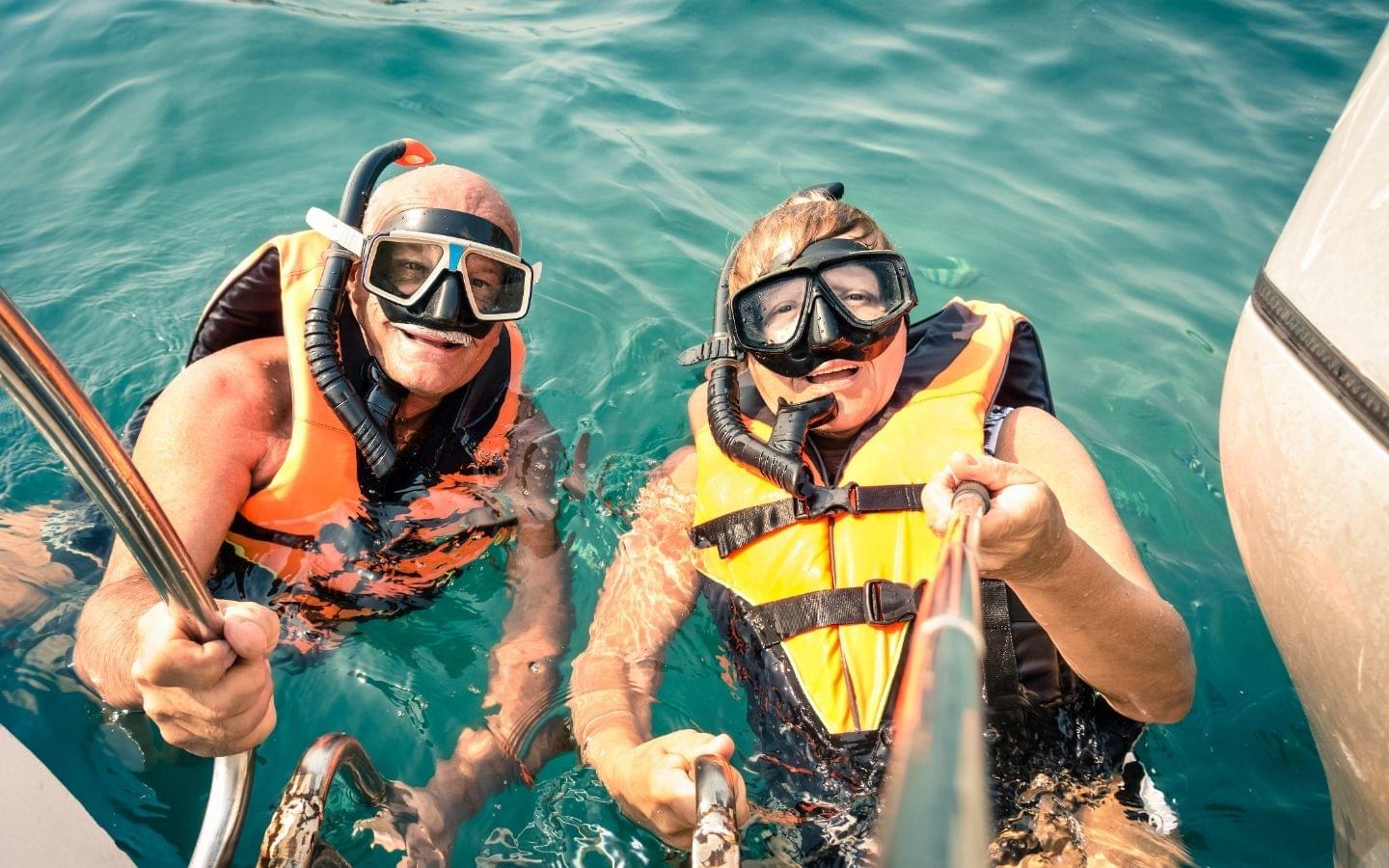
What you are paying for is attitude in the water. The air sits high on your chest and shoulders, which holds you flat on the surface with your face down — the position you actually snorkel in, rather than the head-up position a life jacket is built to give you. That difference is the entire reason this product category exists, and we work it through properly on our snorkel vest versus life jacket page.
The second thing you are buying is a dial. Fully inflated, you cannot swim down; you sit on the surface like a cork. Let half the air out and you can duck under for a few feet and come back up without kicking. Let it all out and it is a vest-shaped nuisance you are wearing for nothing. Most people over-inflate on the first swim and spend an hour fighting to get their face into the water — which is a setting, not a fault in the vest, and it is worth knowing before you decide the thing does not suit you.
The one thing it is not
None of the four vests below is a US Coast Guard-approved personal flotation device, and not one of their makers publishes a buoyancy rating for them. That is checkable rather than assumed: an approved device carries an approval number on its label, the Coast Guard maintains a searchable register of approved equipment1, and no maker of approved equipment omits the claim. None of these four makes it. There is also a line in the Coast Guard’s own guidance that lands awkwardly on a page like this: inflatable flotation is explicitly “Not recommended for weak or non-swimmers”2, and every vest here is inflatable.
What that actually means for you — which approval ratings exist, what an approved jacket does that a vest does not, and when you need the other thing instead — is the whole subject of snorkel vests and life jackets. Read it before you buy if any of this is new.
What the drowning data actually says
Hawai’i has studied this more seriously than anywhere else, because it has had to. Between 2009 and 2018 the state recorded 189 ocean drownings among non-residents while snorkeling, against 17 among residents — the widest gap of any water activity in the data3.
The Snorkel Safety Study, funded by the Hawai’i Tourism Authority under the state Department of Health, went looking for why. Its central finding is that hypoxia induced by rapid onset pulmonary edema is the cause of some, probably most, fatal and near-fatal snorkel drownings3. Breathing through a narrow tube while lying face-down in water lowers pressure in the lungs, fluid seeps in from the surrounding capillaries, and oxygen stops crossing. It does not require inhaling any water at all. The report describes the sequence as sudden shortness of breath, weakness, loss of strength, confusion, unconsciousness — with few if any signs of distress3. That is why so many of these deaths look like someone floating quietly, close to shore, on a calm day.
Two numbers from the study’s survey of 36 people who got into trouble are worth sitting with. 13% drifted away from safety, and nobody cited a lack of swimming or snorkeling experience as a factor3. These were not people out of their depth in the ordinary sense.
Here is what that means for the thing you are about to buy. A vest genuinely helps with two of the failure modes: it stops you drifting out while you are absorbed in the reef and it removes the energy cost of staying up, which is the difference between a tired swim and an incident. It does nothing whatsoever about pulmonary edema. You can be perfectly buoyant and still be losing oxygen, and the vest will hold you at the surface throughout.
The study’s own message to snorkelers includes a line that no page selling a vest wants to print: “If you can’t swim, don’t snorkel.”3 We would rather print it than have you read the rest of this and conclude that ninety dollars of inflatable nylon settles the question. It does not. If you cannot swim, the answer is a guided tour with a boat, a guide and a float line, and our guide to snorkeling if you can’t swim is the page to read next.
What we would buy, and for whom
If you are buying one vest and you intend to spend real time in the water, buy a jacket. The Seaview 180 Palawan at Amazon is the straightforward version of that: sized to your body, fabric across the back, and it does not hang off your neck. The back panel is not a comfort feature, it is sun cover on the one surface that faces the sky for the entire swim, and the number of guests I have handed aloe to at the end of a day makes the case better than any spec sheet.
If you want to find out whether you like snorkeling in flotation before committing, buy a horse collar. The Rrtizan at Amazon is one size, packs into a corner of a bag and costs less than a taxi to the beach. Read the capacity first: the listing says up to 220 pounds and publishes no lower limit4, which is a real constraint on both ends.
If you are buying for someone whose body is outside the middle of the range, the SCUBAPRO Cruiser at Amazon is the one with sizes from XS to 3XL5 — the widest published range of the four, and the reason to pay more for it. The neoprene back is warmth you will want in the Adriatic in May and may not want in Bonaire in August.
For a child, buy the Scuba Choice youth vest at Amazon and buy it for the straps rather than the price. Everything below is the detail behind those four sentences.
Horse collar or jacket, which is the only real fork
Every vest here is one of two things, and the choice between them decides more than the brand does.
A horse collar is an inflatable tube that goes over your head, held in place by a waist strap and a crotch strap. It is light, it packs small, and it is nearly always one size, because straps do the adjusting. Its weaknesses follow from the same design: it hangs from your neck, it leaves your back bare, and it depends entirely on a crotch strap that a lot of people find annoying and quietly leave undone. A horse collar without its crotch strap will ride up over your ears the moment it takes your weight, which is precisely when you needed it not to.
A jacket has fabric across the back — mesh on the light ones, neoprene on the warm ones — and closes at the front or the side. It spreads the load across your chest, it does not migrate, and it covers you. The cost is that it is sized, and a zip or velcro closure has far less adjustment in it than a strap. A jacket one size too large is worse than a horse collar that fits.
The practical rule from fitting these on guests: nervous swimmers and anyone planning more than a quick look do better in a jacket. Confident swimmers who want flotation as insurance, and anyone packing light, do fine in a collar.
The four vests
Seaview 180 Palawan

Seaview 180 Palawan Inflatable Snorkel Vest
Seaview 180
A jacket-style inflatable vest listed for adults and youth, so it is sized to the body rather than sold one-size. The back panel is the point: it is the surface that faces the sun for the whole swim.
Check pricePros
- Pro: Fabric across the back covers the one part of you that is permanently facing the sky
- Pro: Sized rather than one-size, which is what stops a jacket riding up under load
- Pro: One model covers a teenager and an adult, so a family buys the same thing twice
- Pro: Jacket cut spreads the load across the chest instead of hanging off the neck
Cons
- Con: Sized on the body, so it is a purchase you can get wrong — measure and read the maker's chart first
- Con: No published buoyancy rating, and no Coast Guard approval
- Con: Bulkier and heavier to pack than a horse collar
- Con: A zip or velcro closure has far less adjustment in it than a pair of straps
The Palawan is the jacket most people mean when they say snorkel vest. The listing sells it for adults and youth6, so it is sized rather than one-size, and that is both the reason to buy it and the thing to get right before you order. Measure, then read the manufacturer’s chart, and do not assume your t-shirt size transfers.
What it does well is the unglamorous part. It sits where you put it, it does not climb, and the back panel means that at the end of three hours in the water you are not scarlet from the shoulders down. It packs less flat than a collar and it is heavier in a case, which is the trade.
Rrtizan Inflatable Snorkeling Vest

Rrtizan Inflatable Snorkeling Vest
Rrtizan
A classic horse collar: an inflatable tube over the head, held down by a waist strap and a crotch strap. The listing states a capacity of up to 220 pounds and does not publish a lower limit.
Check pricePros
- Pro: One size, so there is no size chart to get wrong
- Pro: Packs down small and weighs almost nothing in a case
- Pro: Straps give far more adjustment range than a jacket closure
- Pro: The cheapest way to find out whether you actually want to snorkel in flotation
Cons
- Con: Stated capacity is up to 220 lb, with no published floor — light adults and children are outside what it is described for
- Con: Leaves your back completely bare to the sun
- Con: The crotch strap is the part people take off and then wonder why the vest rides up
- Con: No published buoyancy rating, and no Coast Guard approval
This is a plain horse collar and it is honest about it. The listing states a capacity of up to 220 pounds4, with no published minimum, which is the number to check first — a light adult or an older child sits below what it is described for, and the vest will still float them but nobody has told you how well.
For a once-a-year trip it is a sensible purchase, and it is the one I would suggest to somebody who is unsure whether they want to snorkel in a vest at all. Wear the crotch strap. It is the entire reason the collar stays on your chest instead of your chin.
SCUBAPRO Cruiser

SCUBAPRO Cruiser Adult Diving Vest
SCUBAPRO
SCUBAPRO's snorkeling vest, built from nylon and stretch neoprene with an inflatable front bladder and a security pocket, in high-visibility yellow. Sold XS to 3XL — the widest published size range of the four.
Check pricePros
- Pro: Sizes run XS to 3XL, so it fits bodies the one-size vests do not
- Pro: Neoprene back adds warmth and sun cover on a long swim
- Pro: High-visibility yellow, which is what a boat driver is looking for
- Pro: A zipped pocket for a key or a car fob, which sounds trivial until you are on a beach
Cons
- Con: This particular listing is one variant only — Yellow/Black, X-Large — so check you are buying your size
- Con: The most expensive of the four by a distance
- Con: SCUBAPRO's own page makes no life-jacket, PFD or Coast Guard claim, and publishes no buoyancy figure
- Con: Neoprene is warmth you may not want in genuinely tropical water
SCUBAPRO builds the Cruiser from nylon and stretch neoprene with an inflatable front bladder, a security pocket and a high-visibility yellow finish, and publishes sizes from XS through 3XL5. That size range is the strongest argument for it. One-size vests work for the middle of the distribution and fail everybody else, and this is the only one of the four with a published answer for a very small adult or a very large one.
Two cautions. The specific listing linked here is a single variant — Yellow/Black in X-Large — so check what you are actually adding to the basket. And SCUBAPRO’s own product page, like everyone else’s, claims no PFD status and publishes no buoyancy figure5. It is a well-made snorkeling vest, not a rated safety device, and the company does not say otherwise.
Scuba Choice Youth Snorkel Vest

Scuba Choice Youth Snorkel Vest
Scuba Choice
A children's horse collar rated by the listing for up to 100 pounds, with a crotch strap, an anti-ride-up strap, an oral inflator and a name box on the front.
Check pricePros
- Pro: Listed capacity up to 100 lb, which covers most children before they fit adult sizes
- Pro: Crotch strap and anti-ride-up strap, which are the two things that keep a vest off a child's face
- Pro: A name box on the front, which is genuinely useful when six children are wearing the same vest
- Pro: Neon color, so you can find your child in a group without swimming over to check
Cons
- Con: One size, so a small five-year-old and a large eleven-year-old wear the same vest
- Con: Horse collar design leaves the child's back exposed, and children burn faster than adults
- Con: No published buoyancy rating, and no Coast Guard approval — it is not a substitute for supervision
- Con: A vest does not make a non-swimming child safe in open water
Children fit adult vests badly and the failure mode is specific: an oversized vest rides up and ends up around the head, which is worse than no vest. This one is listed for up to 100 pounds and includes a crotch strap, an anti-ride-up strap, an oral inflator and a name box on the front7.
The name box sounds like packaging copy and is not. Put six children in identical neon collars and you will understand why somebody added it. The neon itself is doing the same job for you from thirty meters away.
What this vest does not do is make a child who cannot swim safe in open water, and it should not be bought as though it does. It buys a child buoyancy and it buys you visibility. Supervision is still the whole safety system.
What each listing actually buys
| Vest | Style | Sizing | Stated capacity | Back cover |
|---|---|---|---|---|
| Seaview 180 Palawan | Jacket | Sized, adults and youth | Not published | Fabric |
| Rrtizan | Horse collar | One size | Up to 220 lb | None |
| SCUBAPRO Cruiser | Neoprene jacket | XS to 3XL | Not published | Neoprene |
| Scuba Choice Youth | Horse collar | One size | Up to 100 lb | None |
None of the four publishes a buoyancy rating in pounds or newtons, and none is Coast Guard approved. That is not four oversights. It is what the category is.
Fit is the whole thing
This section and the one below it are what I see on tours rather than a specification.
The test I use with guests takes four seconds and is done on dry land. Put the vest on, fasten everything, and try to pull it up past your chin. If it moves, it is too big or too loose, and it will move a great deal more once it is holding your weight in water.
Three things go wrong repeatedly. People buy a jacket by t-shirt size instead of measuring, and the charts do not agree between manufacturers — a large in one brand is a medium in another, and the difference is a vest that fits or one that floats up. People leave the crotch strap undone because it feels absurd, and then discover in the water that it was the only thing holding the collar down. And people fasten everything correctly on a dry body and never re-check after ten minutes, by which point the straps have settled and there is slack that was not there before.
The other adjustment nobody makes is the air. A vest is not a binary. Start with a couple of breaths, not a lungful, and add more only if you find yourself working to stay up. Over-inflating is the single most common reason a new snorkeler cannot get their face into the water and concludes that the vest is the problem.
Using it in the water
Get in first, then inflate. Inflating on the beach and then wading out means fighting a balloon through the shore break, and it is where most of the tangles happen.
If you want to duck under for a closer look, let air out before you go rather than trying to swim down against it. Two breaths’ worth is usually the difference between being pinned at the surface and getting three or four meters down comfortably. Put it back in when you surface — you can do the whole cycle floating, one-handed, without taking the mask off. Our guide to snorkeling without swallowing water covers clearing the tube when you come back up.
If somebody in your group is struggling, an inflated vest is something you can hand over. It is one of the few genuinely useful things a vest gives you that a swimming ability does not, and it is worth knowing before you need it.
And take the study’s own advice seriously on the one signal that matters: shortness of breath while snorkeling is not something to swim through. Stop, stand up if you can, get the snorkel out of your mouth and get out of the water3. A vest will keep you at the surface while that is happening, which is useful, but it is not a reason to stay in.
When not to buy one
Three cases, and we would rather lose the sale than have you find out afterwards.
Your tour provides them. Most operators carry vests, and if you are doing one boat trip on one holiday you do not need to own one. Where operator stock genuinely runs out is children’s sizes, so if you are traveling with a small child, buy that one and borrow the rest.
A belt might suit you better. A snorkel belt is a foam or inflatable band worn at the waist. It leaves your chest and shoulders entirely free, it is what a lot of guides hand to confident swimmers who just want a little help, and it interferes with nothing. It gives you less lift and it will not hold you if you go limp, so it is the wrong answer for a nervous swimmer and often the right one for a strong one.
You may not want flotation at all. A competent swimmer in calm, warm, shallow water does not need a vest, and wearing one costs you the ability to duck-dive on a whim, which is most of the fun. Buy a vest because you want to float and rest without effort, or because a specific person in your group needs it. Do not buy one because it appeared on a list.
Frequently asked questions
Frequently asked questions
What is a snorkel vest?
An inflatable jacket or collar worn at the surface while snorkeling. You inflate it by mouth through a tube on the front and let air out through the same valve, so you can add buoyancy when you want to rest and take it away when you want to duck under. Unlike a life jacket, it is shaped to hold you flat and face-down, which is the position you actually snorkel in.
Is a snorkel vest a life jacket?
No, and the distinction matters. A life jacket is a US Coast Guard-approved personal flotation device built to hold your head clear of the water, and the strongest types are designed to turn an unconscious wearer face-up (US Coast Guard). A snorkel vest is not approved, is not rated, and does neither of those things.
That is not a defect, it is the trade. Being held upright with your head back is exactly what stops you looking down at a reef. For the full comparison see snorkel vests and life jackets.
Can I wear a snorkel vest for other water sports?
Generally not. Snorkel vests are not approved for boating, kayaking, water skiing or anything else that requires a personal flotation device on board, and they are not intended for rescue or life-saving. If you need a legal PFD you need a separate one, and a vest in the locker does not satisfy that requirement.
Do snorkel vests come with CO2 inflators?
Modern ones do not. Older models paired a CO2 cartridge with an oral tube, but cartridges corrode in salt water, and manufacturers have largely dropped them in favor of a plain oral inflator. In practice this means the vest only holds the air you put in it, so if you want buoyancy in a hurry you should already be wearing it inflated rather than planning to inflate it.
What's the difference between a horse collar and a jacket-style vest?
A horse collar is an inflatable tube that goes over your head, held down by a waist strap and a crotch strap. It packs small, it usually comes in one size, and it leaves your back bare.
A jacket has fabric across the back — mesh on the light ones, neoprene on the warm ones — and closes with a zip or a side fastening. It is sized to your body, it is more comfortable over a long swim, and it gives you sun cover on the one part of you that is permanently facing the sky. Non-swimmers and anyone spending real time in the water are usually better served by a jacket.
How should a snorkel vest fit?
Snug enough that you cannot pull it up past your chin when it is dry, and adjustable enough that you can still turn your head and reach forward. Sizes are set by weight or by chest and waist measurement, so measure rather than guess, and check the maker's chart — they do not agree with each other.
Fit matters more on a jacket than on a horse collar, because a zip or velcro closure has far less adjustment in it than a pair of straps. A jacket that is one size too big will ride up over your ears the moment it takes your weight.
References
Footnotes
-
“Equipment Search.” USCG Maritime Information Exchange (CGMIX), cgmix.uscg.mil — the Coast Guard’s own register of approved equipment, and the authority against which any approval claim can be checked. ↩
-
“Life Jacket Wear / Wearing your Life Jacket.” U.S. Coast Guard Boating Safety, uscgboating.org. ↩
-
Wilcox, Carol, Philip R. Foti and Ralph S. Goto. “Mysterious Snorkel Drownings Explained: Snorkel Safety Study Interim Report.” July 2020, prepared in cooperation with the Hawai’i State Department of Health and funded by the Hawai’i Tourism Authority, snorkelsafetystudy.com. ↩ ↩2 ↩3 ↩4 ↩5 ↩6
-
“Rrtizan Snorkel Vest, Adults Inflatable Snorkeling Vest up to 220 lbs.” Amazon product listing, read 31 July 2026. ↩ ↩2
-
“Cruiser Snorkeling Vest.” SCUBAPRO, scubapro.johnsonoutdoors.com. ↩ ↩2 ↩3
-
“Seaview 180 Palawan Inflatable Snorkel Vest for Adults & Youth.” Amazon product listing, read 31 July 2026. ↩
-
“Scuba Choice Youth Kids Snorkel Vest — Neon Yellow/Blue Safety Floatation Aid, Up to 100 lbs, Adjustable Fit with Name Box & Anti-Ride-Up Strap, Easy Oral Inflator & Secure Crotch Strap.” Amazon product listing, read 31 July 2026. ↩

Rebecca Jambrovic — Snorkeling and kayaking guide
Rebecca lives next to the Adriatic Sea in Croatia, where she guides kayaking, stand up paddleboarding, and snorkeling tours. She is passionate about outdoor activities and enjoys writing pieces that inspire others to get outside.