Snorkeling
Snorkeling in Dominica: five sites, the fees, the month
Dominica's snorkeling is shore-entry, volcanic and deep, and mostly inside one reserve charging US$2 at the water's edge. Where each site is, and what it costs.
We earn a commission on purchases made through links on this page, at no extra cost to you. It never affects which products we recommend.
On this page
- Where the sites are
- What the reef is actually like now
- Champagne Reef
- Scotts Head, Soufriere Bay and the marine reserve
- The north: Cabrits, Douglas Bay and Toucari
- Rodney’s Rock, and three corrections
- Snorkeling Dominica from the shore
- When to go
- Getting there, and the drive
- The sperm whales, and the law that changed underneath them
- What to book, and where to stay
- Frequently asked questions
Dominica has almost no white sand, very little shallow reef, and a coastline that drops away fast enough that most of its named sites are dive sites first. That is why snorkeling here does not resemble snorkeling anywhere else in the Lesser Antilles: you get in over rock, in water that is warm from below as well as above, and the interesting thing is usually within thirty feet of where you were standing.
It is a smaller problem than it looks. The island runs about 29 miles north to south,1 everything worth swimming is on the leeward coast — the eastern weather station records 2,652.7 mm of rain a year against the west’s 1,759.8 mm2 — and most of that sits inside one marine reserve charging US$2.
Where the sites are
North to south, which is the order you will drive them.
| Site | Where it is | Getting in | Fee | What it is for |
|---|---|---|---|---|
| Toucari Bay | Far north-west, beyond Portsmouth | Shore | None | Arches, swim-throughs, a fumarole of its own3 |
| Douglas Bay | Off Cabrits National Park | Shore or short boat hop | Cabrits pass, US$84 | The best coral left in the north |
| Secret Beach | South end of Prince Rupert Bay | Boat or kayak only5 | None | Seclusion. Not reef |
| Salisbury and Mero | Mid-west coast | Shore, black sand | None | Swimming and a beach bar. Not snorkeling6 |
| Rodney’s Rock | Tarou Point, north of Canefield | Shore, calm days only | None | Frogfish, seahorses, octopus7 |
| Champagne Reef | South-west, below Pointe Michel | Shore, over shingle | US$28 | The volcanic vents |
| Bubble Beach | Soufriere village | Shore, black sand | US$28 | A second vent field, in 1–5 m |
| Tous Sable, Scotts Head | The island’s southern tip | Shore, cobble | US$28 | The drop-off, and the best shallow reef9 |
Two clusters, an hour and a half apart: the Soufriere Scotts Head Marine Reserve in the south, Cabrits and its bays in the north. If you have one day, spend it in the south — both vent fields are down there and one US$2 ticket covers the whole reserve.
What the reef is actually like now
Hurricane Maria, September 2017. Maria passed within 3 km of a Dominican reef at 261 km/h, the most severe storm to affect this island’s reefs in the whole 1980–2024 record.10 The dive-sector assessment that followed found moorings needing wholesale replacement across the west coast and sediment choking the staghorn beds at Champagne itself.11 Five years on, a survey by the UK’s National Oceanography Centre with Dominica’s Division of Fisheries still found seagrass where reef should have been, and reefs “typically smaller than would normally be expected at those water depths.”12
No hurricane has made landfall since. In nine years the closest hurricane-strength pass was Tammy, 83 km east in October 2023, and Beryl tracked 300 km south in July 2024, leaving Dominica outside its wind field altogether.13
The damage has come from heat instead. Degree heating weeks are NOAA’s measure of accumulated thermal stress, and the 5 km satellite cell containing Champagne Reef reads 18.93 in 2023, 20.25 in 2024 and 14.03 in 2025, with 126 and then 152 days above the stress threshold. NOAA’s scale puts multi-species mortality as likely above 12, severe mortality in over half of corals above 16, and near-complete mortality in more than 80% above 20.14 Champagne crossed that last line on 8 November 2024, in the third consecutive year of it. Caribbean-wide, hard coral cover fell 16.9% in 2023 alone,10 and stony coral tissue loss disease reached the island in 2021.15 One clean number against all that: the same cell has taken zero heat stress so far in 2026, to 25 July — the first uninterrupted year since 2022.14
What this changes, and what it does not. Dominica was never a coral-cover proposition; the north-coast elkhorn reefs are below 5% live cover,10 and if branching coral is what you are flying for, this is the wrong island and always was. What it has is geology — a seabed that vents gas, a drowned crater with a wall in it, caves, arches, and the steep shelf where frogfish and seahorses live. None of that bleaches.
Champagne Reef
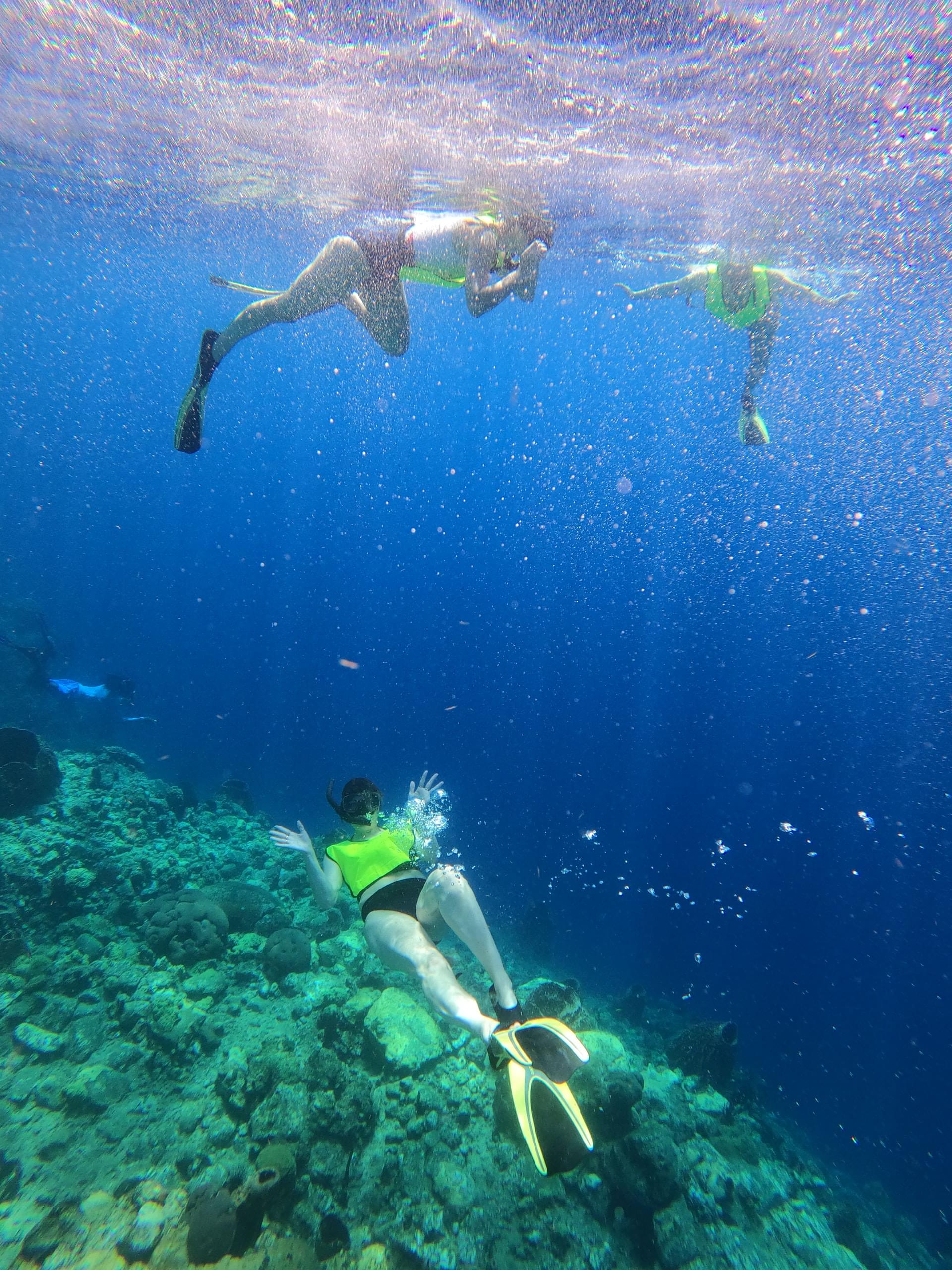
South of Pointe Michel, geothermal gas rises through the seabed in fine bubble streams at around 15 feet. You swim out over a shingle bank and the bottom starts fizzing. The water above the vents is noticeably warm, and the faint sulphur is the same volcanic system that heats the island’s rivers.
The fee is US$2 per person, per site, paid to the wardens at the beach entrance. It is the marine park user fee for the Soufriere Scotts Head Marine Reserve, set by regulation in 2001 and never revised.8 Parking on the road above is free. If someone quotes you US$5 they have read EC$5 as US dollars: the East Caribbean dollar is pegged at EC$2.70 to US$1, so EC$5 is about US$1.85 — the same money. No guide is required, either; diving here independently is the thing that needs the Chief Fisheries Officer’s authorisation, which is why every diver on the site is attached to a shop.8
Wear something on your feet. The entry is rock and shingle, and booties are the most useful thing to pack for Dominica. The beach facility has been under a US$558,000 upgrade agreed with the CARICOM Development Fund in October 2023.16
Do it yourself or book it? With a car and booties, US$2 is the whole cost. Without, the guided price is fair and buys the boat sites you cannot walk to: Nature Island Dive runs US$35 for one site and US$45 for two plus the fee; Dive Dominica quotes US$37.20 inclusive. This is the reserve’s busiest site and cruise-ship mornings are the crowded ones, so go early either way.
Scotts Head, Soufriere Bay and the marine reserve
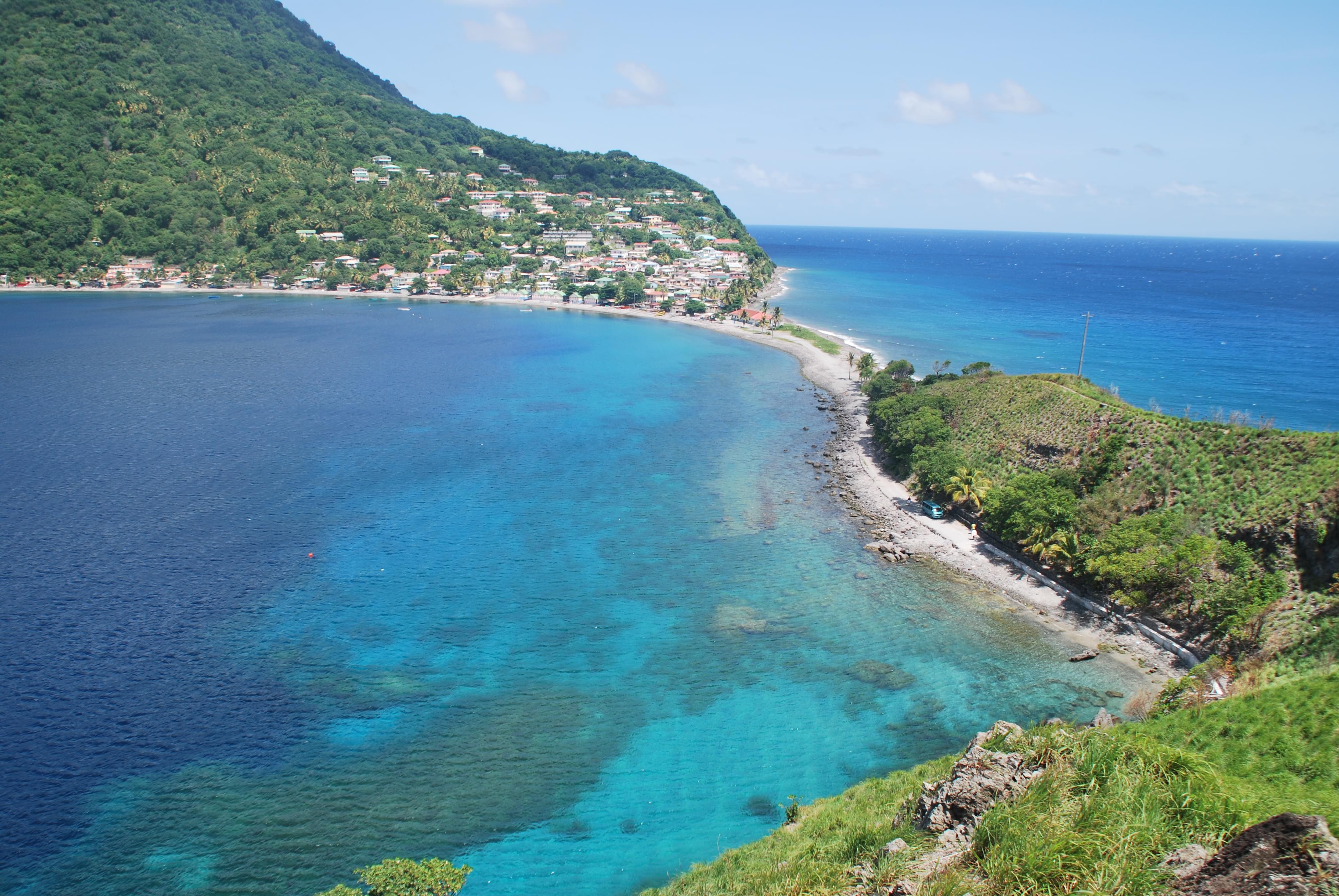
Soufriere Bay is a flooded volcanic crater, and the peninsula at Scotts Head shelters it from the Atlantic, which is why the calmest water on the island is also the deepest. The reserve was declared in 1998 and given its regulations in 2001. It has four zones, and the one you want is Tous Sable, the shore recreation zone at Scotts Head — that is where you are allowed to walk in.9
The reserve lists 12 dive sites and 10 snorkel sites, and the distinction matters more than the old guidebook advice about “venturing into deeper water” suggests. Swiss Cheese, the Soufriere Pinnacles and Scotts Head Pinnacle are dive sites, not snorkel sites.9 They sit below any sensible breath-hold, and the current across the mouth of the bay is not a snorkeler’s current. Stay inside the marked recreation area unless you are a strong swimmer: the drop-off is the attraction and also why this is not a beginner’s entry.
Bubble Beach, in Soufriere village itself, is the beginner’s version of Champagne, and almost nobody writes it up — a separate vent field in 1 to 5 meters of water, straight off a black sand beach, inside the same reserve and covered by the same US$2. If Champagne’s swim-out or its crowds put you off, this is the answer. Nature Island Dive is based here.
The north: Cabrits, Douglas Bay and Toucari
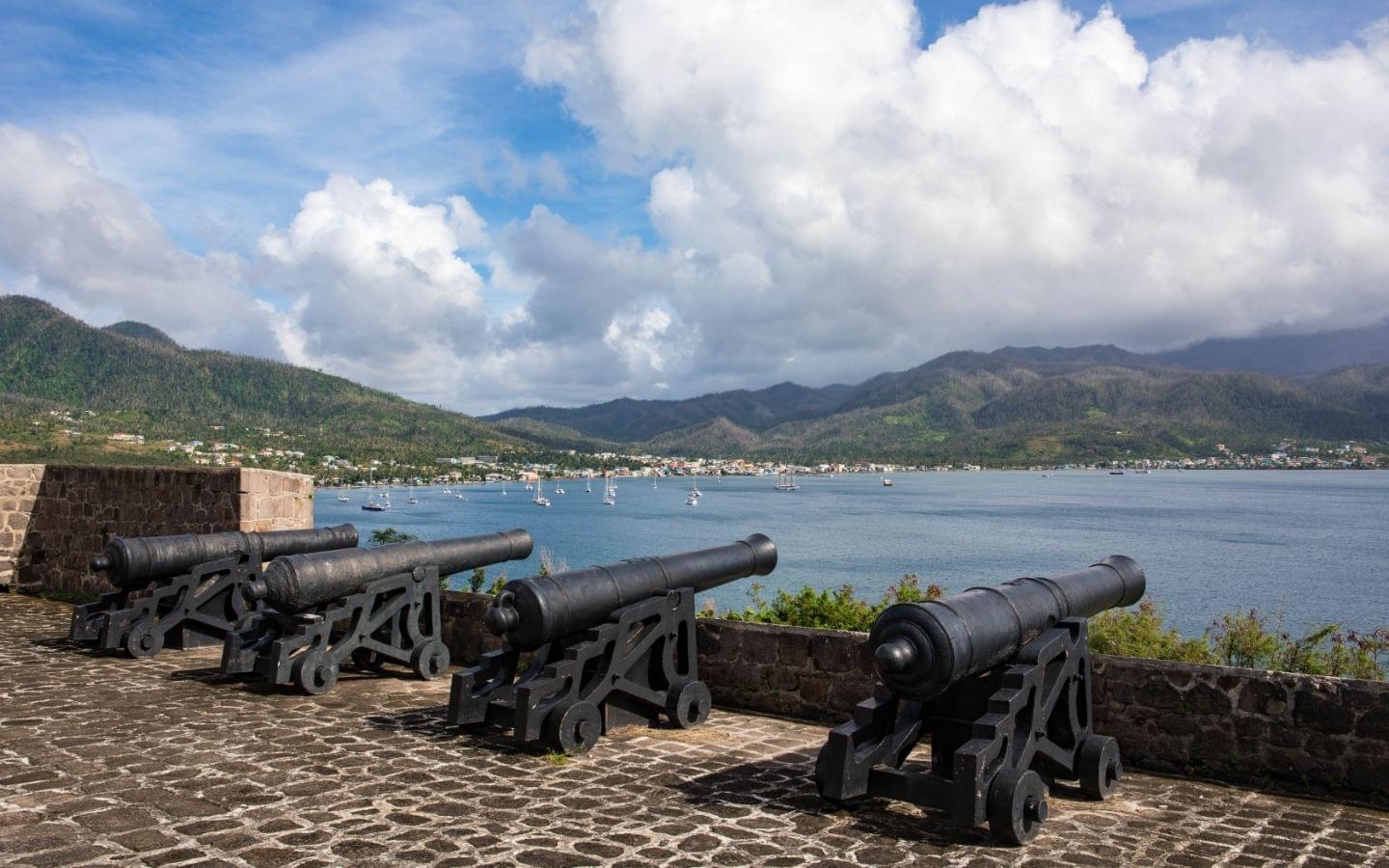
Cabrits National Park sits on a peninsula beside Portsmouth, and its marine section runs roughly 421 hectares from Prince Rupert Bay round to Toucari.17 On land there is Fort Shirley, a British garrison from the 1700s; in the water there is Douglas Bay, which holds the best coral on the north coast.
The entry price has changed and most published guides still carry the old one. Dominica’s national site pass is now US$8 for a single site, US$20 for a day and US$50 for a week, per the Forestry Division’s schedule as of 31 July 2026 — not the US$5 in older write-ups, including the previous version of this page.4 The park runs 08:00 to 16:00. And that is a park pass, not a water fee: there is no marine park charge anywhere on the north coast, and Cabrits Dive Centre’s price list carries none.18 Snorkel Douglas Bay from a boat and you may pay nothing at all.
Toucari Bay, further north, is the north’s best shore snorkel and the island’s second surprise: arches, swim-throughs and a fumarole of its own, so the venting seabed is not a southern monopoly.3 The caves proper run to about 38 feet and belong to divers; the shallows above them do not. Cabrits Dive Centre in Portsmouth is the operator up here.
Rodney’s Rock, and three corrections
Rodney’s Rock, at Tarou Point just north of Canefield, is the island’s critter site — frogfish, seahorses, octopus and flying gurnards are why the dive shops keep coming back.7 It is free, a shore entry straight off the coast road, and exposed enough that it only works on a calm day. If you would rather look at small strange things than big blue ones, it is worth more than any beach on the island.
Three claims that have circulated about Dominica for years, including on this page, do not survive checking.
There is no Salisbury Marine Reserve. Dominica’s regulations designate exactly one marine reserve, and it is Soufriere/Scott’s Head.8 Salisbury and Mero are pleasant black-sand beaches with a bar and a dive shop, and the snorkeling is poor — volcanic sand with nothing to hold anything.6 Go for the swim, not the mask.
Secret Beach was not a Pirates of the Caribbean location. Those scenes were shot at Indian River, Titou Gorge, Vieille Case, Hampstead, Capucin Point and Londonderry.19 Secret Beach is a lovely cove reachable only by boat or kayak,5 and it is somewhere to be rather than somewhere to snorkel.
And the marine reserve is not a World Heritage Site. It has sat on Dominica’s UNESCO tentative list since 2015, never inscribed; the island’s inscribed site is Morne Trois Pitons, inland.
Snorkeling Dominica from the shore
Almost all of it is, which is unusual for the Caribbean and the practical reason to choose Dominica over its neighbors. Five entries are worth planning around: Champagne, Bubble Beach, Tous Sable at Scotts Head, Rodney’s Rock and Toucari Bay. Douglas Bay is shore-reachable but easier from a boat. Three things they share, and each changes what you pack.
None of them is sand. Every one is shingle, cobble or volcanic rock, so booties or hard-soled water shoes are not the nicety here that they are on a sand island — the footwear is the Dominica-specific part of what to wear snorkeling.
The bottom stops being close very quickly. The shelf is narrow and steep, and at Scotts Head it is a crater wall — which makes a snorkel vest worth more here than on a shallow reef island, particularly for anyone who is not a confident open-water swimmer.
Some of them fail before the others. When a swell is running, Rodney’s Rock and Toucari go off first — both are exposed rock with nothing in front of them — while Champagne and Tous Sable hold up longest.
Every dive shop named here rents gear, but carry your own mask: our travel snorkel gear guide covers what packs small.
When to go
| Months | Rain, leeward coast2 | Storm risk13 | Verdict |
|---|---|---|---|
| Feb – Apr | Driest — March 49.0 mm, April 54.8, Feb 62.1 | None | Go now. The year’s best water |
| Dec – Jan | Moderate | None | Next best, and busier |
| May | Rising | Season opens 1 June | Fine, less reliable |
| Jun – Aug | Wet — July 251.4 mm, Aug 244.3 | Rising through August | Swimmable, rarely excellent |
| Sep – Oct | Wettest — Sept 253.7 mm | Peak, 10 September | Worst on every axis at once |
| Nov | Falling | Season ends 30 November | Improving week by week |
February and March are the answer, and the margin is not small. March takes 49.0 mm of rain on the leeward coast against September’s 253.7 mm — 19% of it.2 That matters more than comfort, because on a steep volcanic island what ruins visibility is river sediment, and rain is the only thing that makes it. One caveat: the rain shadow is a dry-season effect only. In April the east records 3.1 times the west’s rainfall; by July the two have equalized.2 Water temperature is never the constraint — 80 °F in February to 85 °F in September,14 so a rash guard is enough.
Hurricane season runs 1 June to 30 November and peaks on 10 September.13 There is a quieter reason to avoid the same window: over the last three years the annual peak of coral heat stress at Champagne landed on 1 November 2023, 14 November 2024 and 1 November 2025.14 Late autumn is when this island’s water is under the most pressure, in every sense.
Getting there, and the drive
There is now a daily non-stop from the United States, which a lot of Dominica planning advice predates. American Airlines flies Miami to Douglas-Charles every day, with a second Saturday rotation, and Contour added San Juan and St Thomas in late September 2025. United’s Newark service is seasonal, roughly October to April. Two carriers in the older guides are gone — Silver Airways stopped on 11 June 2025, Air Antilles was liquidated on 27 April 2026 — and nothing flies direct from Europe.20 If you are island-hopping, FRS Express des Îles sails from Roseau to Guadeloupe, Martinique and St Lucia in two to four hours, five days a week rather than daily, from €119 return.21
Then the drive. Douglas-Charles is on the windward coast and every site here is on the leeward one, so you land and cross the island. The UK and Canadian governments both describe Dominica’s roads as narrow, steep, winding and poorly marked, and single out the airport road as landslide-prone with sheer drops where the carriageway has fallen away; the FCDO advises against driving it at night.22 Take the daytime flight. Dominica drives on the left, and a visitor’s permit is required — EC$30 for a month or EC$60 for three, about US$11, issued at the airports, by authorised rental agents, at Traffic and Licensing in Roseau or at Portsmouth police station.23 Older guides quoting US$30 are out of date.
The sperm whales, and the law that changed underneath them
Two things about Dominica’s sperm whales are commonly got wrong.
They are resident, not migratory. Roughly fifty families live in these leeward waters year-round, which is what makes Dominica unique in the Caribbean. The November-to-March “season” everybody quotes is a season for seeing them — calmer water — not for their being here.
And the legal position changed completely in the last year. The reserve announced with great fanfare in 2023 was, for two years, only an announcement. Parliament passed the bill on 14 October 2025 and it was gazetted on 11 November 2025 as the Sperm Whale Reserve Act, 2025 (Act No. 9 of 2025); a Board, a Chief Whale Officer and Rangers were appointed on 24 March 2026, and the Corridor and Traffic Route Regulations followed on 11 June 2026.24 The Government puts it at about 1,231 km². It is live law — and Dominica’s own tourism authority still describes the country as “establishing” it, so much of what you read online is a year out of date. The 2026 headline is the shipping corridor the Act requires: a lane at least two nautical miles wide into the Port of Roseau, with tourism and media activity prohibited inside it.24
For a visitor the rules are strict. Whale watching and swim-with-whales are prohibited across Dominica’s maritime zones except inside the reserve; inside it, getting in the water needs a permit from the Chief Whale Officer, and no more than two tourism operators may run swim-with-whales at any one time. Snorkel or freedive only, and never privately or from your own boat.24 Book the operator before you book the flight: two permits island-wide is the binding constraint, not the calendar.
What to book, and where to stay
Two names in the older guides are gone. Al Dive in Roseau and East Carib Dive at Salisbury were standard recommendations before 2017 and neither reopened. Trading in 2026: Dive Dominica at Castle Comfort, Nature Island Dive at Soufriere, Cabrits Dive Centre at Portsmouth, Fort Young Dive in Roseau, and PH Whale Watch on the beach at Champagne.
For a first day, the three-hour boat tour covering Champagne, Bubble Beach and Scotts Head does the reserve properly in one go. To pair the water with the island’s other half, this four-hour multisport day adds Titou Gorge and Freshwater Lake, and this waterfall and Champagne Reef trip adds Trafalgar Falls.
Where you sleep decides which cluster you get, and for a snorkeling week it should be the south. From Roseau and the coast below it the whole reserve is inside half an hour and the dive shops are on the doorstep; Portsmouth puts you next to Cabrits, Douglas Bay and Toucari and 90 minutes from everything else.
Jungle Bay is not where the older guides put it: the original resort at Delices was destroyed by Tropical Storm Erika in August 2015 and reopened at Morne Acouma above Soufriere on 30 June 2019, fifteen minutes from the reserve.25 Secret Bay, on the cliff above Secret Beach, gives guests kayaks and gear — which matters at a beach you cannot walk to. And InterContinental Dominica Cabrits Resort & Spa, the closest bed to Douglas Bay, left the Kempinski brand in April 2023 and is still listed under the old name in plenty of places.26
Frequently asked questions
How much does it cost to snorkel at Champagne Reef?
US$2 per person, per site. It is the marine park user fee for the Soufriere Scotts Head Marine Reserve, it is collected by the wardens at the beach entrance, and it is the statutory rate set in 2001. Parking on the road above the beach is free. If a guide quotes you US$5, they have almost certainly read EC$5 as US dollars — the East Caribbean dollar is pegged at EC$2.70 to US$1, so EC$5 is about US$1.85, which is the same money. Operators who bundle it charge more for the trip and hand over the same US$2: Nature Island Dive runs US$35 for one site and US$45 for two, plus the fee, with gear at US$16 a day.
Do you need a guide to snorkel in Dominica?
No. Shore snorkeling at Champagne, Bubble Beach and Scotts Head is open to anyone who pays the US$2 marine reserve fee, and there is no guide requirement on the north coast at all. Two things do need someone else's permission. Diving independently inside the marine reserve requires the Chief Fisheries Officer's authorisation, which is why every diver you see there is with a shop. And getting in the water with sperm whales is permit-only and the permit belongs to the operator, not to you.
Is Champagne Reef still worth visiting after Hurricane Maria and the bleaching?
Yes, for the vents rather than the coral. The geothermal bubbles are the reason the site is famous and they are undiminished — operators were still describing them as normal in February 2026. The coral is a different answer. The 5 km satellite cell containing Champagne accumulated 18.93 degree heating weeks in 2023 and 20.25 in 2024, and NOAA puts near-complete mortality in more than 80% of corals as the likely outcome above 20. Nobody has published a survey of the site itself since 2018. Come for the geology, the drop-off and the small strange animals, which is what Dominica has always actually been good at.
When is the best time to snorkel in Dominica?
February and March. March is the driest month on the leeward coast at 49.0 mm of rain against September's 253.7 mm, February has the coolest and clearest water at about 80 °F, and both sit outside the hurricane season entirely. April is a close second. September and October are the worst months on every axis at once — wettest, peak storm risk, warmest water, and the annual peak of coral heat stress, which over the last three years has landed in the first half of November.
Can you snorkel in Dominica from the shore?
Yes, and it is how most of the island's snorkeling is done. Five shore entries are worth planning around — Champagne Reef, Bubble Beach at Soufriere, Tous Sable at Scotts Head, Rodney's Rock at Tarou Point, and Toucari Bay in the far north-west. What they have in common is that none of them is sand. Every one is shingle, cobble or volcanic rock, so booties or water shoes matter more here than anywhere else in the Caribbean, and the shelf drops away fast enough that a snorkel vest earns its place in the bag.
Can you swim with sperm whales in Dominica?
Legally, yes, and only through a certified operator. Under the Sperm Whale Reserve Act 2025, swim-with-whales and whale watching are prohibited across Dominica's maritime zones except inside the reserve, and inside it swimming requires a permit from the Chief Whale Officer. No more than two tourism operators may run swim-with-whales at any one time, which makes the operator the scarce thing rather than the season. Snorkel or freedive only — scuba, rebreathers and underwater scooters are all excluded. Book the operator before you book the flight.
Sources
Footnotes
-
Niddrie, David Lawrence and Momsen, Janet D. “Dominica.” Encyclopedia Britannica, britannica.com. Island dimensions and climate. ↩
-
Dominica Meteorological Service station normals, Canefield Airport (leeward coast) and Douglas-Charles Airport (windward coast), weather.gov.dm. Monthly rainfall normals and the annual totals of 1,759.8 mm west against 2,652.7 mm east. ↩ ↩2 ↩3 ↩4
-
“Toucari Caves.” PADI Dive Site Directory, padi.com. Depth, arches, swim-throughs and the site’s own fumarole. ↩ ↩2
-
“User Fees Programme.” Forestry, Wildlife and Parks Division, Commonwealth of Dominica, accessed 31 July 2026, forestry.gov.dm. Site pass at US$8 single site, US$20 day, US$50 week. ↩ ↩2
-
“Secret Beach.” A Virtual Dominica, avirtualdominica.com. Boat and kayak access only. ↩ ↩2
-
“Mero Beach.” Nature Island, updated 25 April 2026, nature-island.com. Volcanic sand and limited reef structure. ↩ ↩2
-
“The Unknown Dominica: Diving the Central Coast.” Scuba Diving, scubadiving.com. Rodney’s Rock frogfish, seahorses, octopus and flying gurnards. ↩ ↩2
-
Fisheries (Marine Reserve) Regulations, S.R.O. 7 of 2001, Commonwealth of Dominica, faolex.fao.org. The US$2 per-person snorkel and dive fee, the US$20 monthly rate, the permit requirement for independent diving, and the designation of Soufriere/Scott’s Head as the country’s marine reserve. Corroborated as current by Nature Island Dive and by the operator on the beach, PH Whale Watch, page updated 28 February 2026. ↩ ↩2 ↩3 ↩4 ↩5 ↩6
-
Soufriere Scotts Head Marine Reserve Management Plan 2015–2025, obapao.org, and the reserve’s own site listing. Four zones, Tous Sable as the shore recreation zone, 12 dive and 10 snorkel sites, and the sites that are dive-only. ↩ ↩2 ↩3
-
Status of Coral Reefs of the Caribbean 1970–2024. Global Coral Reef Monitoring Network, 9 December 2025, gcrmn.net, Dominica chapter. Maria’s proximity and wind speed, the 1980–2024 storm counts, north-coast elkhorn cover below 5%, and the 16.9% regional decline in 2023. ↩ ↩2 ↩3
-
Marine Damage Report and Dive Sector Needs Assessment, Post Hurricane Maria. Organization of American States, 2018. Mooring replacement at Mero, Grande Savanne, Cabrits and inside the marine reserve, and sediment over the staghorn beds at Champagne. It remains the only site-level assessment of storm damage to Dominica’s dive and snorkel sites; nothing has re-surveyed it since. ↩
-
“New survey points to lasting impact of Hurricane Maria on marine environments in Dominica.” ECO Magazine, 29 April 2022, ecomagazine.com. National Oceanography Centre survey with Dominica’s Division of Fisheries. ↩
-
“Tropical Cyclone Climatology” and the Tropical Cyclone Report archive, NOAA National Hurricane Center, nhc.noaa.gov and nhc.noaa.gov/data/tcr; closest-approach distances computed from HURDAT2 for every Atlantic named system 2018–2025, and cross-checked against the Dominica Meteorological Service’s quarterly climatic newsletters, weather.gov.dm. Season dates and the 10 September peak; Tammy at 83 km east in October 2023; Beryl’s track and the 45-knot gust at Freshwater Lake, July 2024; and the absence of any landfall since Maria. ↩ ↩2 ↩3
-
NOAA Coral Reef Watch 5 km Degree Heating Weeks and sea surface temperature for the cell containing Champagne Reef (15.2875 N, 61.3875 W), coralreefwatch.noaa.gov; series retrieved 31 July 2026 via PacIOOS ERDDAP. Annual peaks, days above the stress threshold, the published mortality thresholds at 12, 16 and 20 DHW, and monthly sea temperature. ↩ ↩2 ↩3 ↩4
-
“SSMR wardens learn how to deal with SCTLD.” Soufriere Scotts Head Marine Reserve, 10 July 2022, ssmrdominica.com. Stony coral tissue loss disease reached Dominica in 2021. ↩
-
Agreement between the Government of Dominica and the CARICOM Development Fund for the upgrade of the Champagne Beach facility, signed 11 October 2023 — USD 558,000 (EC$1.5 million). ↩
-
“The Cabrits National Park.” Protected Areas of Dominica, Forestry Division, protectedareas.forestry.gov.dm. Marine section of about 421 hectares from Prince Rupert Bay to Toucari. ↩
-
“Prices.” Cabrits Dive Centre, cabritsdive.com. North-coast diving and snorkeling with no marine park fee listed. ↩
-
“Pirates of the Caribbean: Dead Man’s Chest filming locations.” The Worldwide Guide to Movie Locations, movie-locations.com. The Dominica locations used. ↩
-
“Douglas-Charles Airport — July Flight Schedule 2026.” Discover Dominica Authority, dated 1 July 2026, discoverdominica.com. American Airlines’ daily Miami service and the Saturday second rotation, Contour’s San Juan and St Thomas routes, and United’s seasonal Newark schedule. Air Antilles’ liquidation was ordered by the Commercial Court of Pointe-à-Pitre on 27 April 2026; Silver Airways ceased operations on 11 June 2025. ↩
-
FRS Express des Îles timetable and fares in force from 31 March 2026, express-des-iles.com. Crossing times from Roseau, the five-days-a-week frequency, and the €119 return fare. FRS acquired L’Express des Îles in February 2024. ↩
-
“Dominica travel advice.” UK Foreign, Commonwealth and Development Office, 10 December 2025, gov.uk, and Government of Canada travel advice, 29 July 2026, travel.gc.ca. Road conditions and the specific warning about the Douglas-Charles road. ↩
-
Visitor’s driving permit fees, Inland Revenue Division, Commonwealth of Dominica, ird.gov.dm. EC$30 for one month and EC$60 for three, and where the permit is issued. ↩
-
Sperm Whale Reserve Act, 2025 (Act No. 9 of 2025), Commonwealth of Dominica — passed 14 October 2025, gazetted 11 November 2025; Sperm Whale Reserve (Corridor and Traffic Route) Regulations, S.R.O. No. 8 of 2026, gazetted 11 June 2026; Board, Chief Whale Officer and Rangers appointed 24 March 2026. ↩ ↩2 ↩3
-
“Our Story.” Jungle Bay Dominica, junglebaydominica.com. Destruction of the Delices resort by Tropical Storm Erika in August 2015 and the reopening at Morne Acouma on 30 June 2019. ↩
-
“Dominica resort rebrands as an InterContinental.” Travel Weekly, travelweekly.com. The Kempinski-to-InterContinental change, April 2023. ↩

Liz Meyer — Travel writer
Liz is a full-time traveler and a PADI Rescue Diver. She loves to explore new places in and out of the water and share her experiences with others.