Snorkeling
Snorkeling in Greece: which island, and what you will see
Clear water, far fewer fish than the photographs promise. From the Aegean: which island to pick, why wind beats month, and what changed at Shipwreck Bay.
We earn a commission on purchases made through links on this page, at no extra cost to you. It never affects which products we recommend.
On this page
- What is first-hand here, and what is sourced
- What Greek water is actually like
- The wind decides the day, not the month
- When to go, and how warm the water actually is
- Which island to pick
- Zakynthos, the turtles, and what happened to Shipwreck Bay
- Sea urchins are the only hazard worth planning around
- Getting to the water
- Where to stay
- Frequently asked questions
- Where to go next
Greek water is the clearest I have ever swum in, and there is not very much living in it. Both are true at once, and almost nothing written about snorkeling in Greece tells you the second — which is why people arrive with a mask bought for a Caribbean holiday and come out after twenty minutes wondering what they missed.
They did not miss anything. This is a different kind of snorkeling: rock, light, seagrass and remarkable visibility, with fish in ones and twos rather than clouds. And the good part is almost never a booked excursion — it is a swim off a rock at nine in the morning, before the wind gets up.
What is first-hand here, and what is sourced
I live in Greece, on the Aegean, and this page answers the questions you actually have on the first morning of a trip. What the water is like, how few fish are in it, what the wind does to a morning, and the fact that urchins are the hazard people meet rather than anything with teeth: that is the part that comes from being here. The Ionian, which is where most readers end up choosing between islands, is a different sea and behaves differently — so everything with a number attached is sourced and dated, because living somewhere is not a source for a number.
What Greek water is actually like
The Mediterranean is oligotrophic — low in nutrients, which is exactly why it is so clear and so blue. On a still morning you can lie on the surface in five meters of water and read the bottom as though there were nothing in between. What lives down there is mostly on the rock rather than above it: sea bream and wrasse working the line between stone and sand, damselfish in dark clouds wherever there is structure, and, if you are lucky, an octopus — which you find by the tidy pile of shells outside its hole rather than by seeing the animal.
You will also swim over Posidonia oceanica constantly and probably not recognize it — a flowering seagrass endemic to this sea, which looks like a drowned lawn and is not the boring bit. Those meadows are the nursery for most of what you are hoping to see, and much of the reason the water above them is so clear.1 Where a coast has healthy Posidonia, it has fish.
On the fish, honestly. This sea has been worked hard and it shows to a snorkeler. The most recent FAO assessment puts 52% of assessed stocks as overfished — genuinely good news, because a decade ago it was 87%, and the biomass of the stocks evaluated has risen about a quarter.2 Emptier than a reef, emptier than a century ago, and slowly improving. All three at once.
One thing has been added rather than taken away. Lionfish came through the Suez Canal, were first recorded off Rhodes in 2015 and reached Crete soon after.3 Beautiful, invasive, venomously spined — admire from further away than you would like to.
The wind decides the day, not the month
This is the thing I would most want a first-time visitor to know.
Greek summer weather is boringly reliable — the sun will be out — but the meltemi, the northerly that blows across the Aegean, is not. It runs mainly from June to September, is strongest in July and August, typically blows Force 4 to 5 and can reach 6 to 7, and it has a daily rhythm: it builds through the early afternoon and drops away around sunset.4
Three rules follow.
Swim in the morning. A bay that is glass at eight o’clock can be unusable chop by two. This is the single most valuable habit on this page.
Pick your coast on the day. Every island has a sheltered side and an exposed one, and the meltemi decides which. A north-facing cove in August is a washing machine while the southern shore is flat calm.
A canceled boat trip is not bad luck. If the operator calls it off, the sea is worse than it looks from the beach.
The Ionian gets far less meltemi than the Cyclades — a real argument for going west if you are planning around the water.
When to go, and how warm the water actually is
Ten-year monthly averages for Zakynthos, a touch warmer than the north Aegean:5
| Month | Sea temperature |
|---|---|
| May | 19.3 °C / 66.7 °F |
| June | 23.1 °C / 73.6 °F |
| July | 25.6 °C / 78.1 °F |
| August | 26.7 °C / 80.1 °F |
| September | 25.7 °C / 78.3 °F |
| October | 23.3 °C / 73.9 °F |
| November | 21.0 °C / 69.8 °F |
The sea lags the air by about two months, so October is warmer than June, and May — which feels like summer on land — is the coldest water most visitors will try. The window for an hour in without neoprene runs mid-June to late October, longer than most people assume.
Late September is the best time to come. The sea is still at 25 °C, the meltemi has usually eased, and the crowds have gone.
Expect warmer than the table, later in the year: 2025 was the Mediterranean’s second-warmest year on record, and June 2025 the warmest June ever measured for the basin.6 Pleasant for us; not good news for the things living in it.
Which island to pick
Roughly in the order I would choose them.
Corfu, and the day boat to Paxos
The best all-round choice for a first trip, and the one most people underrate. The north-east coast — Nissaki, Kalami, Agni, Kerasia — is a run of small rocky coves facing a sheltered channel: easy entry and exit, calm far more often than not, structure within twenty meters of the shore. On the exposed west coast, Porto Timoni is worth the walk down: two back-to-back bays, so one is sheltered whatever the wind is doing.
The thing to actually book is the day boat to Paxos and Antipaxos, which takes in the Paxos blue caves and then Antipaxos, the clearest water in the Ionian. Take your own mask; these boats carry buoyancy aids far more reliably than snorkels.
Crete
Right for a longer trip, because the island is big enough that there is always a sheltered coast. Elafonissi in the far west is the famous one: a shallow pink-sand lagoon, lovely, mobbed, and better understood as wading for small children than as snorkeling. It is a protected Natura 2000 site and taking sand, shells or plants away is prohibited.7
The south coast is the better half, and holds its warmth latest. Skinaria near Plakias is the site the local dive schools use — clear water, rock structure, easy entry. If you would rather somebody else picked the spot, this boat trip combines guided snorkeling with paddleboarding.
Rhodes
The best bet for a late-October trip. Anthony Quinn Bay near Faliraki is the site everyone names: a small rocky cove with good structure, gear rental on the beach and, in season, more people in it than fish. Go early, and bring reef shoes — Rhodes has a real urchin population on exactly the rock you want to be over. This catamaran cruise takes in three snorkeling stops and reaches coastline you cannot drive to.
Kefalonia
Quieter than its neighbors and better for it. Foki, the pebble cove near Fiskardo, is the pick: sheltered, clear, easy to get into, cypress trees down to the water. Its name comes from the Greek for seal, and monk seals do use caves along this coast, though seeing one is luck. The bay is the better snorkeling; leave the sea caves either side to strong swimmers.
The Cyclades, honestly
Santorini, Mykonos, Naxos, Paros — the islands most people picture when they picture Greece, and the wrong ones for snorkeling. Santorini is a drowned volcano with steep, dark water and little shallow rock; Mykonos and Paros take the full meltemi.
If you are going anyway, take a boat to water you cannot walk to. A Santorini kayak trip includes cave snorkeling along the rocky coast, and a caldera catamaran cruise will put you in at the hot springs and Red Beach. Book them as boat trips with a swim in them.
Zakynthos, the turtles, and what happened to Shipwreck Bay
Zakynthos has the best set-piece snorkeling in Greece and the strictest rules — and the first thing to know is a closure.
Navagio is closed, and the listings have not caught up
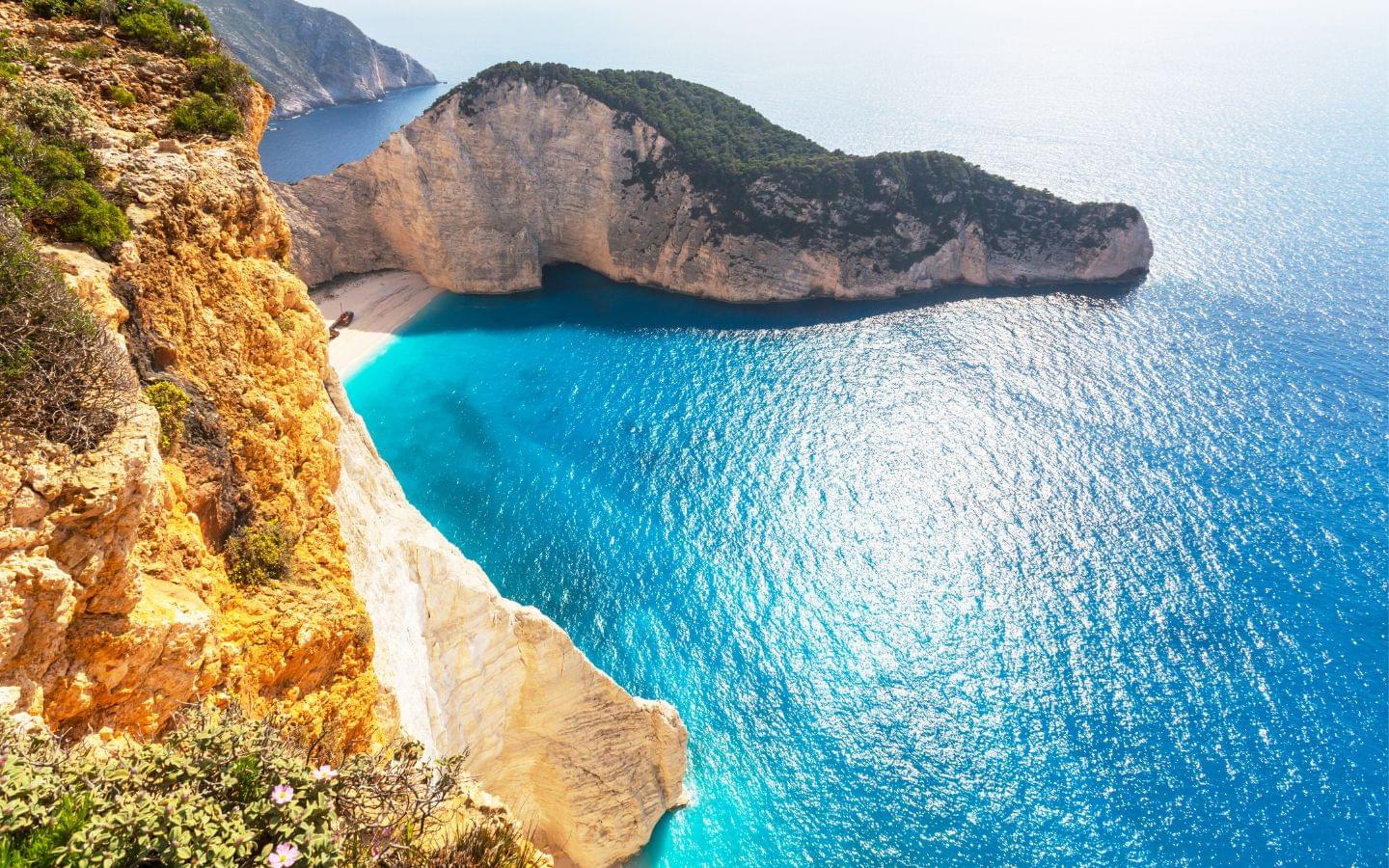
Navagio — Shipwreck Bay, the cove with the rusting freighter on the front of every brochure about Greece, including the photograph at the top of this page — is closed. Landing on the sand is prohibited, swimming anywhere in the cove is prohibited, and vessels may not come within 50 meters of the shoreline. The measures follow repeated landslides from the 200-meter cliffs above, they run to at least 31 October 2026, and they are enforced.8 You can still see the bay from the clifftop platform and by boat from outside the exclusion line. What you cannot do is the thing the photographs show.
What to do instead, which is better anyway
The Blue Caves, at the island’s northern tip between Agios Nikolaos and Cape Skinari, are the real attraction and are open — arches and sea caves cut into white limestone, where the light comes up through the water from below rather than down from above and turns everything, including you, an unreasonable blue. Small boats can go inside; the big round-island boats cannot and stop at the entrances. Go between about eight and eleven, when the light is right and the sea is flattest.
At the southern end, the Keri caves are the same idea in a quieter setting, usually combined with Marathonisi — Turtle Island — and Cameo Island. This half-day boat trip covers that circuit, and does not supply mask or snorkel, which catches people out every year. Our travel snorkel gear guide covers what packs small.
The turtles, and the rules that come with them
The Bay of Laganas is the most important loggerhead nesting site in the Mediterranean and a National Marine Park with enforced zoning: no boats at all in zone A, a 6-knot limit in zones B and C, and the nesting beach at Sekania closed to all but researchers.9 Females nest from May to August, and the beaches carry an overnight curfew and a ban on artificial light. You may well see a loggerhead; keep your distance and do not swim after it, because boat strikes are a real problem here.
The Mediterranean monk seal is the better story: downlisted on the IUCN Red List from Endangered to Vulnerable in 2023, on roughly 450 to 600 mature individuals, most of them in Greek waters.10 Its stronghold is not here but at the National Marine Park of Alonissos and the Northern Sporades, the largest marine protected area in the Mediterranean.11 Greece has also become the first country in Europe to commit to banning bottom trawling across all its protected waters, by 2030.12
Sea urchins are the only hazard worth planning around
Not sharks, not jellyfish, not currents. Urchins — dense populations of them, on exactly the shallow, sunlit rock that makes the best snorkeling. They are not venomous in any way that matters; the problem is mechanical. The spines are brittle, they go in easily, and they snap off under the skin, where they are painful and prone to infection.
Three habits cover most of it:
- Wear reef shoes to get in and out. Most injuries happen in the first and last thirty seconds, standing on rock in surge.
- Never put a hand down to steady yourself. Float instead.
- Get in over sand if you have children or a nervous swimmer with you, and swim to the rock.
If you are spined: hot-water immersion for the pain, careful removal of superficial spines, and a doctor for anything deep, near a joint, or turning hot and red.13 Spines left in place can cause trouble months later. If the swimming itself is the worry, start with snorkeling if you can’t swim instead.
Getting to the water
Islands. Crete, Rhodes, Corfu, Zakynthos and Kefalonia all have airports with direct summer flights from most of Europe, so for a one-island trip, fly. Ferries are for island-hopping: Blue Star Ferries runs the long conventional routes out of Piraeus, while Seajets runs fast catamarans at roughly double the price — and a meltemi a conventional ferry shrugs off will cancel a high-speed craft.
Beaches. Greek beaches are public, and since 2024 the law has been explicit: at least 70% of any beach must be kept clear of sunbeds, rising to 85% on protected beaches, with 251 beaches as of 2026 where none are allowed at all.14 A government app, MyCoast, shows a beach’s concession status and takes complaints. If a beach looks entirely covered in loungers, the free part exists and somebody has taken it.
What to take. A mask that fits, a snorkel, reef shoes and a rash vest. The midday sun is what will actually hurt you.
Where to stay
The useful question is how far you are from water worth getting into.
On Zakynthos, Porto Zante Villas and Spa is on the east-coast beach with its own watersports center — the sheltered side, within reach of the northern caves, and the argument for it over Laganas, which sits inside the marine park.
On Crete, Hapimag Resort Damnoni is near Plakias, which puts Skinaria and a run of rocky coves within a short drive; Corinna Mare Suites and Studios near Chania is the budget end of the western, Elafonissi trip.
On Rhodes, Atalanti Boutique Hotel sits above Anthony Quinn Bay, which is worth it only if you intend to be in that cove at eight in the morning — and if you do, it is worth it a great deal. We earn a commission on these links, and the hotels’ own sites are sometimes cheaper.
Frequently asked questions
Frequently asked questions
Is snorkeling in Greece actually any good?
It depends entirely on what you are comparing it to. The water is some of the clearest you will ever put your face in, and on a calm morning you can see the bottom at twenty meters. But the Mediterranean is a nutrient-poor sea and a heavily fished one, so there are far fewer fish than a Caribbean or Red Sea photograph has led you to expect. If you arrive wanting a reef, you will be disappointed. If you arrive wanting clear water, rock, light and the odd octopus, it is wonderful, and it is free.
Which Greek island has the best snorkeling?
For a first trip, Corfu — the north-east coast is sheltered from the prevailing summer wind, the coves are small and rocky, and the day boat to Paxos and Antipaxos gets you the clearest water in the Ionian without needing to be a strong swimmer. Zakynthos is the pick if you want a genuine sea cave, Crete if you want variety and a long enough coast that there is always a sheltered side, and Rhodes if you want somewhere warm late in the season. Santorini and Mykonos are lovely islands and poor snorkeling.
When is the best time of year to snorkel in Greece?
Late September is the sweet spot. The sea is at its warmest from August to early October — around 26 °C in August on the ten-year averages for Zakynthos — and by late September the meltemi wind that blows through July and August has usually eased and the crowds have gone. June is warm enough for most people and calmer than July. May and late October are swimmable but you will want a shorty, and our guide to what to wear snorkeling covers the thickness question.
Can you still swim at Navagio, the Shipwreck Beach on Zakynthos?
No. Landing on the beach and swimming anywhere in the cove are both prohibited, and vessels may not come within 50 meters of the shoreline. The restrictions run to at least 31 October 2026 because of landslide risk from the cliffs above, and they are enforced. To Vima reported the terms of the extended decision in June 2026. You can see the bay legally from the clifftop observation platform, and by boat from outside the exclusion line. Tour listings that still advertise a swim at Shipwreck Beach are out of date — check what the itinerary actually says before you book.
Are sea urchins a problem when snorkeling in Greece?
They are the one hazard you are genuinely likely to meet, and they are on exactly the rocky, shallow, sunlit ground that makes the best snorkeling. They are not venomous in any serious sense — the problem is that the spines are brittle, snap off under the skin and are hard to get out. Wear reef shoes to get in and out over rock, never put a hand down to steady yourself, and get in where there is sand if you have children with you. The Merck Manual's guidance on treatment is worth reading before rather than after.
Is there good snorkeling near Athens?
Not really, but there is some, and most visitors to Greece land in Athens whether they mean to or not. The Attica coast is built up and the water is busy, so the honest advice is to treat it as a swim rather than a snorkeling trip. If you have a spare morning, head south to Cape Sounion, or take a boat out to Schinias and Marathon Cape on this half-day excursion from Nea Makri. The islands are the reason you came.
Where to go next
If Greece has sold you on Mediterranean snorkeling, the Adriatic coast of Croatia is the same sea with more relief and colder water, written by someone who guides on it. For packing: what to wear snorkeling and the travel snorkel gear guide.
References
Footnotes
-
“Posidonia seagrass.” WWF Greece. Distribution, ecological role and decline of Posidonia oceanica in Greek waters. wwf.gr. ↩
-
The State of Mediterranean and Black Sea Fisheries 2025. General Fisheries Commission for the Mediterranean, FAO. Share of assessed stocks overfished (52%, from 87% a decade earlier) and the ~25% rise in biomass of evaluated stocks, across 120 stocks assessed 2013–2023. Checked 31 July 2026. fao.org. ↩
-
Kletou, D., Hall-Spencer, J.M. & Kleitou, P. “A lionfish (Pterois miles) invasion has begun in the Mediterranean Sea.” Marine Biodiversity Records 9, 46 (2016), with subsequent review of the invasion front. First Greek records off Rhodes in 2015, then Crete and Karpathos. link.springer.com. ↩
-
“Meltemi storms in the Aegean sea of Turkey and Greece.” Sailing Issues. Seasonal window, Beaufort range and the afternoon-build, sunset-drop daily pattern. A sailing reference rather than a meteorological authority; treat the figures as typical rather than official. sailingissues.com. ↩
-
“Water temperature in Zakynthos.” Sea Temperature Info. Monthly means calculated from satellite and in-situ observations over the past ten years. Checked 31 July 2026. seatemperature.info. ↩
-
“Ocean Temperature Bulletin — Mediterranean Sea, 2025.” Mercator Ocean International / Copernicus Marine Service. Mediterranean 2025 mean surface temperature 21.35 °C, +1.03 °C above average and second only to 2024’s 21.50 °C; June 2025 the warmest June on record for the basin at 23.86 °C with 62% of the surface under strong-or-higher marine heatwave conditions. mercator-ocean.eu. ↩
-
“Elafonisi, the pink beach in Crete, is a Natura 2000 protected area.” Protected status of the Elafonissi area and the prohibition on removing sand, shells, plants or animals. cretetravel.com. ↩
-
“Zakynthos: Navagio Beach access curbs extended through 2026.” To Vima, June 2026. Closure of the prohibited and controlled-access zones, the 50-meter vessel exclusion, the swimming ban across the cove, and the 31 October 2026 end date subject to reassessment. Checked 31 July 2026. tovima.com. ↩
-
“National Marine Park of Zakynthos.” Marine zones A, B and C in the Bay of Laganas, the 6-knot limit in zones B and C, the no-access rule in zone A, the strictly protected Sekania nesting beach and the May-to-August nesting season. nmp-zak.org. Management has since passed to the Natural Environment and Climate Change Agency (NECCA). ↩
-
“Monachus monachus, Mediterranean Monk Seal.” The IUCN Red List of Threatened Species. Downlisted from Endangered to Vulnerable in 2023 under criterion D1, on an estimated 450–600 mature individuals. iucnredlist.org. ↩
-
“National Marine Park of Alonissos Northern Sporades.” Monk Seal Alliance. Area of 251,440 hectares, the largest marine protected area in the Mediterranean, and the monitoring work carried out there by MOm, the Hellenic Society for the Study and Protection of the Monk Seal. monksealalliance.org. ↩
-
“Greece’s commitments.” 9th Our Ocean Conference, Athens, April 2024. Ban on bottom trawling in national marine parks by 2026 and across all marine protected areas by 2030; the Ionian Marine National Park and South Aegean Marine Protected Area; 30% of Greek waters protected by 2030, 10% strictly. ourocean2024.gov.gr. ↩
-
“Sea urchin stings.” Merck Manual, Professional Edition. Hot-water immersion, removal of superficial spines, and the indications for medical assessment including retained deep spines, joint involvement and secondary infection. merckmanuals.com. ↩
-
2024 Greek coastal development law, and subsequent revisions. Minimum 70% of any beach free of sunbeds, 85% on protected beaches, and the list of beaches where no sunbeds or umbrellas are permitted, which stood at 251 in 2026 against 238 in 2024. The MyCoast reporting application is operated by the General Secretariat of Telecommunications and Post. ggtt.mindigital.gr. ↩

Jon Persson — Co-founder, OutsiderView
Jon lives in Greece, on the Aegean Sea, and co-runs OutsiderView. He writes from a traveler's and a beginner's point of view rather than an expert's.