Snorkeling
Snorkeling in Dubai means driving two hours east
Dubai's own coast is dredged sand with almost nothing to see, and the sea hits 35 °C in August. The real snorkel is Snoopy Island in Fujairah, on the other coast. The sites, the tank prices, the rules, and the month to go.
We earn a commission on purchases made through links on this page, at no extra cost to you. It never affects which products we recommend.
On this page
- Where the sites actually are
- The water temperature is the constraint
- The reef, as it stands
- Snoopy Island
- Dibba Rock, Sira Island and Martini Rock
- The aquarium question, answered straight
- Dubai’s own coast, and the reef being built under it
- The rules that decide your day
- Musandam, and whether it is worth the border
- When to go, and what to book
- Frequently asked questions
Dubai sells snorkeling the way it sells everything else: confidently, at volume. What it does not have is a reef.
I guide on the Adriatic, another warm, enclosed, reef-poor sea that people arrive at with pictures of the Red Sea in their heads, and I have reset that expectation on a beach often enough to know the shape of this one. Dubai’s coast is dredged sand over silt. The one good shore snorkel is two hours east, in a different emirate on a different sea. The water off the city averaged 34.2 °C this July, which is warm enough to be dangerous.
None of that writes the trip off. It just moves the good day out of the city.
Where the sites actually are
Two seas, behaving nothing alike. Dubai sits on the Arabian Gulf: shallow, semi-enclosed, heavily dredged. Two hours east, across the mountains, the country faces the Gulf of Oman — open ocean, rock headlands, its only real reef.
| Site | Where | Getting in | Cost | What it is for |
|---|---|---|---|---|
| Snoopy Island | Al Aqah, Fujairah · Gulf of Oman | Shore, 200 m swim | Day pass from AED 105 | The one genuine walk-in snorkel |
| Dibba Rock | Off Dibba, Fujairah · Gulf of Oman | Boat, ~20 min | From AED 125 | Coral gardens and turtles, protected |
| Sira (Shark) Island | Khor Fakkan, Sharjah · Gulf of Oman | Boat, short hop | Dive center | Anemones and turtles off a public beach |
| Martini Rock | Off Khor Fakkan · Gulf of Oman | Boat, 10–25 min | Dive center | A dive site you can snorkel over |
| Jumeirah artificial reef | Dubai city · Arabian Gulf | Shore | Free | Twenty pleasant minutes, no more |
| Dubai Aquarium cage | The Dubai Mall · a tank | Cage | AED 370 | Children and nervous swimmers |
| Ambassador Lagoon | Atlantis, The Palm · a tank | Guided | AED 445, or ~US$67 via Viator | Twenty minutes among 65,000 animals |
| Deep Dive Dubai | Nad Al Sheba · a pool | Guided | AED 400 | Not the sea, and doesn’t pretend to be |
| Musandam fjords | Oman · Gulf of Oman | Dhow, border crossing | From ~US$78 | Scenery first, snorkeling second |
If the water is the point, sleep at Al Aqah rather than driving to it. If Dubai is the trip, take one long day east and enjoy the city guilt-free.
The water temperature is the constraint
| Month | Dubai coast (Arabian Gulf) | Al Aqah (Gulf of Oman) |
|---|---|---|
| February, coolest and best | 22.0 °C | 23.6 °C |
| July, the Dubai peak | 34.2 °C | 32.9 °C |
| August, the inversion at its widest | 34.1 °C | 31.9 °C |
| November, when the season opens | 28.9 °C | 28.7 °C |
High summer on the Dubai coast is a health question, not a comfort one. July averages 34.2 °C, or 94 °F. The cell has cleared 35 °C in three of the last four years, most recently 35.2 °C on 5 August, and sits at or above 33 °C for ninety to a hundred and seven days a year.1
Above about 36 °C the water stops taking heat off you at all, less if you are swimming hard.2 Open-water races cap at 31 °C.2 Snorkeling is where you float still, face down, in full sun, and notice too late.
In July or August: in early, keep it short, drink more than you think.
The two coasts swap. Al Aqah is warmer from December to June and cooler from July, running 2.2 °C below Dubai by August, because cold water wells up off Oman in summer. The east coast wins both ways.
The reef, as it stands
Arabian Gulf corals are the most heat-tolerant on earth. Their symbiont, Symbiodinium thermophilum, survives summer peaks of 36 °C. Everywhere else one degree above the summer maximum breaks the symbiosis.3
These corals need roughly three weeks at 35 °C, or eight to nine weeks at 34 °C, before they bleach.4 They are dying anyway.
The corals on the good coast are the fragile ones. The Gulf of Oman side never went through that winnowing, so it holds far more species, including the branching and table corals that make a reef look like a reef, and it bleaches at about 32 °C.4
September 2021 was the bill. At Khor Fakkan, the nearest surveyed reef to Snoopy Island and 25 km south of it: 40.7% of hard corals bleached, live cover 68% to 25%, Acropora 23% to 2%, after 76 days above 32 °C and a peak of 36.1 °C.4
The first bleaching ever recorded on the UAE’s Gulf of Oman coast, and recovery was still limited eight months later. On the Arabian Gulf side, 92.75% bleached at Sir Bu Nair.4
Gulf coral cover is down over 80% in a decade, and Acropora table corals are functionally extinct here.4
NOAA declared the fourth global bleaching event in April 2024, Persian Gulf included. That summer brought near-total bleaching from Abu Dhabi to Umm Al Quwain and hit around 40% of reefs off Khor Fakkan.
Al Aqah took 9.94 degree heating weeks and 55 days above Alert Level 2, where severe bleaching with mortality is expected. Dubai peaked at 5.92 and never cleared it.1
| Year | Dubai coast | Al Aqah (Gulf of Oman) |
|---|---|---|
| 2023 | 5.63 peak, 63 days at Alert 1 | 0.15 peak, clean |
| 2024 | 5.92 peak, 75 days at Alert 1 | 9.94 peak, 90 days at Alert 1, 55 at Alert 2 |
| 2025 | 0.00, clean | 1.20 peak, clean |
| 2026, to 9 August | 1.94 peak | 2.21 peak |
The good news is real. 2025 was clean on both coasts, 2026 is running well below alert, and live coral was up 15–20% through 2025. These animals are built for punishment.
Go expecting structure and fish rather than color. It is the adjustment I ask of Adriatic visitors who came for the Red Sea, and it usually decides whether the swim was worth it.
Snoopy Island
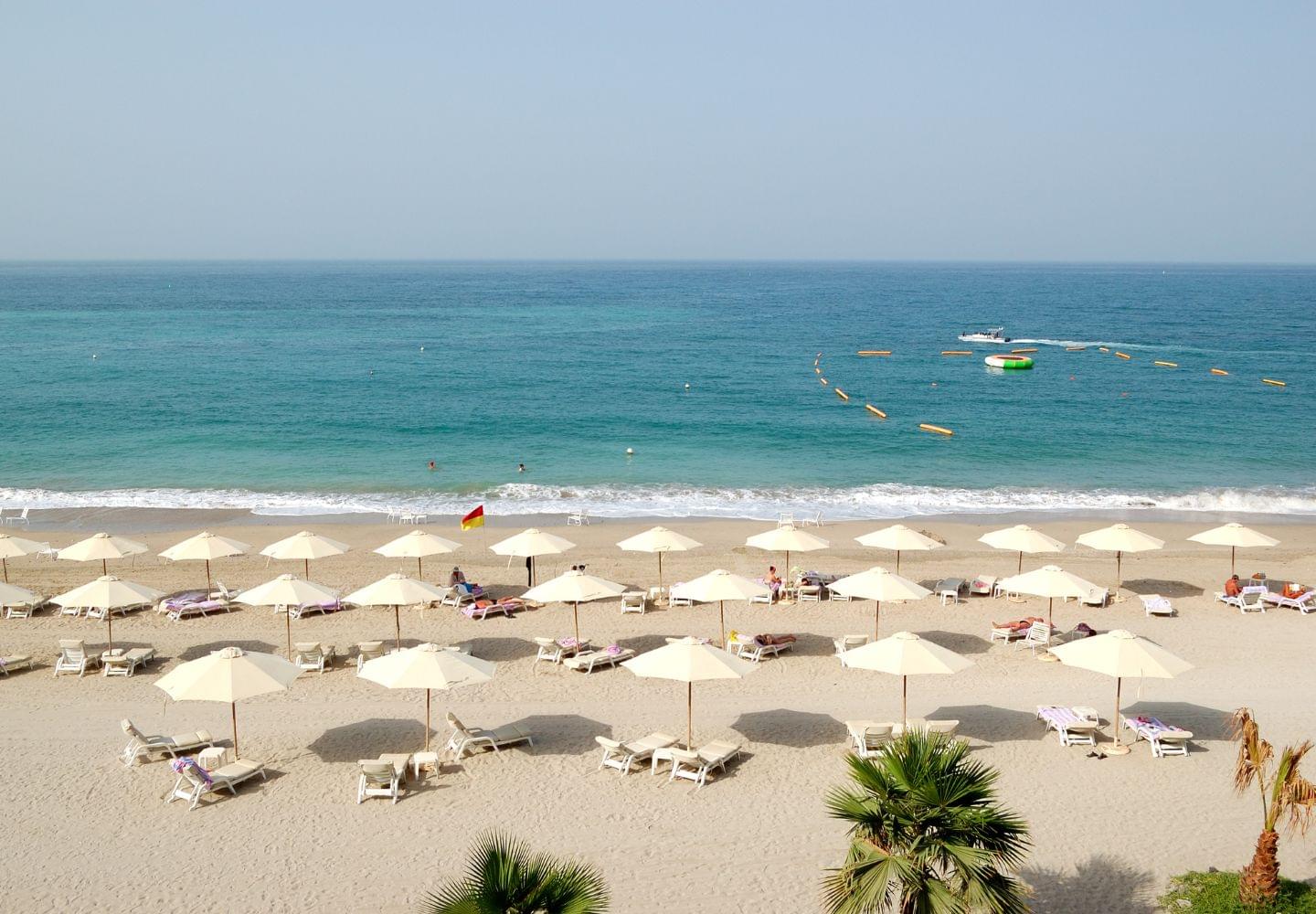
Snoopy Island sits 200 meters off the beach at Al Aqah, in seven meters of water. A shore site, open all year: trumpetfish, sergeant majors, redtoothed triggerfish, parrotfish, turtles.
No boat, no guide, no certification — just a swim out from the sand.
The beach belongs to the Sandy Beach Hotel and Resort, family-owned and at Al Aqah longer than most of Dubai has existed. Non-guests pay a day pass from AED 105 for adults and AED 70 for children, against list prices of AED 150 and AED 100.
It runs 9am to 6pm daily including public holidays: beach, pool, loungers, showers, changing rooms. The Sandy Beach Dive Academy rents and guides: snorkeling boat tour AED 350, discounted to AED 300; shore dive with kit AED 215.
The drive is longer than the internet says. Downtown Dubai to Al Aqah is 151 km, about two hours at free-flowing speed and realistically two and a half door to door; from the airport it is 139 km.
Guides saying “two hours to Fujairah” mean Fujairah city, not where the snorkeling is. Leave at six and you are in before the wind and the heat.
Do not swim around the island: the operators ask you not to, and the far side is exposed. Go on a weekday. Al Aqah is where the whole country swims.
Dibba Rock, Sira Island and Martini Rock
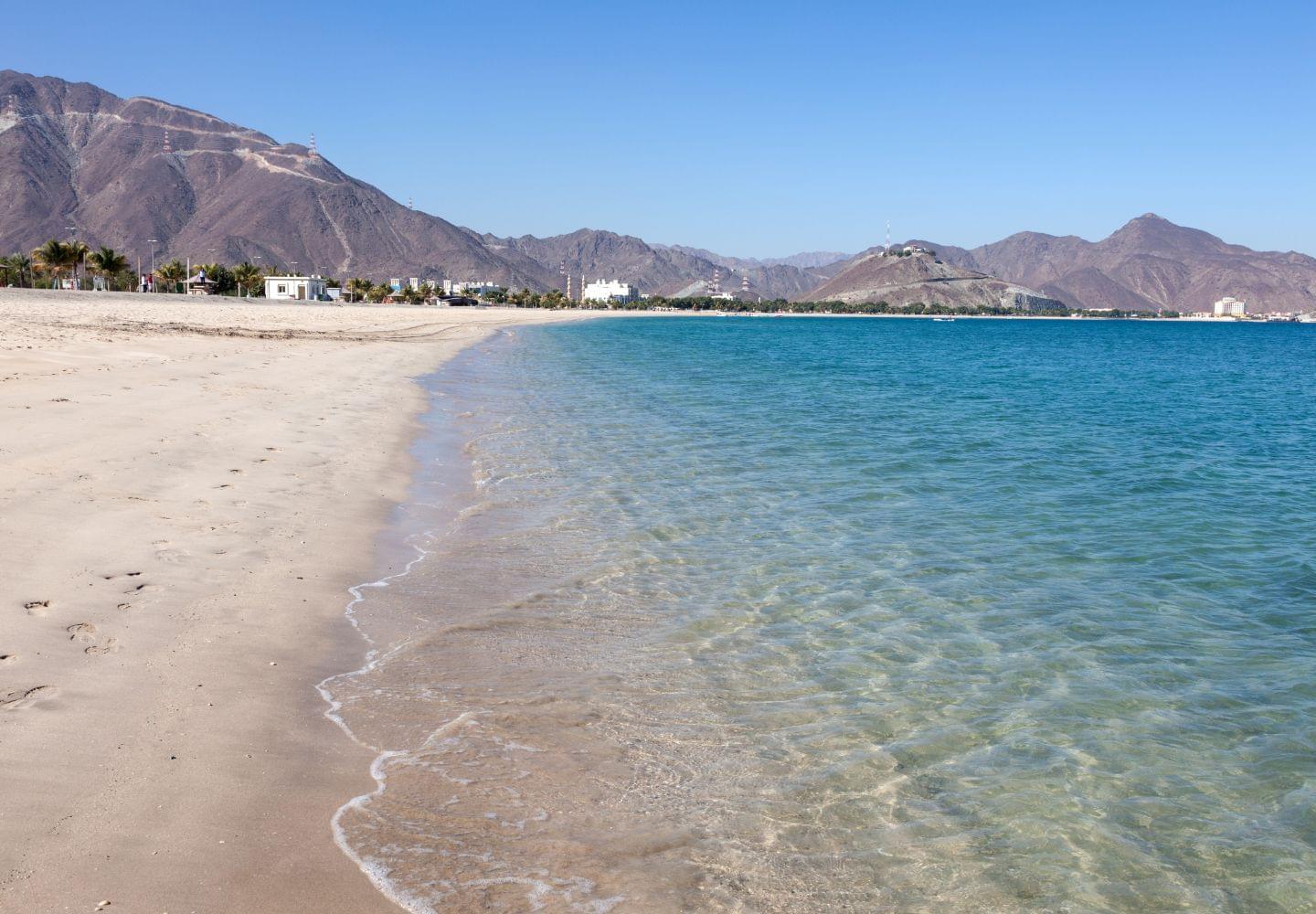
Dibba Rock is the best of the three, and it is a boat trip. Inside the Al Aqah marine protected area, about 15 meters deep, 20 minutes out: turtles, clownfish, parrotfish, blacktip reef sharks, seahorses.
No shore access, and snorkeling inside Fujairah’s marine reserves needs a license from the emirate’s environment authority. Enforcement is real: 2025 violations include illegal diving in protected areas and anchoring on coral.
The license sits with the operator, so book one. Freestyle Divers at Dibba port runs a one-hour Dibba Rock snorkel for AED 125, equipment AED 65 a day.
Sira Island, which everyone calls Shark Island, is in Sharjah rather than Fujairah. A short boat hop off the public beach at Khor Fakkan, behind the port at its southern end. Sea anemones and turtles.
Martini Rock is a dive site. Two submerged pinnacles about 160 meters long, dropping to 22 meters, ten minutes from Khor Fakkan, twenty-five from Al Aqah.
Al Boom Diving sells it as a snorkel, and on a flat day you see plenty over the top. But no reef flat, no shore entry. One boat trip goes to Dibba Rock.
Operators, since half the names in older guides have moved or closed. Al Boom Diving works out of Le Méridien Al Aqah: Fujairah snorkeling from AED 175 including VAT, age six and up, all gear including a wetsuit.
Nemo Diving Center runs a four-hour Dibba snorkel from AED 250, at 08:30 and 13:30 daily, minimum age ten. Divers Down is at the JAZ Miramar Al Aqah, formerly the Miramar. Nomad Ocean Adventures at Dibba has closed — domain dead, both centers gone.
The aquarium question, answered straight
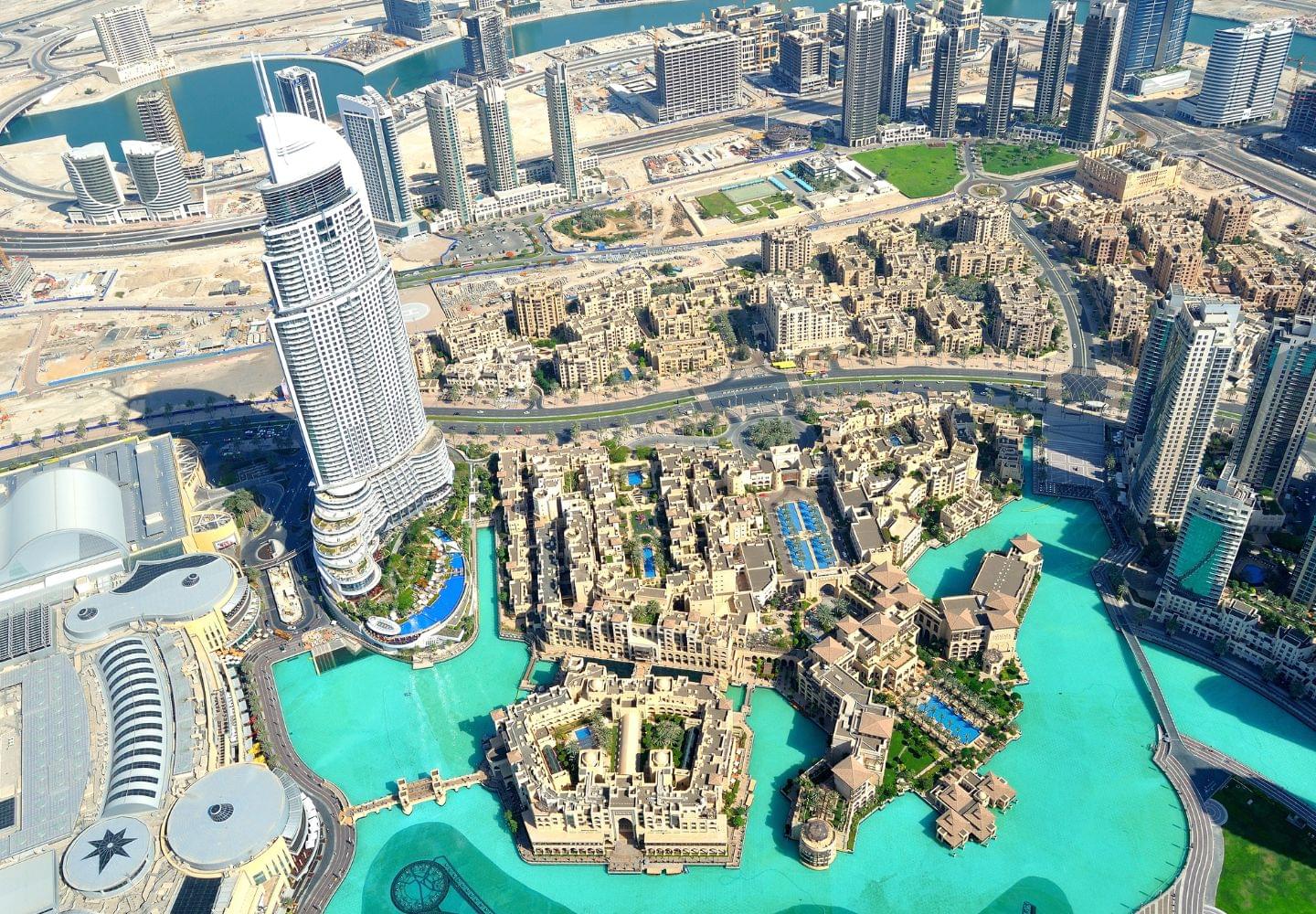
Two of the city’s biggest attractions sell in-water experiences and call it snorkeling.
Dubai Aquarium & Underwater Zoo is on the ground floor of the Dubai Mall: a 10-million-liter tank, more than 140 species, over 300 sharks and rays, and a 48-meter acrylic tunnel eleven meters down.
Its cage lowers up to four people into that tank. AED 370, minimum age eight, no experience required, not available to pregnant guests, run for the aquarium by Al Boom Diving.
There is no online checkout (book by phone or email through the dive operator) and no published duration, so ask. General admission starts at AED 199.
You are not swimming with the sharks; you are in a box among them.
Atlantis, The Palm is where the naming changed and most guides have not caught up: the Lost Chambers Aquarium is now the Lost World Aquarium, and the old address redirects.
The Ultimate Snorkel runs over the Ambassador Lagoon, a ten-meter enclosed exhibit holding a stated 65,000 animals. AED 445 direct for twenty minutes on the surface, age six and up, with wetsuit, mask, snorkel, lifejacket, towel and same-day aquarium access.
Through Viator the same thing is about US$67, roughly AED 248. The aquarium day pass alone is AED 85. Aquaventure’s Shark Snorkel is AED 515 for twenty minutes over Shark Lagoon.
Deep Dive Dubai ranks first for this search and is not the sea either: a 60-meter, 14-million-liter freshwater pool, AED 400, for an experience its own page calls limited to the surface. Minimum age six, and you must be able to swim.
With children under ten, or anyone anxious in open water, the cage at AED 370 is the best of the four and cheap by this city’s standards.
For mask down, fins on, real water and fish that chose to be there, none of them is it. The drive east is.
Dubai’s own coast, and the reef being built under it
You can snorkel off Jumeirah Beach. Almost nobody should build a day around it.
Dubai has no natural coral reef. The coast is sand over silt, and twenty years of dredging for the offshore islands put much of it in the water column. Visibility runs five to fifteen meters, less with any wind.
An artificial reef sits in the shallows off Jumeirah — sunken concrete and placed rock, four or five meters down. Sergeant majors, butterflyfish, the occasional ray or moray. On a flat winter morning it is a pleasant twenty minutes.
What is coming is more interesting. Dubai Reef, launched in 2024, is sinking 20,000 purpose-built modules across 600 square kilometers, each engineered to last more than a century.
Around 3,660 were down by mid-2025, colonized already by 15 fish and 17 invertebrate species, with a projected 10% biodiversity gain and up to eightfold more fish biomass. A fisheries program, for fish stocks, not snorkelers.
On water quality: raw sewage in the storm drains closed Jumeirah Beach in 2008–09. All twelve are now sampled at the Dubai Central Laboratory, and E. coli was within limits when the issue resurfaced in 2019.
208 sewage tankers were fined and illegal dumping now costs AED 100,000. Nothing comparable since.
What Dubai’s beaches are genuinely good for is the hours. Three are lit and lifeguarded for night swimming — Jumeirah 2, Jumeirah 3 and Umm Suqeim 1, 800 meters in all, sunset to sunrise, with electronic safety screens.
Stay in the marked zones after dark. June to September, it is the only sensible time to be in this water.
The rules that decide your day
Swimwear is for the beach, the pool and the water park, and nowhere else. Nothing transparent or indecently revealing, and no nudity of any kind, including topless sunbathing.5
Public indecency carries a fine of AED 1,000 to AED 100,000 under the federal penal code.6 Ordinary swimwear is unremarkable on Dubai’s beaches; cover up the moment you leave the sand.
Sharjah is stricter, and you drive through it. Its decency rules, issued in June 2001, ask for conservative swimwear on the beach and bar it from the street altogether. Khor Fakkan and Sira Island are Sharjah.
So is the alcohol rule: drinking or possessing alcohol is illegal in Sharjah, while the Al Aqah resorts in Fujairah are licensed.7 Do not carry a bottle across the emirate line.
Your camera is a legal object here. Photographing people without consent is a criminal offense, fines reported at AED 150,000 to AED 500,000, and men have been arrested for photographing women on beaches.7 Point it at the water.
Ramadan changes less than you have been told. Ramadan 1448 is expected to begin Monday 8 February 2027, with Eid al-Fitr on 9 or 10 March, both subject to the moon sighting.
You are not required to fast. Restaurants run as normal, there are no restrictions on eating or drinking in public for non-fasters, the beaches are open, and beachwear is fine at hotel beaches and pools.
The old offense of eating in public during daylight was not carried into the 2021 penal code. What changes is tempo: shorter hours, a quieter city by day. February and March are the best snorkeling months, so plan around it.
Dubai’s public safety law took effect on 1 June 2026 and covers beaches and pools, with penalties from AED 500 to AED 1,000,000, doubled for a repeat within a year.8 Swim at permitted times, in marked zones.
Musandam, and whether it is worth the border
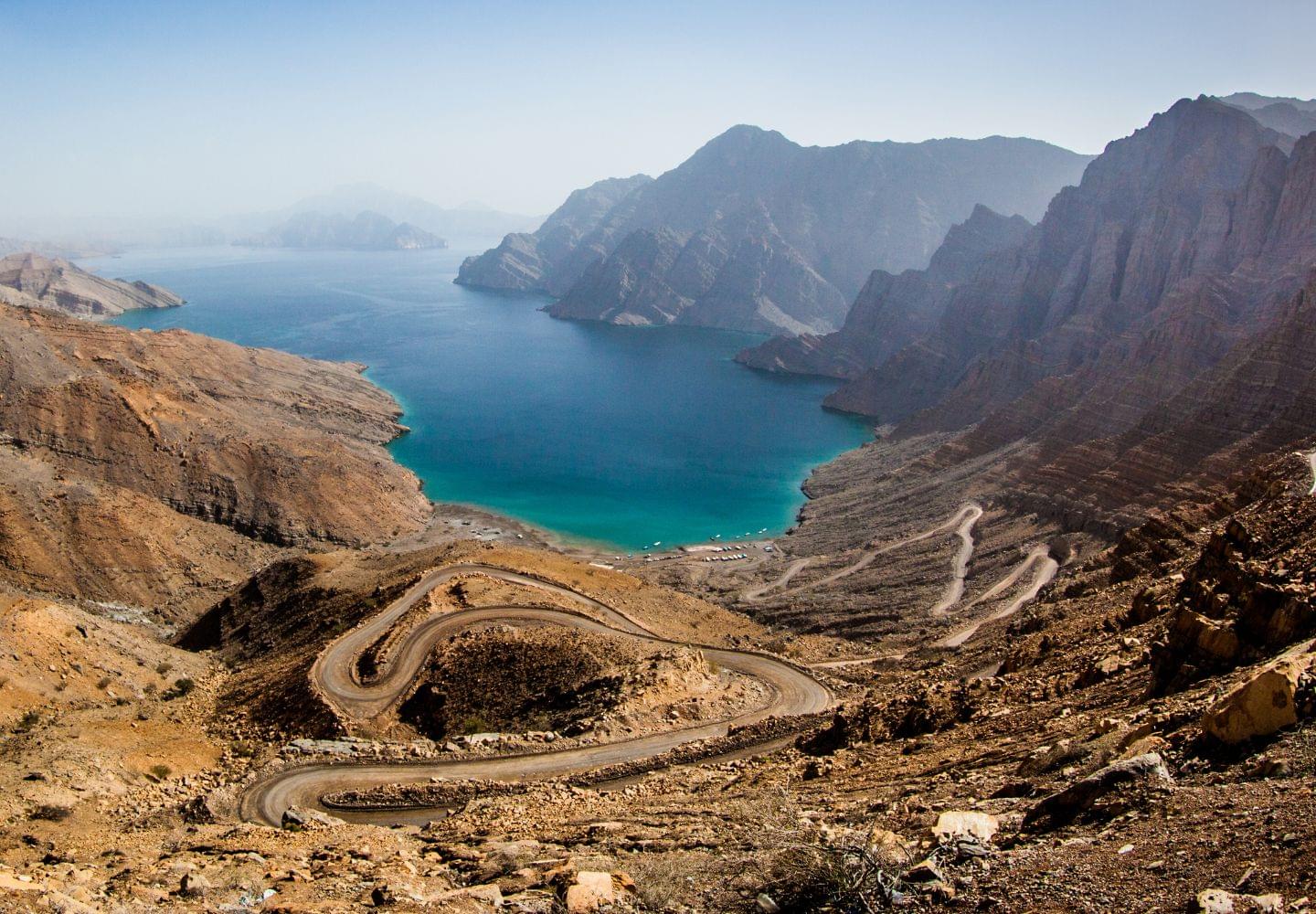
Oman’s Musandam peninsula holds the most beautiful water within reach of Dubai, and it is a scenery trip with snorkeling attached, not the reverse. Khor Ash Sham’s inlets are sheer, sheltered and quiet, the dhow anchors for a swim or two, and dolphins are a realistic hope.
Telegraph Island is the usual stop: a 1.1-hectare rock less than 400 meters offshore, built as a cable repeater station in 1864 and abandoned four years later.
The border is the whole question. Musandam is an exclave, cut off from the rest of Oman by the UAE, and there are two ways in.
Khasab, on the west coast, is three to three and a half hours via the Al Darah crossing out of Ras Al Khaimah. Border processing runs thirty to sixty minutes, far longer on a public holiday.
Dibba, on the east coast, is two to two and a half hours — and carries a trap. Your dhow or hotel booking must be filed with the UAE authorities at least 48 hours ahead, or you will be refused exit from the UAE. Not refused entry to Oman. Refused exit.
Which is why you book this through an operator.
UK, US, European, Australian, Canadian and Japanese citizens enter Oman visa-free for fourteen days, on a passport valid six months or more. There is an AED 35 UAE exit fee at the land border.9 A single-entry UAE visit visa is consumed by leaving overland.
Go for the fjords, not the coral: the reef claims for Telegraph Island do not survive checking. For snorkeling alone, Dibba Rock is closer and better.
When to go, and what to book
November to April, and February or March if you have the choice. February asks for a 2 mm shorty or a good rash guard on the Dubai side, a rash guard alone at Al Aqah.
What to wear snorkeling covers the rest. Best winter snorkeling destinations ranks the alternatives. Croatia is my own version of the same proposition: warm, enclosed and reef-poor, but with water you can see through and Roman masonry on the bottom. Snorkeling in Greece is the same trade in the Aegean. For living coral, Egypt’s Red Sea is one of the world’s best snorkeling regions.
The day trips east, in the order I would book them. Budget option: the full-day Fujairah snorkeling trip from Dubai, eight hours with hotel pickup from US$71.61, solving the drive, the gear and the guide in one purchase.
For a small group and a better boat, the Fujairah turtle snorkel with transfers runs eight hours from US$139. With your own car, the Snoopy Island snorkel and watersports day is nine hours from US$97.68 — though Al Boom’s AED 175 snorkel direct is better value.
For Musandam, the full-day Dibba dhow cruise from Dubai is the shorter border and the better day, from US$78 with pickup. Already in Khasab: the six-hour Khor Ash Sham dhow cruise, from US$50.
Where to sleep follows what you want. If the water is the trip, stop commuting to it: the Sandy Beach Hotel & Resort puts Snoopy Island outside the door, the Dibba boats forty minutes up the coast.
Le Méridien and the other Al Aqah resorts sit a kilometer or two from the same water. If Dubai is the trip, Atlantis, The Palm has the one genuine claim on this page: the Ambassador Lagoon is downstairs.
Bring your own mask whatever you book. Rented masks are the commonest reason a good day goes wrong.
Frequently asked questions
When is the best time to snorkel in Dubai?
November to April, and February or March above all. Most guides say spring and autumn, which is how people end up swimming in 34 °C water in May. February runs 22.0 °C on the Dubai side and 23.6 °C at Al Aqah: a 2 mm shorty for one, a rash guard for the other.
Can you snorkel at Jumeirah Beach?
You can. There is an artificial reef of sunken concrete in the shallows, sergeant majors and butterflyfish over it, and on a flat winter morning it is a pleasant twenty minutes. It is not a reason to pack a mask. The hours are the real draw: three of these beaches are lit and lifeguarded all night.
How far is Snoopy Island from Dubai, and do you need a boat?
You drive, then you swim out from the beach. No boat at any point. Al Aqah is 151 km from downtown Dubai, about two hours each way, and the island sits 200 meters offshore in seven meters of water. The beach belongs to the Sandy Beach Hotel and Resort, which sells a day pass from AED 105 for adults and AED 70 for children.
How much does it cost to snorkel with sharks in Dubai?
AED 370 for the cage at the Dubai Aquarium, minimum age eight, no experience needed. There is no online checkout; you book by phone or email through Al Boom Diving. Atlantis charges AED 445 for twenty minutes over the Ambassador Lagoon, or about US$67 through Viator. Both are tanks. Both are good days out with children.
Can I wear a bikini on the beach in Dubai?
On the beach, at the pool, in the water park: fine. Anywhere else it is an offense rather than a faux pas, and public indecency runs to AED 100,000. Two things catch snorkelers out. Sharjah asks for more coverage than Dubai does, and Khor Fakkan is Sharjah. And photographing people without their consent is a crime here, which a wide-angle camera on a busy beach commits constantly.
Do you need a visa for the Musandam day trip from Dubai?
You are crossing an international border, but the visa is not the hurdle: UK, US, European, Australian, Canadian and Japanese passports get fourteen days free, on six months' validity. The paperwork is the hurdle. Your booking must reach the UAE authorities 48 hours before you turn up at Dibba, or you will be refused exit from the UAE. Book through an operator. Carry AED 35 for the exit fee.
Sources
Footnotes
-
My own pull of NOAA Coral Reef Watch 5 km sea-surface temperature and Degree Heating Weeks, January 2023 to August 2026, via PacIOOS ERDDAP. ↩ ↩2
-
“Exposure-Related Injuries,” Divers Alert Network; competition range from Markey et al., J. Sci. Med. Sport 29(1) (2026). ↩ ↩2
-
Hume et al., “Symbiodinium thermophilum sp. nov.,” Scientific Reports 5:8562 (2015). ↩
-
Hadj-Hammou et al., “Bleaching Impacts on the Last Remaining Acropora-dominated Reefs in the United Arab Emirates,” Diversity 17(9):610 (2025). ↩ ↩2 ↩3 ↩4 ↩5
-
“Social responsibility,” The Official Portal of the UAE Government. ↩
-
Federal Decree-Law No. 31 of 2021, Article 411. It repealed the 1987 law whose Article 313 created the Ramadan public-eating offense. ↩
-
Federal Decree-Law No. 34 of 2021, Article 44; penalties reported by Khaleej Times. Sharjah’s decency rules and alcohol ban: UK FCDO. ↩ ↩2
-
Dubai Law No. 2 of 2026, effective 1 June 2026, covering beaches and pools. ↩
-
“Entry Visas,” Ministry of Foreign Affairs, Oman; the AED 35 exit fee and the 48-hour Dibba booking rule. ↩

Rebecca Jambrovic — Snorkeling and kayaking guide
Rebecca lives next to the Adriatic Sea in Croatia, where she guides kayaking, stand up paddleboarding, and snorkeling tours. She is passionate about outdoor activities and enjoys writing pieces that inspire others to get outside.