Snorkeling
Snorkeling in Belize: which cayes, which boat, what it costs
Belize has almost no beach snorkeling — it has a boat schedule. What Hol Chan charges, why the Blue Hole is not a snorkeling site, and what bleaching left.
We earn a commission on purchases made through links on this page, at no extra cost to you. It never affects which products we recommend.
On this page
- What the reef is actually like now
- Where these places actually are
- Hol Chan Marine Reserve
- Caye Caulker
- Lighthouse Reef, the Blue Hole and Half Moon Caye
- Turneffe Atoll
- Glover’s Reef Atoll
- Tobacco Caye and the South Water Caye Marine Reserve
- Placencia, Gladden Spit and the whale sharks
- When to go
- What to book, and in what order
- Where to stay
- Frequently asked questions
Belize does not really have beach snorkeling. It has a boat schedule.
That is the fact everything else follows from, and most guides bury it. The mainland coast is mangrove, river mouth and silt. The reef — the Belize section of the Mesoamerican Barrier Reef, the second-largest in the world, running more than 600 miles past Mexico, Belize, Guatemala and Honduras1 — sits several miles offshore, and the three atolls a good deal further out. So every decision here is an operations decision: which island, which boat, how long the crossing, whose fee you are paying, and whether the day is worth the money.
Two things have also changed since most of what is written about Belize was written. The 2023–24 marine heatwave produced the worst coral bleaching the country has on record, and the numbers are now in. And Gladden Spit, sold for twenty years as the place to swim with whale sharks in the Caribbean, produced no sightings at all in 2024 and one in 2025. Both are below, because a page that leaves them out is selling a trip that is not on offer.
What the reef is actually like now
Healthy Reefs for Healthy People’s 2024 Mesoamerican Reef Report Card graded Belize’s reef poor, with a Reef Health Index of 2.5 out of 5 across 110 surveyed sites.2
The coral numbers behind that grade are worse than the headline. National live coral cover fell from 18 percent to 15 percent between 2022 and 2024, and Lisa Carne of Fragments of Hope — the group that has been planting corals in southern Belize since 2006 — calls 2024 “the worst bleaching event since we’ve been recording around 2008.” At Moho Caye, live coral cover collapsed from over 50 percent to under 5 percent. Stony coral tissue loss disease, which reached northern Belize in 2019, arrived at Laughing Bird Caye for the first time in May 2025.3
Two things stop that being the whole story.
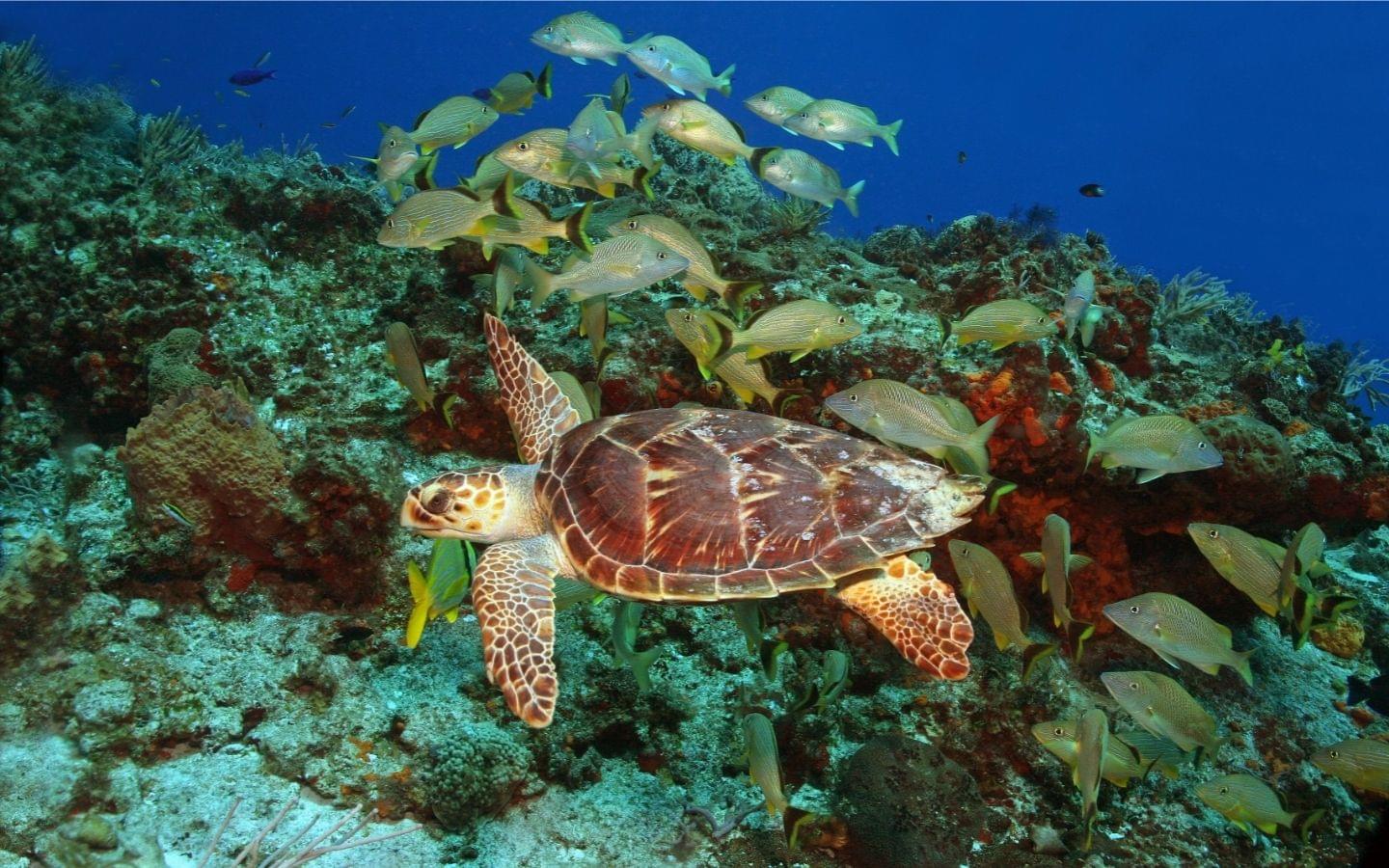
The fish came back. The 2024 report card is the first region-wide improvement in five years, and the reason is not coral — it is biomass. Fish populations rose, credited to enforcement inside the no-take zones; at Lighthouse Reef, commercial fish biomass went from 288 to 1,352 grams per 100 m² between surveys.4 Inside Hol Chan that is exactly what a visitor notices: a wall of grouper, snapper, jacks and parrotfish that does not exist outside the reserve boundary.
And one atoll went the other way. Turneffe’s coral cover rose from 15 to 17 percent between 2021 and 2023 — the only Belizean reef complex in the report card moving in that direction.4
So: Belize is no longer a coral destination and is still an outstanding fish destination. Go for the density of life inside the protected zones, the channel structure, the sharks and rays. Do not go expecting the coral gardens in the 2015 photographs — they are not there, and any page still promising you “healthy elkhorn” has not looked.
Where these places actually are
Belize’s snorkel sites are run by four different bodies on four fee regimes, and they are much further apart than the map suggests:
| Site | Go from | Crossing | Fee, and who charges it | Guide |
|---|---|---|---|---|
| Hol Chan Marine Reserve (incl. Shark Ray Alley, Mexico Rocks) | San Pedro, Caye Caulker, Belize City | 15 min – 1 h | US$15 pp/day, Hol Chan Marine Reserve | Compulsory |
| Caye Caulker Marine Reserve (Coral Gardens, Shark Ray Alley) | Caye Caulker | 10–20 min | Normally inside the tour price | Yes, in practice |
| The Split, Caye Caulker | Walk | — | None | No |
| Lighthouse Reef / Blue Hole / Half Moon Caye | San Pedro, Caye Caulker, Hopkins, Placencia | 2–3 h | BZ$20/day, Belize Audubon Society (Half Moon Caye) | With the boat |
| Turneffe Atoll | Belize City, San Pedro | ~1.5 h | Reserve fee, collected by TASA | With the boat |
| Glover’s Reef Atoll | Sittee River Marina, Hopkins | ~2 h | Inside the resort package | With the resort |
| Tobacco Caye / South Water Caye Marine Reserve | Dangriga | ~45 min | US$5/day, Belize Fisheries | Not needed — swim from the sand |
| Gladden Spit & Silk Cayes | Placencia | ~1 h | Inside the tour price | Licensed operators only |
The pattern that falls out of it: the northern cayes are for reef in the morning and a town in the afternoon; the atolls and the southern cayes are for giving the water a whole trip rather than a morning.
Hol Chan Marine Reserve
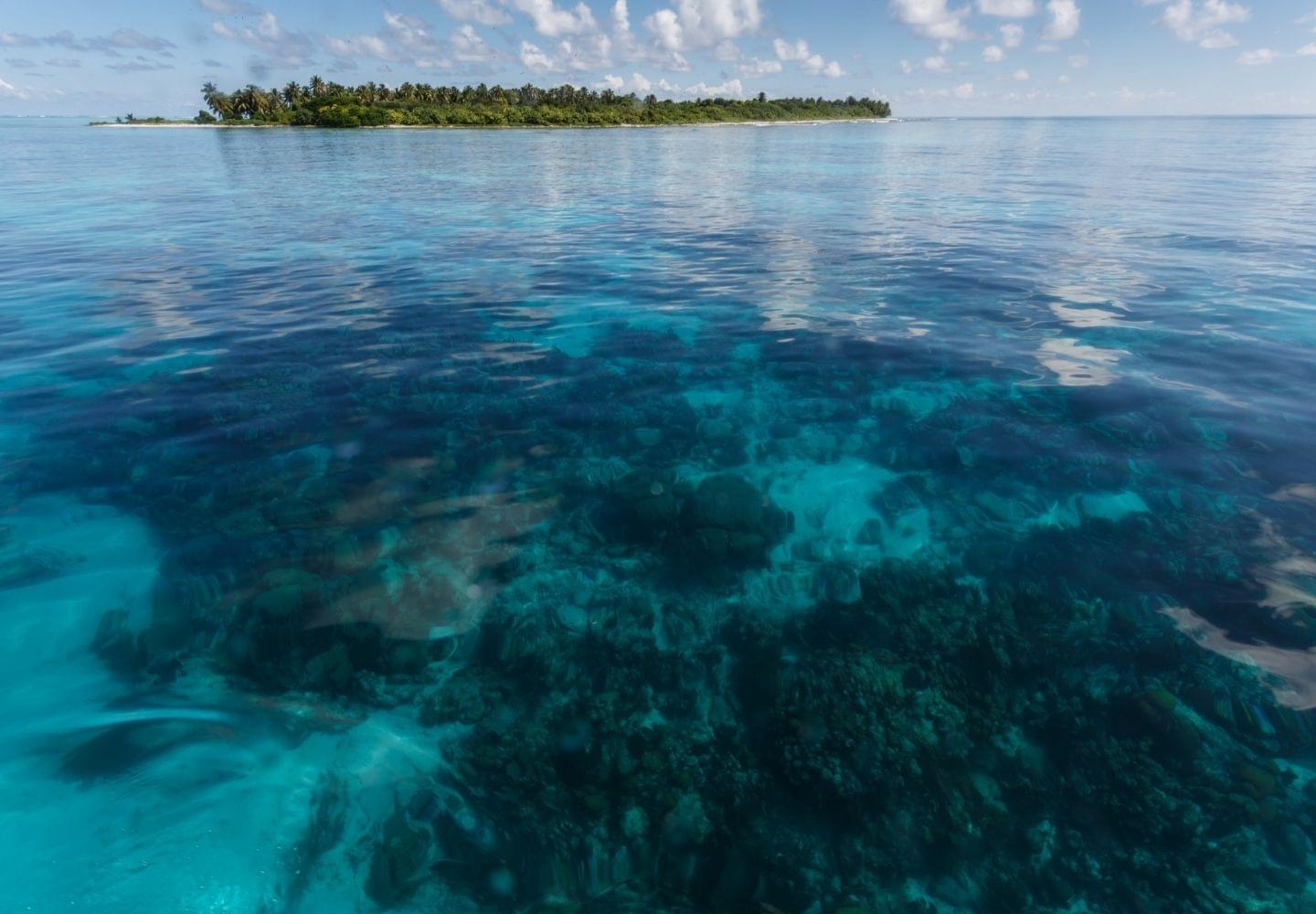
Hol Chan is the reason most people snorkel in Belize, and it is bigger and more regulated than nearly every guide to it says. Belize’s first marine protected area, declared in 1987, it now covers 102,400 acres across eight zones — up from four after the expansion that brought in Bajos, Cayo Frances and both Mexico Rocks zones.5 If you have read that Mexico Rocks and Tres Cocos are a separate trip, that was true once and is not now: Mexico Rocks is Zones G and H of the reserve, under the same rules and the same fee.
Three rules decide whether your plan works.
You cannot go in without a guide. This is not a site you can kayak to and jump off. Visitors register with the reserve and enter with a licensed operator.6 There is no self-guided option.
A guide may take eight snorkelers. That is the reserve’s own cap5 — the difference between two guides and sixteen people, and one guide and twenty-four. Only one of those is legal.
The park fee is US$15 per person per day, and it may not be in your tour price. The reserve raised it from US$10 on 1 August 2024, after agreeing the increase with the operator, guide and sport fishing associations.7 Plenty of listings — some written in 2026 — still quote $10, and Ambergris Divers in San Pedro prices its half-day at US$55 and lists the $15 as not included.8 Ask, and carry cash.
Zone A — the Cut
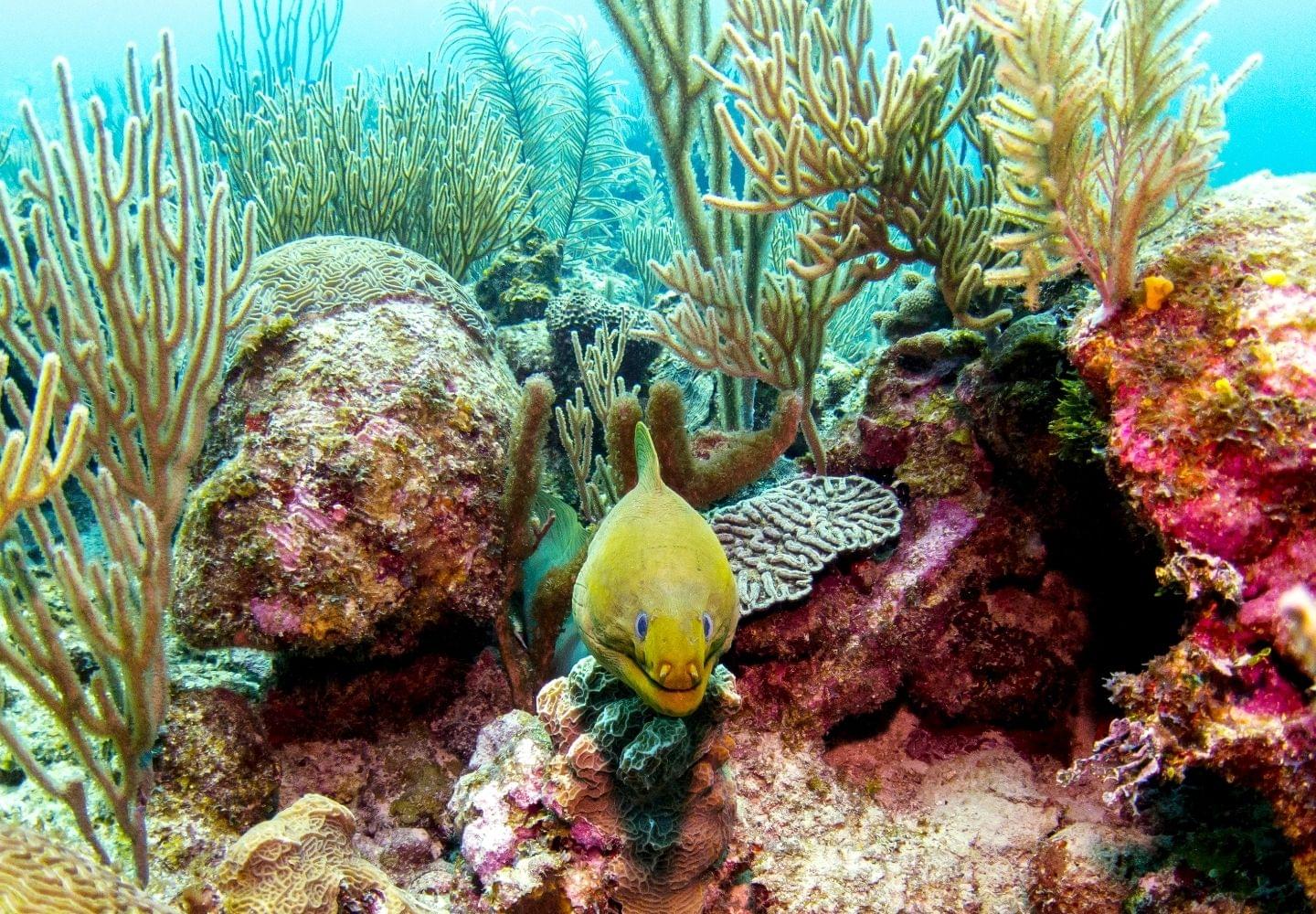
“Hol Chan” is Yucatec Maya for “little channel,” and Zone A is that channel: a 30-foot-deep cut through the barrier reef about four miles south of San Pedro, reef wall rising on both sides. It is the best piece of underwater structure a snorkeler can easily reach in Belize. No fishing and no fish feeding are permitted here,5 and the effect of nearly forty years of that is a fish population that does not behave like a fished one — big groupers that do not move when you approach, horse-eye jacks stacked in the channel, green morays in the ledges, turtles on the seagrass either side.
Current runs through the cut with the tide, which is why guides work it one way and pick you up at the other end. Not difficult water, but not still water either, and if you are a nervous swimmer this is the site to wear a vest for.
Zone D — Shark Ray Alley
The nurse sharks and southern stingrays at Shark Ray Alley are real and there are a lot of them, and it is worth being clear about why. The site began as a place where fishermen cleaned their catch, and the aggregation is maintained by feeding: guided fish feeding is still permitted inside Zone D, and scuba is not allowed in the exclusive recreational area.5
That does not make it a bad stop — swimming in three meters of clear water surrounded by two-meter nurse sharks is remarkable. It does mean this is a wildlife encounter with a hand on the scale, which is worth knowing before you decide whether it is the highlight or the bit you tolerate.
Zones G and H — Mexico Rocks
Mexico Rocks is a shallow patch reef field off the north of Ambergris Caye: coral heads in three to six meters of clear, calm water, and a much easier introduction than the channel. Zone H is no-take; Zone G allows regulated use but no spearfishing or nets.5 If you are bringing children or anybody new to a mask, this is the better first stop, and most operators will run it if you ask.
Is the standard combo worth it?
The default Ambergris product is Hol Chan plus Shark Ray Alley in a half-day, around two and a half hours, leaving mid-morning.8 Yes — do it once, and take the morning departure, because the light in the channel is better and the boats are fewer. What is not worth it is doing it twice. Spend a second water day on Mexico Rocks and the north end, or on the crossing to Caye Caulker.
From San Pedro, this full-day sail to Hol Chan, Shark Ray Alley and Caye Caulker runs on a 40-foot sailboat and is the one to book if you would rather have a long day than two short ones. From Belize City, the standard is this Hol Chan and Shark Ray Alley half-day, and there is a wider list of Hol Chan operators if you want to compare boat sizes first.
Caye Caulker
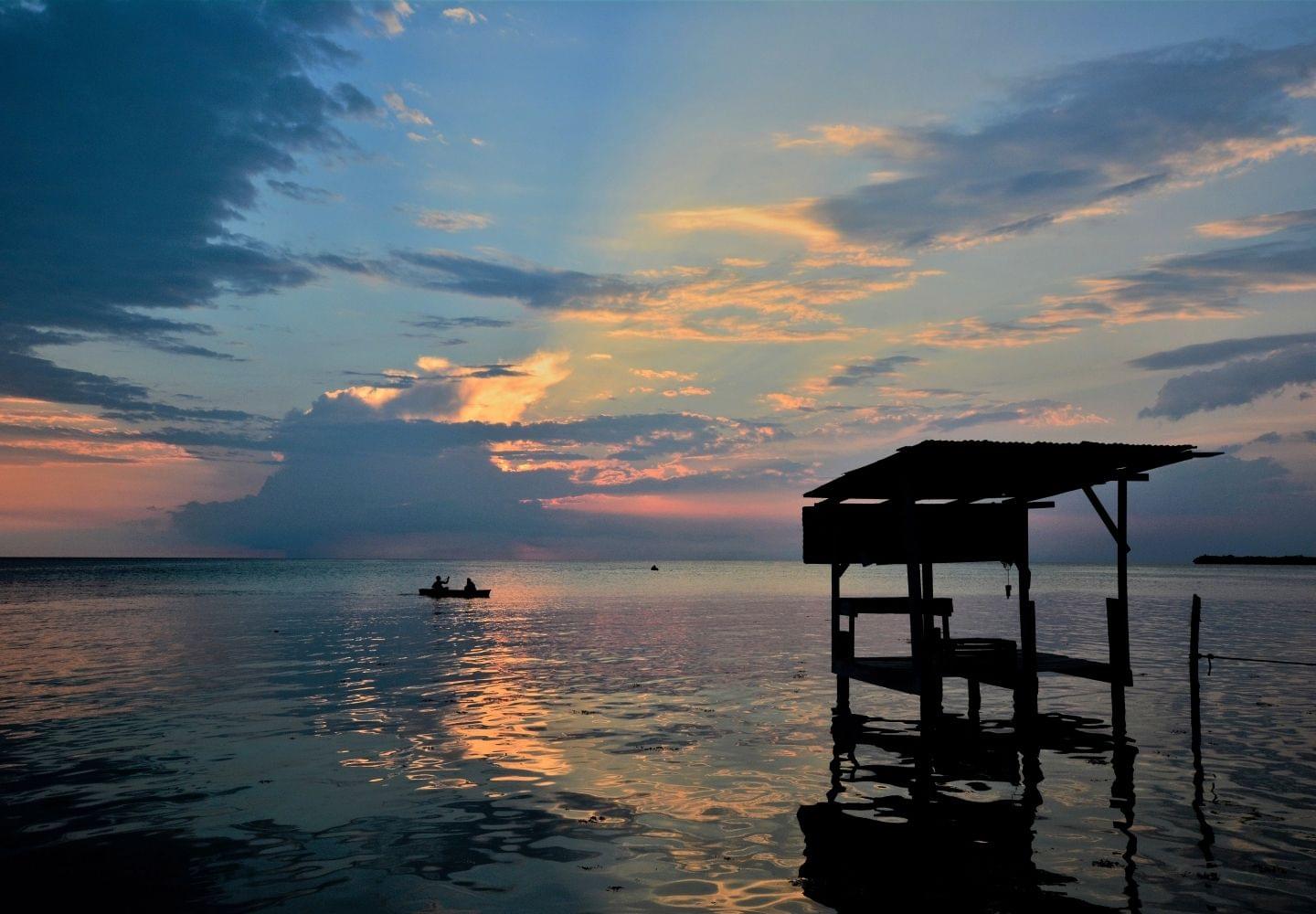
Caye Caulker is the cheaper, slower, better-value base of the two northern cayes, and it has its own marine reserve rather than borrowing Hol Chan’s. The water taxi is about 45 minutes from Belize City and 20 from San Pedro, so it works as a day trip as well as a base.
The reserve’s two stops are Coral Gardens, a shallow patch reef area that is the easiest snorkeling on the northern cayes, and Caye Caulker’s own Shark Ray Alley, a different site from the one inside Hol Chan and usually less crowded. Operators here quote marine park fees as included rather than charging them on the water, the reverse of San Pedro — confirm when you book. The Coral Gardens and Shark and Sting Ray Alley half-day from Belize City combines both with a beach stop; if you are staying on the island, this full day covering six sites inside Hol Chan gets you the most water for the money.
The Split, honestly
The Split — the channel that cuts the island in two, opened by Hurricane Hattie in 1961 — is the only place on Caye Caulker you can walk into the water with a mask, and it is routinely recommended as the island’s shore-snorkeling site. It should be recommended more carefully.
What is there: ladders and the Lazy Lizard pier for easy entry, a channel 20 to 26 feet deep against flats of two to four feet, checkered puffers, sergeant majors, foureye butterflyfish and juvenile southern stingrays over the sand. Snorkeling Report rates it three out of five and marks it intermediate, warning that many boats cross the pass and that if the current is strong you should not cross the channel at all.9 Frommer’s is blunter: it is an active boat channel, at least one swimmer has been killed by a boat here, and the tidal current can overpower a child or a weak swimmer.10 The barrier reef is several hundred yards further out — you are snorkeling a channel, not a reef.
So: go, stay inside the roped swimming area and on the flats, and do not treat it as a substitute for a boat trip. If shore entry is what you actually want in Belize, the answer is further south.
Lighthouse Reef, the Blue Hole and Half Moon Caye
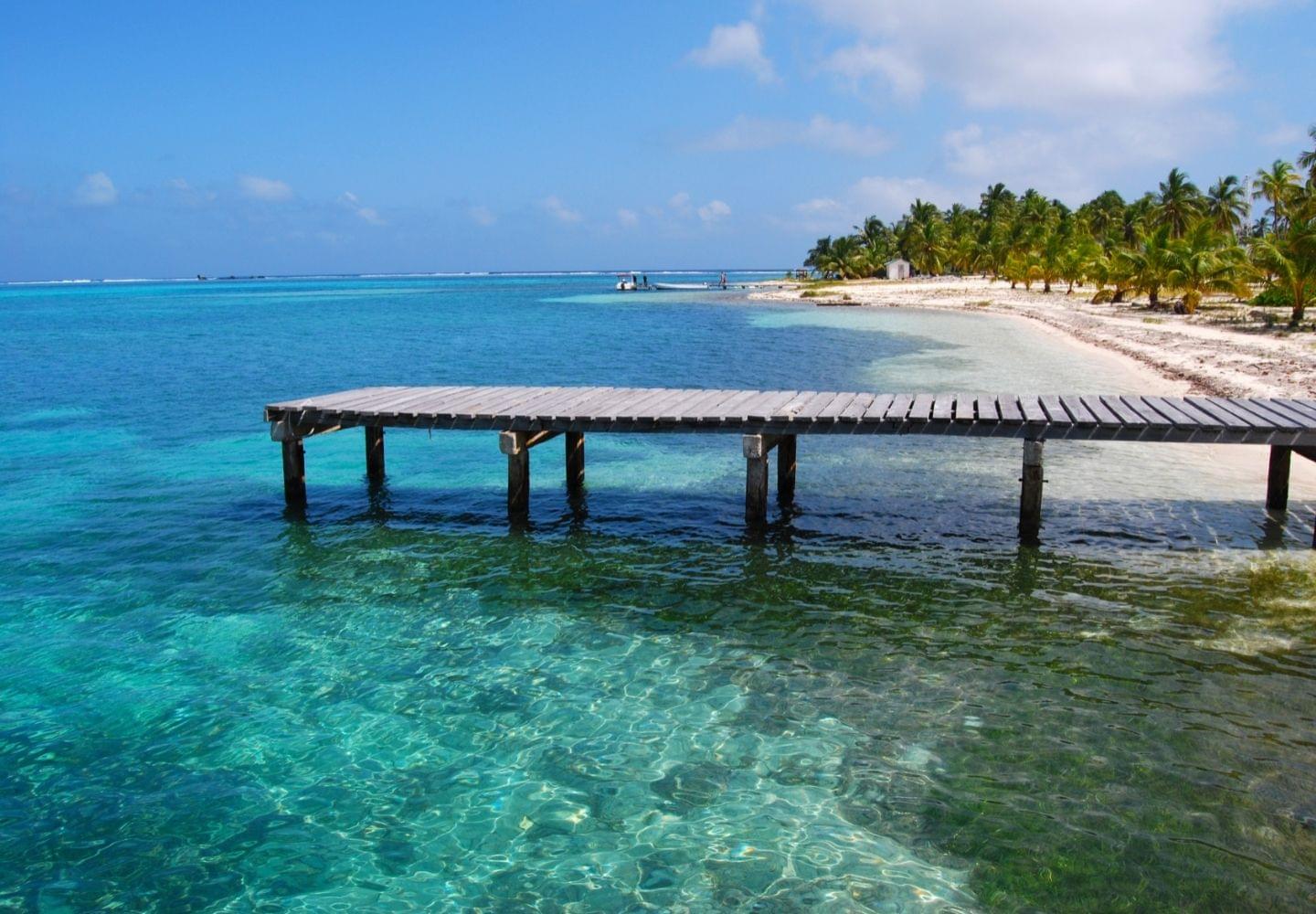
Here is the paragraph this page exists to write: do not book the Blue Hole for the snorkeling.
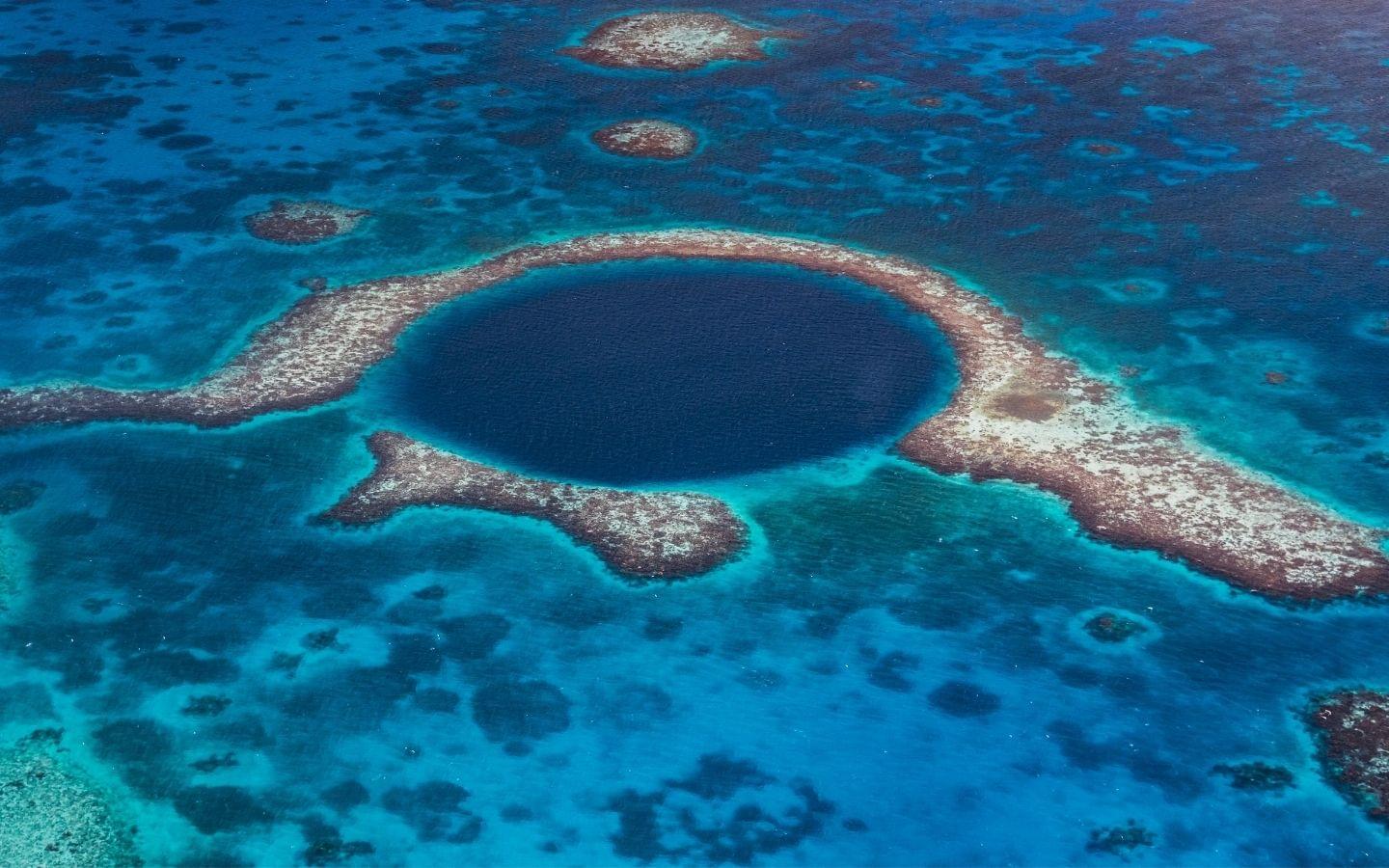
The Great Blue Hole is a collapsed limestone cave system 300 meters across and over 400 feet deep, and everything that makes it a famous dive site — the stalactites, the wall, the reef sharks on the thermocline — is a hundred feet below the deepest breath you will take on a snorkel. From the surface it holds very little reef and very little marine life, and at water level it looks like a slightly darker patch of sea.11 Spectacular from an aircraft, unremarkable from a mask, and two to three hours each way in open water.
What justifies the crossing is Half Moon Caye, at the southeastern corner of the atoll: a Belize Audubon Society natural monument with a visitor center where you register and pay BZ$20 a day as a non-national (BZ$2.50 for Belizeans), open 08:00 to 16:30.12 There is a red-footed booby colony on a boardwalk, a beach, and shallow reef right off it that suits every level. If your operator’s day is Blue Hole plus Half Moon Caye plus one more reef stop, the second and third stops are what you are paying for.
Long Caye, on the western side of the atoll, is the other name worth knowing. Its reef — sold as “The Aquarium” — has excellent visibility and enough current to suit confident swimmers rather than beginners.
Turneffe Atoll
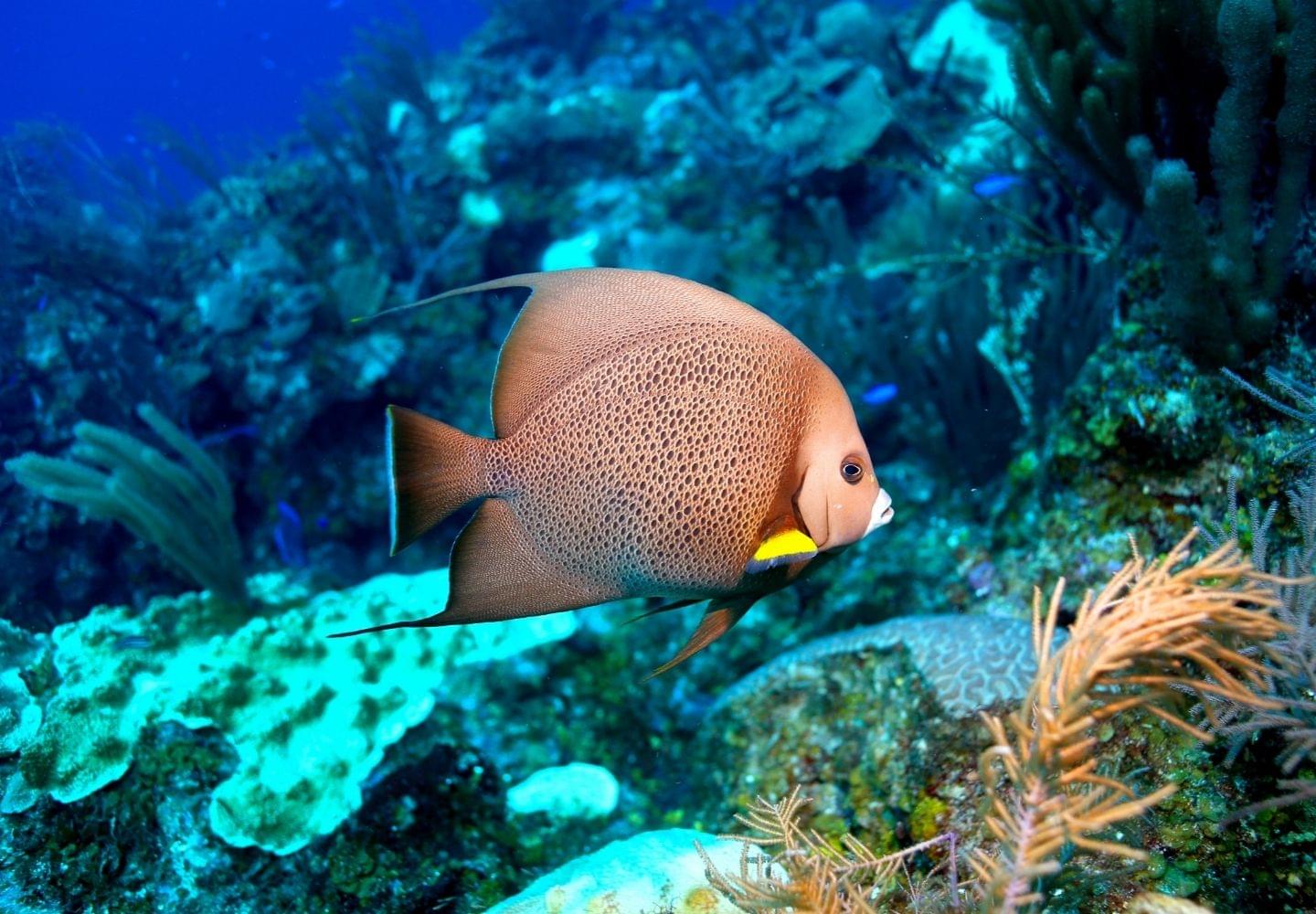
Turneffe is the largest coral atoll in the Caribbean, the closest of Belize’s three to the mainland at about 90 minutes by boat from Belize City, and — on the current evidence — the healthiest. It is the one Belizean reef complex whose coral cover went up in the last report card cycle, from 15 to 17 percent between 2021 and 2023.4 That makes it the atoll to choose if the state of the coral is what you care about, and it is under-sold against Lighthouse Reef only because it has no photogenic hole in the middle.
It is a mosaic of mangrove-fringed lagoons, flats and patch reef holding turtles, eagle rays, dolphins and — occasionally, in the lagoons — West Indian manatees. One country-wide rule: it is illegal to swim with manatees in Belize’s protected habitats, including the Swallow Caye Wildlife Sanctuary. Elsewhere, keep your distance and stay on the surface.
Glover’s Reef Atoll
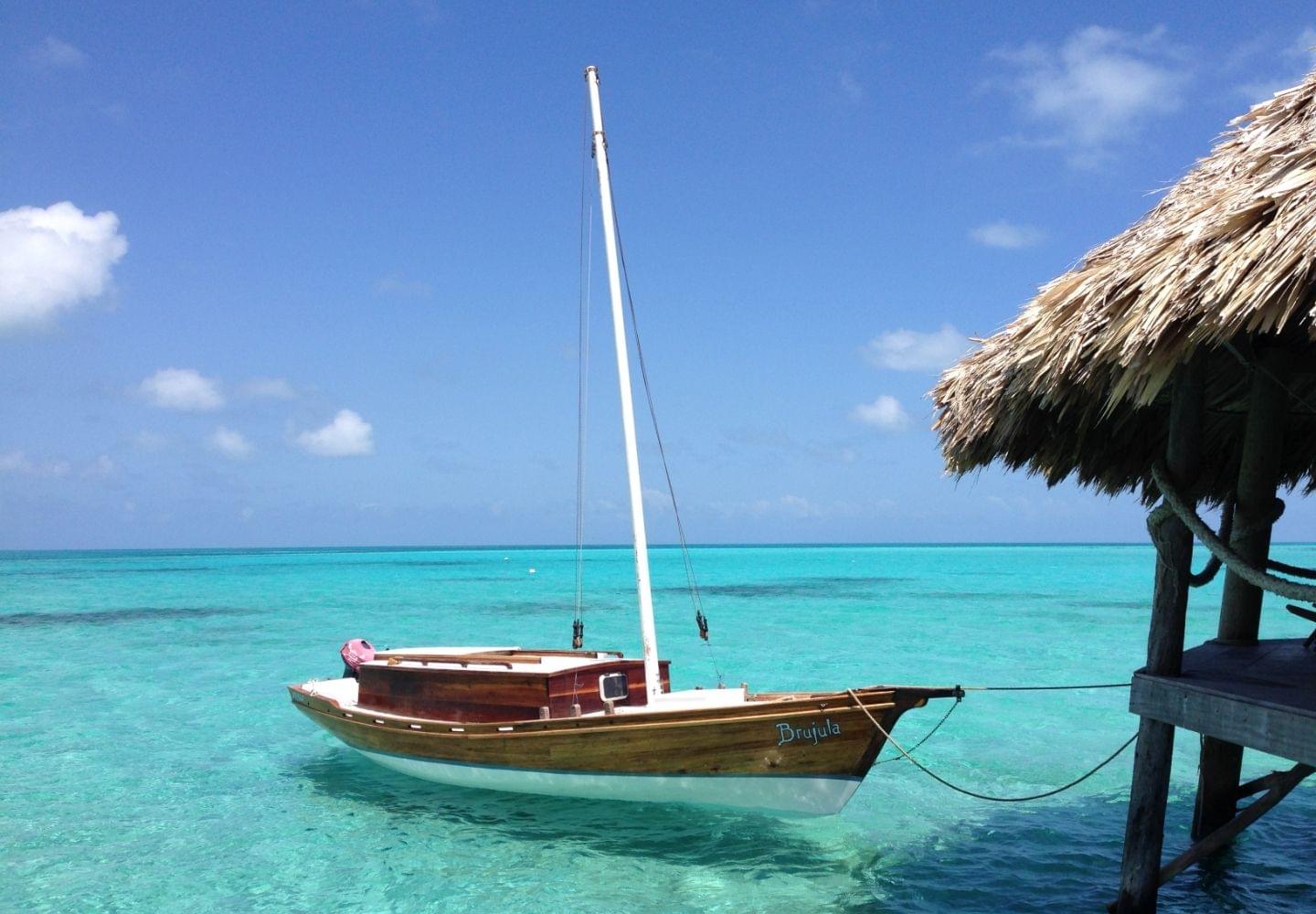
Glover’s is the furthest out and the most committing, and it works differently: you do not day-trip it, you stay on it. Its lagoon holds more than 700 patch reefs inside the ring — the highest concentration of shallow reef structure in Belize, and exactly what a snorkeler wants: findable coral heads in swimmable depths rather than a wall you can only look down at. Boats leave from Sittee River Marina near Hopkins, not Dangriga, about two hours out.
Off The Wall Dive Center & Resort, on Long Caye at the atoll, prices it as one number: US$2,500 per person for seven nights in the 2025–26 season including tax, with two guided tours a day.13 Not cheap, and a week with no restaurants, no roads and intermittent power — also the closest thing in the country to having a reef to yourself.
Tobacco Caye and the South Water Caye Marine Reserve
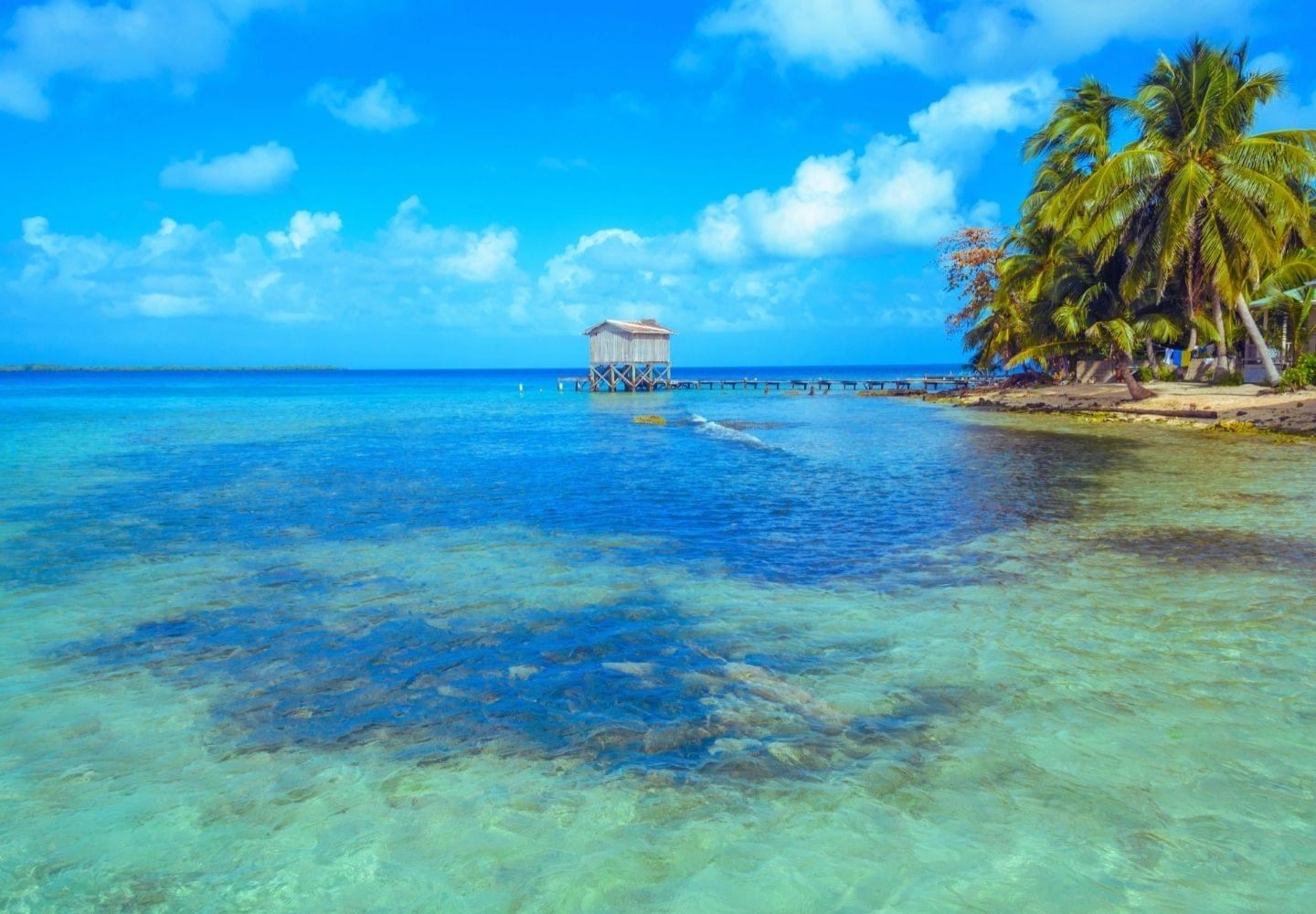
If you have read this far looking for the place in Belize where you can put a mask on and walk into the reef, this is it.
Tobacco Caye is a five-acre island sitting directly on the barrier reef at the northern end of the South Water Caye Marine Reserve, about 45 minutes by boat from Dangriga. The reef is not offshore from the caye; the caye is on the reef, with two to ten feet of water off the sand and the reef crest a short swim away.14 The reserve charges US$5 a day, collected on the island by Belize Fisheries officers, with discounted multi-day tickets14 — the cheapest marine park fee in the country and the only one that buys unlimited unsupervised access.
Accommodation is a handful of small family-run lodges, of which Tobacco Caye Paradise is the best known, with overwater cabanas you can drop off the deck of. Rustic means rustic, the transfer from Dangriga is informal and mostly runs in the morning, and hurricane season can strand or cancel it.
Placencia, Gladden Spit and the whale sharks
For twenty years the standard advice about southern Belize was to be in Placencia in April or May, around the full moon, and go out to Gladden Spit to swim with whale sharks drawn in by the cubera snapper spawning aggregation. It is still everywhere, and it should not be.
Ralph Capeling, who owns Splash Dive Center in Placencia and has run these trips for years, publishes the sighting record. In 2024 there were no whale shark sightings at all. In 2025 there was one, and none in May or June. Splash’s own site now states plainly that sightings “have become increasingly unpredictable, and most tours have not encountered whale sharks.”1516 The spawning aggregation still happens and access is still rationed among licensed operators on allocated time slots;15 the sharks have simply stopped reliably arriving, and this is no longer a bad-year story.
So do not build a Belize trip around whale sharks. Go if you are in Placencia in spring and want to anyway, knowing what you are buying: a full-day boat trip to a spawning aggregation where you will very likely see bull sharks, blacktips and dolphins working the bait, and where a whale shark would be a rare bonus.
What is worth planning from Placencia is the Silk Cayes, inside the same reserve: three tiny sand islands with shallow reef around them, reliable hawksbill, loggerhead and green turtles, nurse sharks, southern stingrays and eagle rays. A straightforward, excellent, unglamorous snorkel day that happens whether or not anything enormous shows up.
When to go
Come between late November and April. That is the dry season, it is outside the hurricane window, and it is the low point of the Sargassum year.
Sargassum has quietly become the thing most likely to spoil a beach week here. 2025 was the most severe year Belize has recorded, and it is now reported in some quantity all year, heaviest roughly March to October; November to February is essentially clear on Caye Caulker, and June to August piles it onto the east-facing shores of both northern cayes.17 It affects the beaches far more than the offshore sites — a boat to Hol Chan is unbothered by it — but it decides how the rest of your week feels.
The rainy season runs June to November, with August to October carrying the highest storm risk. Rain reduces inshore visibility and can cancel a crossing; the atolls and southern cayes are the first trips called off. Water temperature is never the variable — around 77–78 °F November through March, rising to about 83–84 °F April to October,18 so a rash guard is for sun and stings rather than warmth.
What to book, and in what order
Pick your base before your sites. San Pedro for the widest choice of boats and the shortest run to Hol Chan; Caye Caulker for the same reef at lower prices; Placencia for the Silk Cayes; Hopkins or Dangriga for an atoll or Tobacco Caye.
Do Hol Chan once, in the morning, and ask whether the $15 is included. It is the best single half-day in the country, and the fee is what people get caught by.
Put the long crossings early. Lighthouse Reef, Turneffe and Gladden Spit are all weather-cancellable. Booked for your last morning, a cancellation is the end of it.
If you want to snorkel unsupervised, go to Tobacco Caye. Nowhere else in Belize will let you.
And if the Blue Hole matters to you, book the flight, not the boat. An hour in a small plane costs less than a day at sea and shows you the thing you came to see.
Where to stay
On Ambergris Caye, San Pedro puts you 15 minutes from Hol Chan and a short run from Mexico Rocks. Xanadu Island Resort, a mile south of town, includes bikes, kayaks and paddleboards and runs a tour desk for the reef trips.
On Caye Caulker, everything is walkable and the boats leave from the front street. Sea Dreams Hotel is at the quiet north end near the Split; Weezie’s Ocean Front sits on the eastern shore facing the reef, with free kayaks and paddleboards.
On the atolls you are buying a package rather than a room. Off The Wall covers Glover’s Reef; Huracan Diving Lodge on Long Caye is the only all-inclusive on Lighthouse Reef and puts you closer to Half Moon Caye than any day boat.
Wherever you stay, bring your own mask — rental gear on the day boats is rarely well fitted, and one that floods every four minutes ruins a morning. Our guide to what to wear snorkeling covers the rest, and if you are weighing Belize against its neighbors, Roatán is the same reef 200 miles south and the wider Caribbean guide puts both in context.
Frequently asked questions
Can you snorkel from the beach in Belize?
Barely, and planning around it will cost you the trip. Mainland Belize is mangrove, river mouth and silt, and the reef sits several miles offshore, so almost every worthwhile site is reached by boat. There are two real exceptions. Tobacco Caye, inside the South Water Caye Marine Reserve, sits directly on the barrier reef with two to ten feet of water off the sand, and you can swim to the reef from the shore (AwayGoWe). The atoll lodges on Glover's Reef and Lighthouse Reef put you in the same position. Everywhere else, budget for a boat.
How much is the Hol Chan Marine Reserve fee, and is it included in the tour?
The park fee is US$15 per person per day and has been since 1 August 2024, when the reserve raised it from US$10 (The San Pedro Sun). Whether it is inside your tour price depends entirely on the operator, and plenty of listings still quote the old figure. Ambergris Divers in San Pedro, for one, prices its half-day at US$55 and lists the park fee separately on top (Ambergris Divers). Ask before you book, and bring US dollars in cash — the rangers collect it on the water.
Is the Great Blue Hole worth doing as a snorkeler?
No. Book it as a scenic flight or skip it. The Blue Hole is a 400-foot sinkhole and everything that makes it famous is far below the range of a mask — from the surface it is a dark circle with very little reef and very little marine life in it, and it looks unremarkable at water level (Tropical Snorkeling). What justifies the two-to-three-hour crossing to Lighthouse Reef is Half Moon Caye, at the southeast corner of the atoll, which has genuinely good shallow reef, a red-footed booby colony and a Belize Audubon visitor center. Book the trip for that and treat the hole as the thing you passed on the way.
Is the Belize reef still worth seeing after the 2024 bleaching?
Yes, with your expectations adjusted. Healthy Reefs for Healthy People graded Belize's reef poor in its 2024 report card, with a Reef Health Index of 2.5 out of 5 across 110 surveyed sites, and national live coral cover fell from 18 percent to 15 percent between 2022 and 2024 after the worst bleaching event on record (Mongabay). What has held up much better is the fish. The same report card recorded the first region-wide improvement in five years, driven by rising fish biomass, and inside the no-take zones the density of grouper, snapper and parrotfish is the thing people actually remember about Hol Chan. Go for the fish and the structure, not for a coral garden.
When is the best time to snorkel in Belize?
Late November to April. That is the dry season, when the rain is not putting sediment into the water, the hurricane risk is over and — importantly now — the Sargassum is at its lowest. Sargassum has become the bigger nuisance of the two: 2025 was the most severe year Belize has recorded, and the heaviest arrivals now run from roughly March to October, while November to February is essentially clear (Belize Travel Insider). Water temperature is never the constraint. It sits around 77 to 78 °F from November through March and rises to about 83 to 84 °F between April and October (Coco Plum Cay).
Sources
Footnotes
-
“The Mesoamerican Reef.” The Nature Conservancy. Reef extent and the four countries it crosses. ↩
-
“Mesoamerican Report Card 2024.” GCRMN, 8 November 2024, on the Healthy Reefs for Healthy People 2024 report card. Belize’s poor grade, the 2.5/5 Reef Health Index across 110 sites, and the first region-wide improvement in five years. ↩
-
“Restoration, protection aim to save Belize’s coral reef from extreme heat and disease.” Mongabay, July 2025. National live coral cover 18% to 15% between 2022 and 2024; Lisa Carne of Fragments of Hope on 2024 being the worst bleaching since records began around 2008; Moho Caye’s collapse from over 50% to under 5%; SCTLD reaching Laughing Bird Caye in May 2025. ↩
-
“From Data to Action: What the 2024 Healthy Reefs Report Card Means for Belize.” University of Belize Environmental Research Institute. Turneffe Atoll coral cover 15% to 17% between 2021 and 2023; Lighthouse Reef commercial fish biomass 288 to 1,352 g/100 m². ↩ ↩2 ↩3
-
“Hol Chan Marine Reserve.” Belize Fisheries Department. Reserve area of 102,400 acres, the expansion from four zones to eight, the definitions of Zones A, D, G and H, the registration requirement, and the cap of eight divers or snorkelers per guide. ↩ ↩2 ↩3 ↩4 ↩5
-
“Hol Chan Marine Reserve: Ultimate Guide to Belize’s Underwater Paradise.” Sandy Point Resorts, 7 March 2025. That the reserve cannot be visited without a tour guide. ↩
-
“New park fee goes into effect at Hol Chan Marine Reserve.” The San Pedro Sun, 1 August 2024. The increase to US$15 per person and the consultation with the operator, guide and sport fishing associations. ↩
-
“Snorkeling Hol Chan & Shark Ray Alley Marine Reserve, half-day.” Ambergris Divers. US$55 per person with the US$15 park fee listed as not included; 2.5-hour duration and 09:00 departure. ↩ ↩2
-
“Snorkeling The Split, Caye Caulker.” Snorkeling Report. Ladder entry, channel depth of 20–26 ft against 2–4 ft flats, species, the warning about boat traffic and current, and the three-star intermediate rating. ↩
-
“Things to Do in Caye Caulker.” Frommer’s. Boat traffic through the Split, the swimmer killed by a boat, and the strength of the tidal current. ↩
-
“Blue Hole Snorkeling Is Not So Special.” Tropical Snorkeling. What a snorkeler sees at the surface of the Blue Hole, and why the reef sites nearer the cayes are the better use of the day. ↩
-
“Half Moon Caye Natural Monument.” Belize Audubon Society. BZ$20 per day for non-nationals and BZ$2.50 for nationals, opening hours of 08:00–16:30, the visitor center and facilities, and the 55-mile distance from Belize City. ↩
-
“Rates.” Off The Wall Belize. US$2,500 per person for seven nights including tax in the 2025–26 season, departures from Sittee River Marina in Hopkins, two guided tours a day, and the 700-plus patch reefs inside the lagoon. ↩
-
“Tobacco Caye, Belize: The Ultimate First-Hand Guide.” AwayGoWe, updated October 2025. The US$5 daily South Water Caye Marine Reserve fee collected on the caye by fisheries officers, the 2–10 ft water off the island, and the 45-minute boat transfer from Dangriga. ↩ ↩2
-
“Whale Sharks at Gladden Spit.” Splash Dive Center. That sightings “have become increasingly unpredictable, and most tours have not encountered whale sharks,” and that the authorities allocate time slots among licensed operators. ↩ ↩2
-
Ralph Capeling, owner of Splash Dive Center, Placencia, in ScubaBoard, “Whale Sharks 2026”. The sighting record: none in 2024, one in 2025, and none in May or June. ↩
-
“Belize Sargassum Season: When and Seaweed Map.” Belize Travel Insider. 2025 as the most severe year recorded, the March–October peak, and the clear November–February window on Caye Caulker. ↩
-
“Belize Diving FAQ.” Coco Plum Cay. Sea temperatures of 77–78 °F November to March and 83–84 °F April to October. ↩
Nick Brisson — Co-founder, OutsiderView
Nick was born in Florida and grew up in Puerto Rico. He spent over ten years in Key West working in the boat charter industry, put four to five years into snorkeling and spearfishing the Florida Keys reef, and lives in Jacksonville Beach now, where he surfs year-round.