Snorkeling
Best snorkeling in the Virgin Islands: USVI or BVI, and when
Two countries, two sets of fees, two kinds of water. Which islands you can walk into the sea on, which need a boat, what the reefs are like now, and the month to come.
We earn a commission on purchases made through links on this page, at no extra cost to you. It never affects which products we recommend.
On this page
- USVI or BVI: the decision that comes first
- What the reefs are actually like now
- St John: the national park, and the only fee you will pay
- St Thomas: two shore entries and a lot of boats
- St Croix: the third island, and why it is a separate trip
- The BVI: everything is a boat, and here is what that costs
- Anegada: the reef everyone names and nobody snorkels
- When to go
- What to book, and where to stay
- Frequently asked questions
One shallow bank, five main islands, dozens of cays, and a national border straight through the middle of it. The Virgin Islands look like one destination and behave like two.
The US Virgin Islands is where you walk into the sea. The British Virgin Islands is where you get on a boat.
I spent over ten years running charter operations out of Key West. That job stops you asking which reef is best and starts you asking who is taking you there, what they are allowed to tie up to, when the boat leaves the dock, and how much of the ticket was never the operator’s to keep. Same questions here. Different answers on each side of the line.
USVI or BVI: the decision that comes first
| US Virgin Islands | British Virgin Islands | |
|---|---|---|
| Status | US territory — no passport from the US mainland | British Overseas Territory. Passport, always |
| Arrival cost | None | US$10 environmental and tourism levy, air or sea1 |
| Leaving | None | US$20 per person by ferry, US$50 by air1 |
| Paperwork | None | Online embarkation card, mandatory since 1 January 20251 |
| Currency | US dollar | US dollar |
| Main islands | St Thomas, St John, St Croix | Tortola, Virgin Gorda, Jost Van Dyke, Anegada |
| How you snorkel | Mostly shore entries, rental car or taxi | Almost entirely by boat |
| What it costs at the water | US$5 once, at Trunk Bay | Nothing at the reef. The boat is the cost |
The crossing is under an hour, Red Hook or Charlotte Amalie to West End or Road Town, and it gets sold as a day trip. Do the arithmetic first. The levy and the departure fee are US$30 a head before the boat ticket — US$120 for a family of four, spent on paperwork.1
One week, most days in the water: stay on St John. Cross for the caves, the rock formations and the wreck, and buy a boat day each time.
What the reefs are actually like now
Three things have happened to this water since 2017. All of them matter more than which beach you pick.
Irma and Maria, September 2017. Irma’s eyewall crossed Tortola, Virgin Gorda, St Thomas and St John on 6 September as a category five; Maria passed St Croix a fortnight later. Nine years on, the National Park Service still says that “coral diseases and hurricanes have significantly impacted Buck Island’s reef system.”
Stony coral tissue loss disease. It reached south-western St Thomas in January 2019 and is now on every reef in the territory; at Flat Cay more than half the living coral died.2 Reefs here rated fair in 2020, before the worst of it. Slower than a hurricane, and it has taken more coral.
Three years of heat. Degree heating weeks measure accumulated thermal stress. Past 12, mixed-species die-off is likely; past 16, more than half of corals die; past 20, the loss runs beyond 80%. All seven satellite cells over these islands peaked between 16.30 and 17.24 in 2023, and between 19.62 and 21.15 in 2024.3
Six of the seven crossed 20 on the 9th and 10th of November 2024. One week, two countries, the whole archipelago at the top of the chart. 2025 came in at half that, and every cell has taken zero heat stress in 2026, the first uninterrupted year since 2022.3
None of that empties the water. Turtles at Maho, schooling fish in the Norman Island caves, the pinnacles at The Indians, wreck steel off Salt Island: all still there, and none of it bleaches. Go for the animals and the geology. Coral cover is a bonus now, not a reason to fly.
St John: the national park, and the only fee you will pay
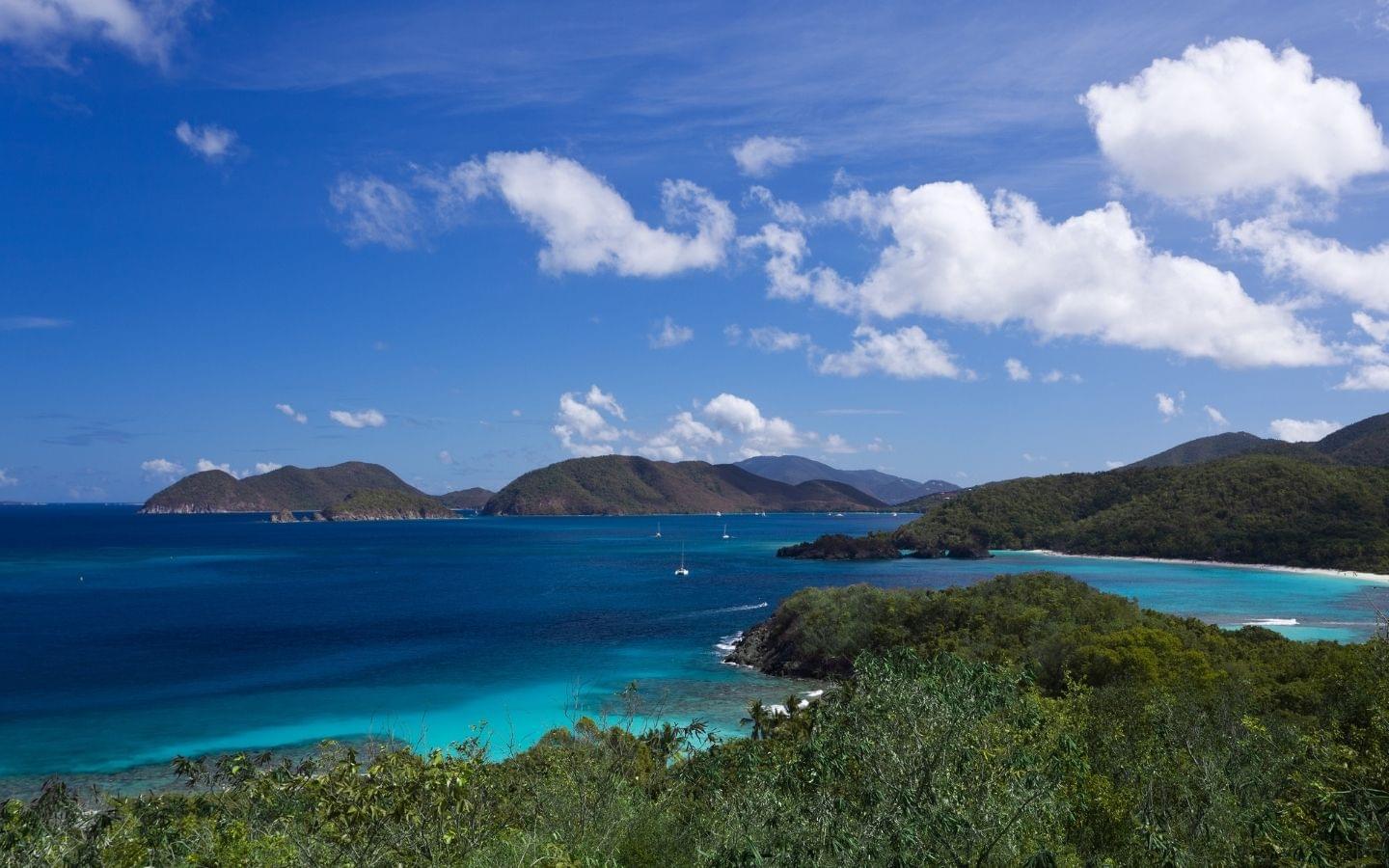
Most of St John is national park, and the park is free. One beach charges. Trunk Bay wants US$5 per person aged 16 and over, US$2.50 with an Interagency Senior or Access pass, paid at the booth or on recreation.gov.
Five dollars is the entire cost of snorkeling this island. It is why I send anyone with a week and a rental car here, not to St Thomas.
The trail is what you are paying for: 300 feet along the west side of Trunk Bay Cay, then back to the beach, with submerged plaques naming what you float over. In the water since 1962, and the plaques read like it. Facilities run 08:00 to 16:00, and there are no lifeguards.
Eleven snorkeling sites sit inside the park: Salomon and Honeymoon, Hawksnest, Trunk, Cinnamon, Maho, Francis, Leinster Bay and Waterlemon Cay, Brown Bay, Salt Pond, the Lameshur bays and the Haulover bays. Five are worth your week.
- Waterlemon Cay, east end of Leinster Bay. Shallow coral heads, then a steep drop-off, and the island’s best snorkeling once you are past the beginner’s trail. Ten minutes on foot from the Annaberg parking area. Strong current on the north, Tortola side; stay south of it. Rock and urchins underfoot, and the park spells it Waterlemon, not Watermelon.
- Maho Bay, the turtle beach. Seagrass rather than reef, and they graze early and late.
- Francis Bay is the calmest water in the park, running west to Little Maho. Put a nervous snorkeler here first.
- Salt Pond Bay — half a mile on foot from the parking area, rocky shoreline, turtles in the grass beds.
- Great and Little Lameshur, five miles out from Coral Bay, with the good water off Yawzi Point. The access road wants four-wheel drive.
Salomon and Honeymoon Bay heads that list, two beaches side by side, a short hike in from the North Shore Road sign or from Cruz Bay on the Lind Point Trail.
The commercial layer around it has gone. Virgin Islands EcoTours no longer sells the Honeymoon day pass or the kayak tours that fed it, and runs turtle kayaking on the north shore now. Walk in, bring water, it costs nothing.
St Thomas: two shore entries and a lot of boats
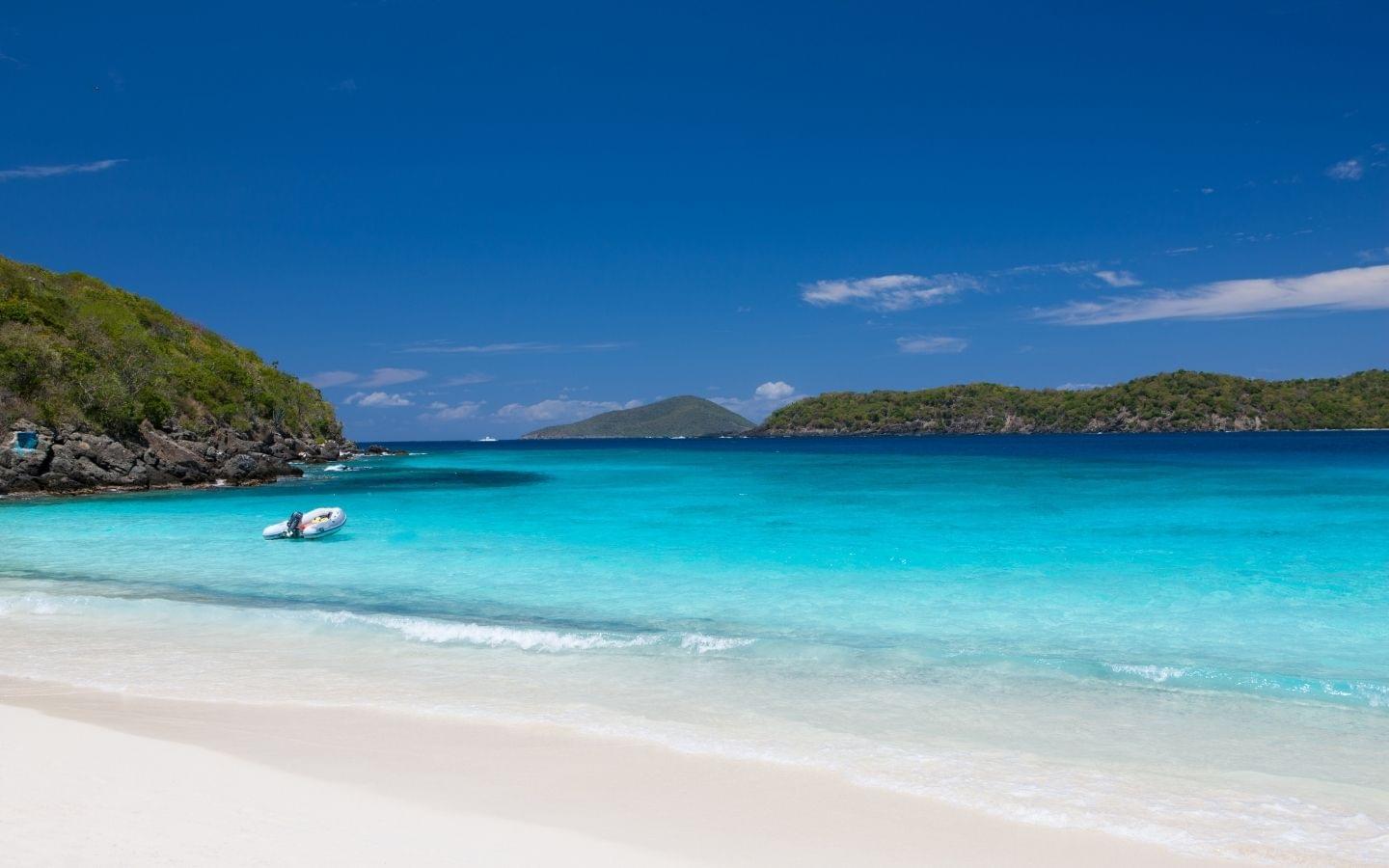
St Thomas is the airport, the cruise port and the ferry terminal, and it snorkels like it. Two good shore entries, both busy, and a large day-boat market built to get people away from them.
Coki Beach, on the north-east corner, has the clearest shallow water on the island and fish used to being fed next door. It is also loud, crowded and heavily vended; come at eight or accept it. Coral World runs 09:00 to 16:00 from US$29, and the ticket booth shuts at 15:00 — the detail that ruins an afternoon.
Secret Harbour, five minutes from Red Hook on the East End, is the same water with a fraction of the people. Work the rocky edges, the right of the bay and the docks on the left. A PADI five-star dive center sits on the beach.
No manta rays at either; they are not a Virgin Islands shore animal. Southern stingrays, the occasional spotted eagle ray, parrotfish, tangs, barracuda, turtles.
The third option is to leave the island. A national park snorkeling excursion runs three and a half hours out of Red Hook to water you cannot walk to; a full- or half-day private charter out of Compass Point Marina builds the day around whatever you name. Six is where the private boat starts paying.
St Croix: the third island, and why it is a separate trip
St Croix sits forty miles south of the others, on its own bank, reached by a daily ferry or a seaplane, not a ten-minute hop. Forty miles of open water is a different week, not a different day.
It also runs against everything above: a walk-in island that happens to have the best boat trip in the US Virgin Islands. Frederiksted Pier, Cane Bay and the east-end preserve are shore entries; Buck Island Reef National Monument is the crossing worth paying for.
Read our St Croix guide for the sites, the cruise-ship rule that closes the pier, the concession system and both operators’ prices.
The BVI: everything is a boat, and here is what that costs
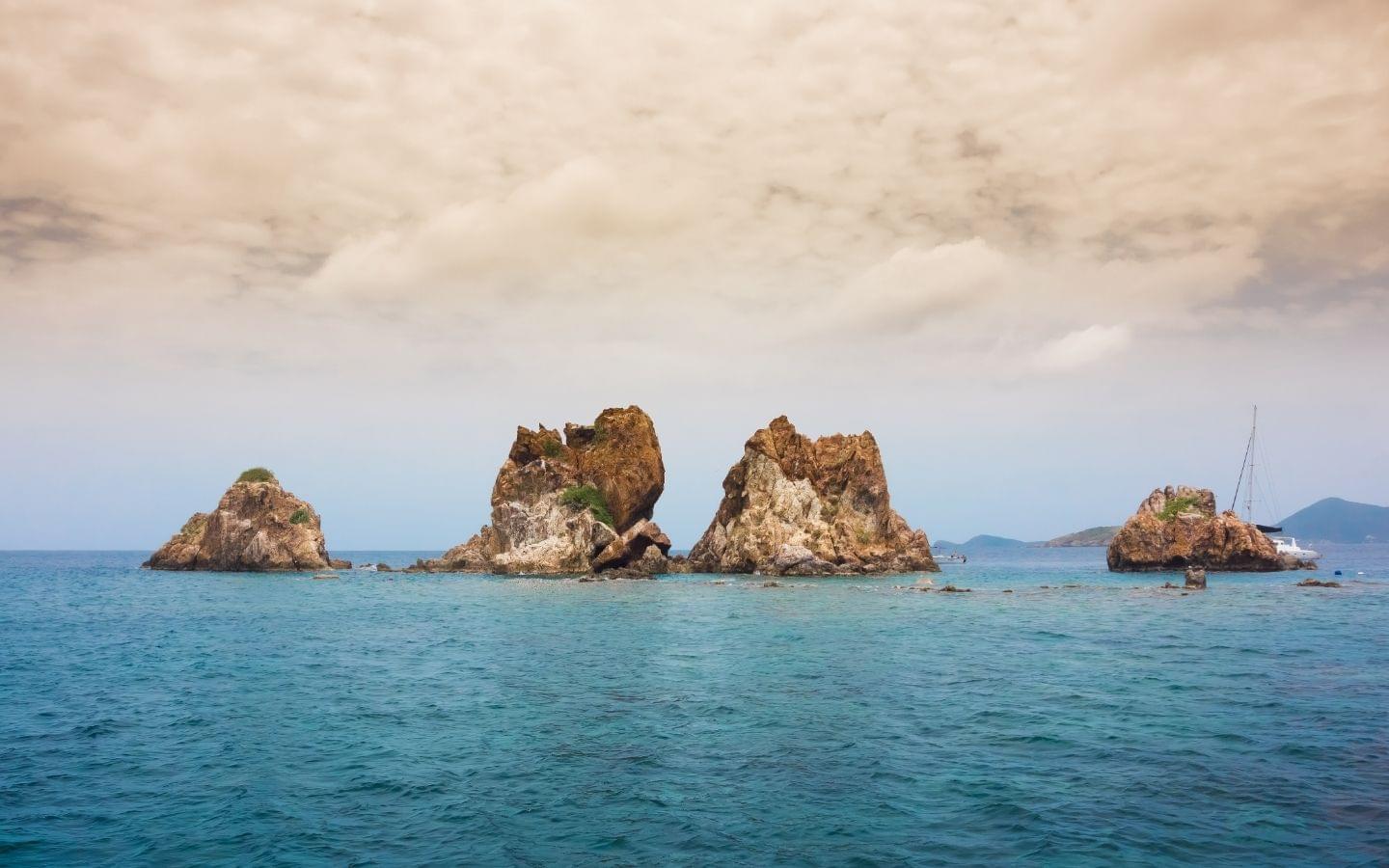
The British Virgin Islands has the best-known snorkeling in the archipelago and almost none of it is reachable on foot.
The Caves at Treasure Point, on the south-west corner of Norman Island, are four sea caves you swim into off a mooring. Schooling fish, orange cup coral, encrusting sponge, and dark enough inside that a light is worth carrying.
The Indians, a short hop away, are four rock pinnacles in the channel between Norman Island and Pelican Island — shallow over the tops, dive depth outside, and clearer than the caves, though the current can run hard. Most boats do the two as one morning, and both want a confident swimmer.
The RMS Rhone off Salt Island is the BVI’s only marine park and its most famous site, between roughly 20 and 80 feet. The shallow stern is visible from the surface; the bow is a dive.
Every one of those sites is a National Parks Trust mooring, and anchoring is prohibited. A charter boat needs the Trust’s marine permit, priced by party size: about US$25 a week for four guests, US$55 for ten, plus US$150 a year for a foreign vessel. Day use only.4
On a commercial trip the operator holds that paperwork. Holding it is not paying for it. Dive BVI on Virgin Gorda charges US$55 for a snorkeler on a regular boat trip, and its rate card itemizes US$10 per person per day of any trip as the BVI National Parks and cruising permit fee.5
Its full day trips run about US$135 for a snorkeler.
The itemization is the useful part: it names the ten dollars that was never the boat’s to keep. The BVI charges you at the border and again at the reef, and the second charge arrives inside somebody else’s price.
Smuggler’s Cove, at the far west end of Tortola, is the one shore exception. Calm, shallow, good for beginners, a couple of beach shacks and nothing else. The road in is unpaved, rutted and steep in places. Take the jeep, not the sedan.
Anegada: the reef everyone names and nobody snorkels
Anegada is the only coral island in a volcanic chain, 28 feet at its highest point, ringed by reef, underwater caves, tunnel formations and the wrecks of Spanish galleons, American privateers and British warships.
Horseshoe Reef, off the east end, is why those ships are there. It is offshore barrier reef reached by boat, not a beach you swim out from, and much of it is not accessible to a snorkeler at all.
What you get instead is the north shore, behind the reef: Cow Wreck, Flash of Beauty, Bones Bight and Windlass Bight, shallow, protected and almost empty. The Arawak conch mounds are off the East End; The Settlement is the island’s one township.
The island faces north and east, so the sargassum lands here when it lands anywhere in the chain.
Getting there is where people come unstuck. Smith’s Ferry Services runs Road Town to Setting Point via Virgin Gorda, and the times are stable: Road Town 07:00, Anegada 08:30, Road Town 15:30, Anegada 17:00, check-in 35 minutes before departure. On paper, a nine-hour day ashore.
The times are not the problem. The calendar is. Smith’s publishes the Anegada run as a list of dates rather than a weekly timetable, and the gaps are long: August 2026 shows six sailings — the 7th, 10th, 12th, 14th, 17th and 19th — and nothing after.6
March and April each ran a sixteen-day hole. The hotels advertise Monday, Wednesday and Friday; the operator commits to nothing of the kind. Read the current month’s calendar, not a hotel’s summary.
Two nights, or fly. Book a night or two and the gaps stop mattering: you are matching two dates instead of one.
For a fixed date, charter the plane. It sounds extravagant and it is not: Fly BVI takes one to nine passengers into the airstrip and runs Anegada day trips as a specialty, priced on request. Set it against four or six people’s levies, departure fees and ferry tickets.
When to go
| Months | Water3 | Storms | Sargassum7 | Heat stress3 | Verdict |
|---|---|---|---|---|---|
| Feb – Apr | 80 – 81 °F, the clearest | None | Building from March | None | Go now |
| Dec – Jan | 81 – 82 °F | None | Clear | Residual, decaying | Next best, busier |
| May – Aug | 83 – 85 °F | Season opens 1 June | Peak arrivals | Building | Swimmable, rarely excellent |
| Sep – Oct | 86 °F | Peak, 10 September | Falling away | Annual maximum | Worst on every axis at once |
| Nov | 84 °F | Season ends 30 November | Clear | Peaks early, then falls | Improving weekly |
February and March, and the margin is not small.
Sargassum is the newest of those problems and the least planned for. It arrives in quantity from roughly March through August and is getting worse: July 2026 regional totals came second only to the record set in 2025.7
Where it lands is a wind question. Windward, south- and east-facing shores take it (Coral Bay on St John, the east end of St Thomas, the south coast of St Croix, Anegada); the north shore mostly escapes, which is why Trunk Bay, Francis and Maho hold up.
Heat stress peaks a few weeks behind the 10 September hurricane peak: the last week of October in 2023 and 2025, 9–10 November in 2024.3 Late autumn is when this water is under the most pressure, in every sense.
What to book, and where to stay
Gear. Every site above rents, and a rented mask is the commonest reason a good day goes wrong. Bring your own. Our travel snorkel gear guide covers what packs small. Something for your feet, too: Waterlemon Cay and Secret Harbour are rock and urchin entries, not sand.
The snorkel vest argument is a real one at Waterlemon and the Norman Island caves, where the current is the hazard rather than the depth.
Sunscreen is a legal question here, not only an ethical one. Oxybenzone, octinoxate and octocrylene sunscreens have been banned from import, sale and possession in the US Virgin Islands since 30 March 2020.8 Buy mineral before you fly, or wear a rash guard. See what to wear snorkeling.
Tours. Out of St Thomas, the national park snorkeling excursion is the cheap option; the private charter out of Compass Point suits a group. In the BVI, book Dive BVI direct rather than through a reseller. St Croix’s Buck Island operators are priced in our St Croix guide.
Where you sleep decides which snorkeling you get. On St John, Cruz Bay and the hillsides above it put the whole park inside half an hour; Estate Lindholm sits on the ridge beside the park boundary.
St Thomas splits the other way. The snorkeling is on the East End not in town, and Secret Harbour Beach Resort is the literal case: reef off the hotel beach, dive center on it.
Across the line, Tortola has the ferries and the charter fleet, Virgin Gorda is quieter, with The Baths on the doorstep, and Anegada is the two-night detour that makes the ferry calendar survivable.
Frequently asked questions
Do you need a passport between the USVI and the BVI?
Yes, and it is a real border in both directions. Most nationalities get one month visa-free, and since 1 January 2025 everyone files the BVI's online embarkation card, up to 72 hours ahead. Then the money: a US$10 environmental and tourism levy on arrival by air or sea, US$20 per person to leave by ferry (US$15 for residents), US$50 to leave by air, usually inside the ticket. All of it per person.
How much does it cost to snorkel at Trunk Bay?
US$5 a head for anyone 16 and over, US$2.50 with an Interagency Senior or Access pass, at the booth or on recreation.gov. It is the only entrance fee anywhere in Virgin Islands National Park. It buys the underwater trail, restrooms, showers, rentals and a snack shack. Facilities close at 16:00, and there are no lifeguards.
Where is the best shore snorkeling in the Virgin Islands?
St John, and it is not close. Eleven sites sit inside Virgin Islands National Park, all reachable on foot: Salomon and Honeymoon, Hawksnest, Trunk, Cinnamon, Maho, Francis, Leinster Bay and Waterlemon Cay, Brown Bay, Salt Pond, the Lameshur bays, the Haulover bays. Only Trunk Bay charges. St Thomas has Coki and Secret Harbour, both busy. In the BVI it is Smuggler's Cove and the north shore of Anegada, and that is the whole list.
Is the snorkeling still good after the hurricanes and the bleaching?
Worth going, yes. Adjust what you are looking for. Stony coral tissue loss disease reached St Thomas in January 2019 and is now on every reef; at Flat Cay more than half the living coral died. Then the heat: the St John cell took 16.59 degree heating weeks in 2023 and 20.20 in 2024, and near-total mortality starts above 20. The fish, the turtles and the rock at Norman Island are still there.
When is the best time to snorkel in the Virgin Islands?
February and March. Coolest, clearest water at about 80 °F, both hurricane seasons far off, and ahead of the sargassum. December and January are next, and busier. September and October are the worst on every axis at once: hurricane peak 10 September, 86 °F water, heat stress at its annual maximum.
Can you snorkel the RMS Rhone?
Partly. The wreck lies between about 20 and 80 feet off Salt Island, in the BVI's only marine park. On a calm day the stern shows from the surface; the bow is a dive. Boat only. Charter boats need the National Parks Trust mooring permit, from US$25 a week for four guests. Dive BVI takes snorkelers from Virgin Gorda, minimum six, at US$55 — US$10 of that the park and cruising permit fee.
Can you snorkel Horseshoe Reef on Anegada?
Not the way the name suggests. Horseshoe Reef is the offshore barrier off Anegada's east end, boat-only, and the reason the island has wrecked ships for four centuries. The snorkeling is on the north shore behind it: Cow Wreck, Flash of Beauty, Bones Bight, Windlass Bight. Smith's Ferry publishes the Road Town run as a dated calendar, not a weekly timetable, with gaps of a fortnight and more. Two nights, or fly.
Sources
Footnotes
-
“British Virgin Islands: entry requirements,” UK Foreign, Commonwealth and Development Office, accessed 10 August 2026, gov.uk. ↩ ↩2 ↩3 ↩4
-
“Virgin Islands Coral Disease,” VI Coral Disease Advisory Committee, vicoraldisease.org. ↩
-
NOAA Coral Reef Watch 5 km degree heating weeks and sea surface temperature, seven Virgin Islands cells, January 2023 to 8 August 2026, coralreefwatch.noaa.gov. ↩ ↩2 ↩3 ↩4 ↩5
-
“National Parks Permit,” BVI Yacht Charters, accessed 10 August 2026, bviyachtcharters.com, corroborated at returntoseasons.com. ↩
-
Dive BVI rate card, accessed 10 August 2026: every trip “Includes $10.00 per day per diver/snorkeler for BVI National Parks fee and Cruising Permit fee,” divebvi.com/rates. ↩
-
Smith’s Ferry Services 2026 monthly calendars, accessed 10 August 2026, smithsferry.com. March: the 2nd and 4th, then the 20th. April: the 1st, then the 17th. ↩
-
Sargassum Outlook Bulletin, July 2026, Optical Oceanography Laboratory, University of South Florida, optics.marine.usf.edu. ↩ ↩2
-
Act No. 8185, Bill No. 33-0043, Thirty-Third Legislature of the Virgin Islands, in force 30 March 2020, act text. ↩

Nick Brisson — Co-founder, OutsiderView
Nick was born in Florida and grew up in Puerto Rico. He spent over ten years in Key West working in the boat charter industry, put four to five years into snorkeling and spearfishing the Florida Keys reef, and lives in Jacksonville Beach now, where he surfs year-round.