Snorkeling
Snorkeling in Antigua: the sites, the boats, the cruise day
Antigua markets 365 beaches, and nearly all of them are sand bottoms. The snorkeling worth your morning is a boat story — Cades Reef in the southwest lee, a 1905 wreck you can swim to from shore, and what a six-hour cruise call really allows.
We earn a commission on purchases made through links on this page, at no extra cost to you. It never affects which products we recommend.
On this page
- Where the sites are
- What is in the water now
- Cades Reef: the boat day
- Deep Bay and the wreck of the Andes
- Stingray City: pay the seventy dollars, or don’t
- Galleon Beach and the Pillars of Hercules
- Great Bird Island and the North Sound
- The beaches, honestly sorted
- The cruise day
- When to go
- Where to stay
- Antigua snorkeling FAQ
- Where to go next
Antigua’s tourism board sells 365 beaches, one for every day of the year.1 It is a good line and a bad map. Nearly all of those beaches are exactly what they look like: sand running into more sand — beautiful swimming water with nothing under it but ripples. The east coast takes the full Atlantic. The snorkeling — the actual snorkeling — lives in a handful of places, most of them on or off the leeward southwest coast, and the best of them need a boat.
I spent over ten years in the Key West charter trade putting people onto a reef that also sat miles from the postcard beaches, and Antigua runs on the same physics. The trade winds blow out of the east, the windward side takes the swell, and the fish live where the structure is, not where the loungers are. So this page is organized the way a boat operator would organize it: where each site is, how you get in, what it costs as of August 2026, and — because Antigua is one of the eastern Caribbean’s big cruise calls — what actually fits inside a six-hour day ashore.
Where the sites are
St John’s, the capital and cruise port, sits on the northwest coast. Ships berth alongside at Heritage Quay and Redcliffe Quay in the middle of town — tendering is rare — with an overflow berth at Deep Water Harbour about 1.5 km out.2 Every distance below starts from there.
| Site | Where | Getting in | Cost | Skill floor |
|---|---|---|---|---|
| Deep Bay & the Andes wreck | West coast, ~7 km from St John’s | Shore, off the sand | Free | Comfortable swimmer |
| Cades Reef | Southwest lee, offshore | Boat only | Tour price, US$110–265 | Any, with flotation |
| Stingray City | Seatons, east coast, ~35 min | Operator speedboat | US$70 | Anyone — you can stand |
| Galleon Beach & Pillars of Hercules | English Harbour, south coast | Shore, or water taxi | Free by road | Confident swimmer |
| Great Bird Island | Northeast, offshore in NEMMA | Boat day | US$125 | Beginner-friendly |
| Long Bay | East coast, ~35 min | Shore, behind the reef | Free | Beginner |
| Darkwood Beach | Southwest coast road | Shore, rocky north end | Free | Beginner |
Two of the seven are in taxi range of a morning whim. The rest reward exactly as much planning as this page takes to read.
What is in the water now
The honest regional baseline first, because no brochure will give it to you. The Global Coral Reef Monitoring Network’s Status and Trends of Caribbean Coral Reefs: 1970–2024, published in December 2025, puts hard coral cover across the Caribbean down 48% since 1980, with the sharpest single-year fall on record in 2023 at −16.9%.3 That 2023 collapse was the front edge of the fourth global bleaching event, which NOAA declared on 15 April 2024 and which put bleaching-level heat stress on 84% of the world’s reef area.4
Antigua’s own numbers are older but specific. The last island-wide survey, run to AGRRA standards between 2017 and 2019, measured 9% live coral cover across the island’s reefs — 13% inside the North East Marine Management Area, 6% in the waters of Nelson’s Dockyard National Park — against 23% fleshy macroalgae, with commercial fish biomass on an improving trend.5 Those figures predate the 2023–24 heat. Read them as the ceiling, not the floor.
So set your expectations the way I set them for charter guests on the Florida Keys reef, which has lost even more: you are not flying to Antigua for coral gardens. You are coming for clear, warm, flat water over structure — a two-mile reef, volcanic rock at a harbor mouth, a steel sailing ship a century into becoming a reef herself — and for the animals that structure holds: rays, turtles, barracuda, parrotfish in numbers. Antigua has one genuine physical advantage here. It is a low, dry island — about 1,000 mm of rain a year at St John’s6 — so there is no mountain rainfall flushing silt into the bays, and rain rarely wrecks the leeward visibility. The wind is the only thing you need to watch, and the wind is exactly what a good operator is watching for you.
Cades Reef: the boat day
The island’s marquee site is a reef running about two miles along the southwest coast, protected on paper since 1999 as the Cades Bay Marine Reserve — 18.11 km² declared under the Fisheries Act, taking in the reef, the seagrass beds behind it and the wetlands ashore.7 The 2021 version of this page called it a marine park, with the implication that a park means pristine; it does not, and the numbers above apply. What the reef still delivers is the thing a barrier does: it kills the swell, so the water inside the lee stays calm and clear while the open coast is not, and it holds fish the way any two-mile structure concentrates what remains.
You cannot walk to it. Three ways out, and they suit three different people:
The catamaran, if you want the day made for you. This is Antigua’s classic trip — sail down the west coast, an hour on the reef, lunch and a beach stop on the way home. Tropical Adventures runs it on the 65-foot Mystic cats at US$110 for six hours, checking in at 10 a.m. on Lower Redcliffe Street in St John’s, a few minutes’ walk from the cruise berths.8 Wadadli Cats, the island’s long-standing catamaran outfit, works the same reef on a fleet of 47- to 66-footers.9 Every boat running the reef is collected on one Viator page; compare departure points before price, because a boat that leaves near your bed beats a cheaper one across the island.
The Reef Riders, if you want your own wheel. Antigua Reef Riders puts you in an 11-foot two-seat inflatable, driving yourself in convoy seven miles down the coast from Jolly Harbour Marina, with about 45 minutes of snorkeling on the reef inside a two-and-a-half-hour tour. US$265 per two-person boat, US$212 solo, two departures daily at 10 a.m. and 1 p.m.; drivers must be 18, passengers 5 and up, no licence needed.10 It is the most fun per hour on this coast and the right pick for people who fidget on catamarans.
A private charter, if there are six of you — at US$110 a head the catamaran math crosses over fast, and any Jolly Harbour charter desk runs a west-coast half-day.
Take the morning departure, whichever way you go. The trades build through the day, the afternoon chop stirs the shallows, and a reef that reads sixty feet of visibility at nine reads a milky thirty by three. And if a front has been pushing wind for two days, move your reef day rather than argue with it — the boat will still run, and the water will not be worth the run.
Deep Bay and the wreck of the Andes
The best free thing in Antigua’s water sits ten minutes from the cruise berths. The Andes, a three-masted steel merchant ship carrying barrels of pitch out of Trinidad, put into Deep Bay when her cargo overheated in 1905; at anchor she caught fire and went down upright, and has spent the century since growing into a reef. She sits in about 30 feet of water — shallow enough that a snorkeler reads her whole outline from the surface, and beginner divers use her as a first wreck.11
This is the site I would send a nervous swimmer’s family to before any boat trip. The bay is sheltered, the swim out is short, and the payoff — a real shipwreck, your own fins, no schedule — beats an hour on a crowded catamaran rail. Corals and sponges crust the hull, and the fish treat her as the only structure in a sandy bay. Go in the morning before day-charter traffic, give the wreck’s interior a miss — a hundred-and-twenty-year-old hull is for looking at, not entering — and climb Fort Barrington on the headland afterward, the 18th-century gun position that watched St John’s harbor and now watches you dry off. The wrecks of Carlisle Bay in Barbados are the same idea six times over, and three are shallow enough to snorkel.
The 2021 version of this page called Deep Bay “not on the typical tourist track.” The honest 2026 sentence is the reverse: it is the most efficient snorkel on the island for anyone starting from St John’s, cruise passengers most of all.
Stingray City: pay the seventy dollars, or don’t
Antigua’s biggest paid in-water encounter was missing from the 2021 version of this page entirely. Stingray City runs from a land base at Seatons on the east coast: a five-minute speedboat hop to a shallow white-sand pool ringed by reef, where southern stingrays — free-swimming, not penned; they turn up because boats mean food — come in to be fed and handled from a floating platform in standing depth, with reef snorkeling after.12 US$70 a head, children the same, transfers extra; departures at 9, 11 and 1; about 35 minutes by road from St John’s. The combination tour with Laviscount Island’s Aldabra tortoises runs US$104.13 Book it ahead on ship days — the 9 a.m. goes first.
How it compares to the famous one: Grand Cayman’s sandbar is built on scale — a whole fleet working one anchorage, busiest whenever ships are in. Antigua’s is one operator, one small site, one boatload at a time. You trade the wild-sandbar spectacle for calm, standing depth and staff who put a ray in a child’s arms without drama. For families, for anyone unsure of their swimming, and for a six-hour cruise call, that trade runs in Antigua’s favor. For a confident snorkeler who wants wild animals on wild terms, it is not the point — spend your seventy dollars on the Reef Riders instead.
Galleon Beach and the Pillars of Hercules
English Harbour is the closest thing the Caribbean has to a sailing capital — Antigua Sailing Week has run out of it since 196714 — and the snorkeling here comes with the best scenery on the island. Galleon Beach lies inside the harbor mouth at Freeman’s Bay, looking across at Nelson’s Dockyard, with the Pillars of Hercules — a wall of wind-carved rock columns — standing at the point beyond the sand.
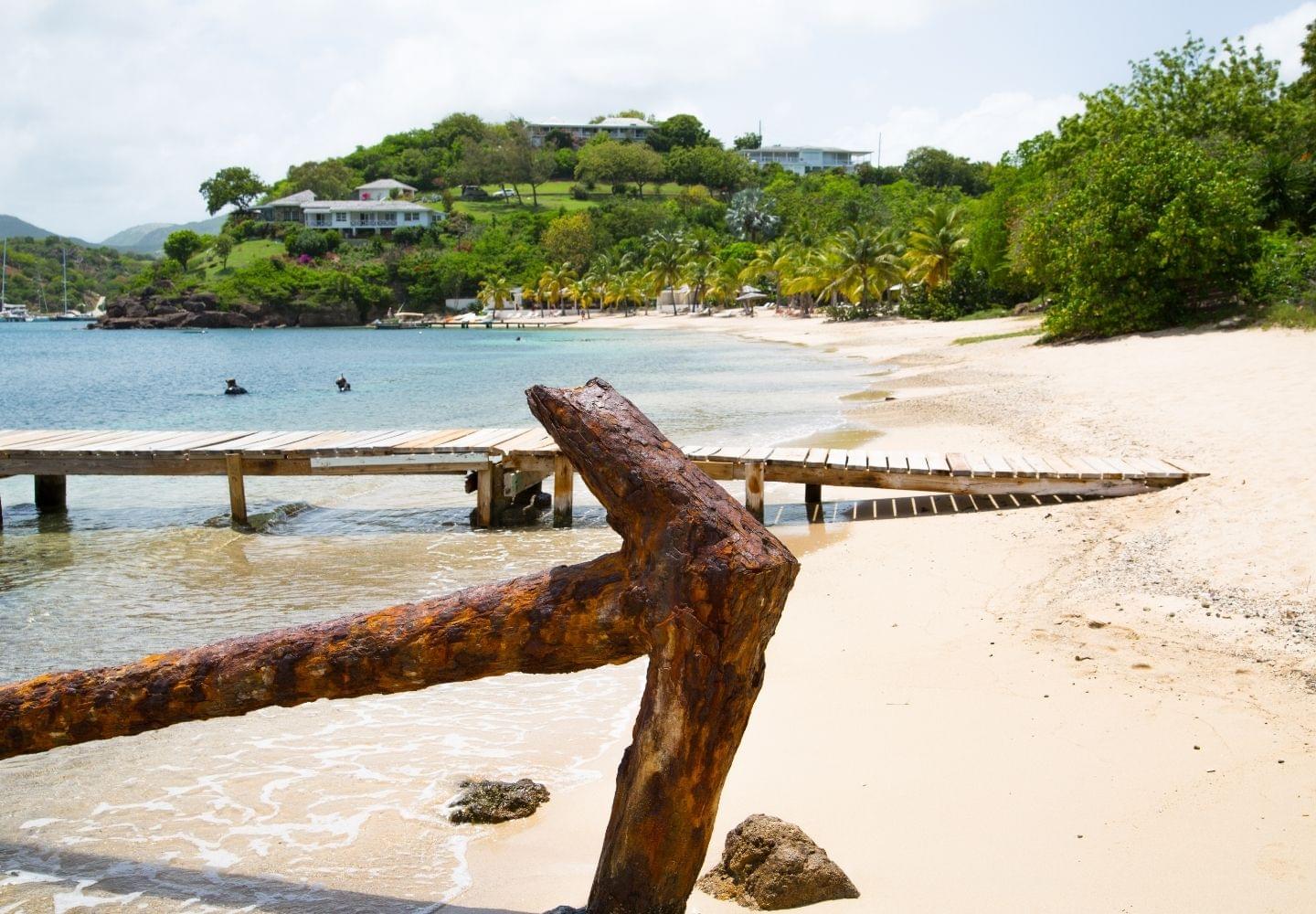
The swim is the south side of the beach: work the rocks out toward the Pillars, through a boulder field that holds squirrelfish, angelfish, rays on the sand seams and turtles over the seagrass inside the bay.15 Under the Pillars themselves you are at the harbor entrance — yacht traffic is constant in season, so stay tight to the rock and keep your head up crossing open water. On a flat day this is the prettiest snorkel on the island; when a southerly swell wraps the point, give it up and go to Deep Bay, because surge against those rocks is nothing to swim in.
Getting there: by road, Galleon Beach is free — a bumpy side road from English Harbour village. By water, the on-demand water taxi crosses from the Copper and Lumber jetty inside Nelson’s Dockyard in about ten minutes, US$9–12,16 which means passing through the dockyard itself — entry is now US$15, covering Shirley Heights and Dow’s Hill too.17 Pay it. The Georgian dockyard and the Shirley Heights view are Antigua’s best non-wet hours, and the 20-minute rock-scramble from the beach to the Pillars fills the surface interval.18 If you would rather see the Pillars’ underwater half with propulsion, a two-hour sea-scooter snorkeling safari runs small groups off Galleon Beach along the same rock line.
Great Bird Island and the North Sound
Off Antigua’s northeast corner, inside the North East Marine Management Area — at 108.5 km² the country’s largest marine protected area, declared in 200519 — sits a scatter of uninhabited islands, and Great Bird is the one worth your day. This is the coast the 2017–19 surveys scored highest on the island for coral,5 and it is boat-only water: reef, seagrass, mangrove and current threading between islets.
The boat to be on is Eli’s Original Eco Tour with Adventure Antigua — the island’s original eco operation, US$125 booked direct, with two guided snorkel sessions, lunch on the boat at Bird Island and the natural jacuzzi at Hell’s Gate on the way.20 It is the right shape for mixed groups: real snorkeling, tropicbirds and a summit walk for the ones who stay dry, and a crew that teaches first-timers without making a production of it. Book it for the first settled-weather day of your week, not the last — North Sound is open to the trades, and this is the trip most worth protecting from the wind.
The beaches, honestly sorted
Here is the sort that the 365-beaches line never gives you.
Long Bay is the beginner’s site. East coast, about 35 minutes out, with an offshore reef that takes the Atlantic’s swell so the inshore water sits flat and shallow — you can wade a long way out, and channels cut through the reef for anyone with fins and sense.21 It is the one east-coast entry I would send a family to, and it is busiest in high season; go early.
Darkwood Beach, on the southwest coast road, is the best casual shore snorkel on the leeward side — coral heads and small-critter hunting off the rocky end, easy parking, a beach bar for afterward.15 Turner’s Beach, just south, is the prettier stretch of sand with the thinner underwater story; swim it for the swim.15
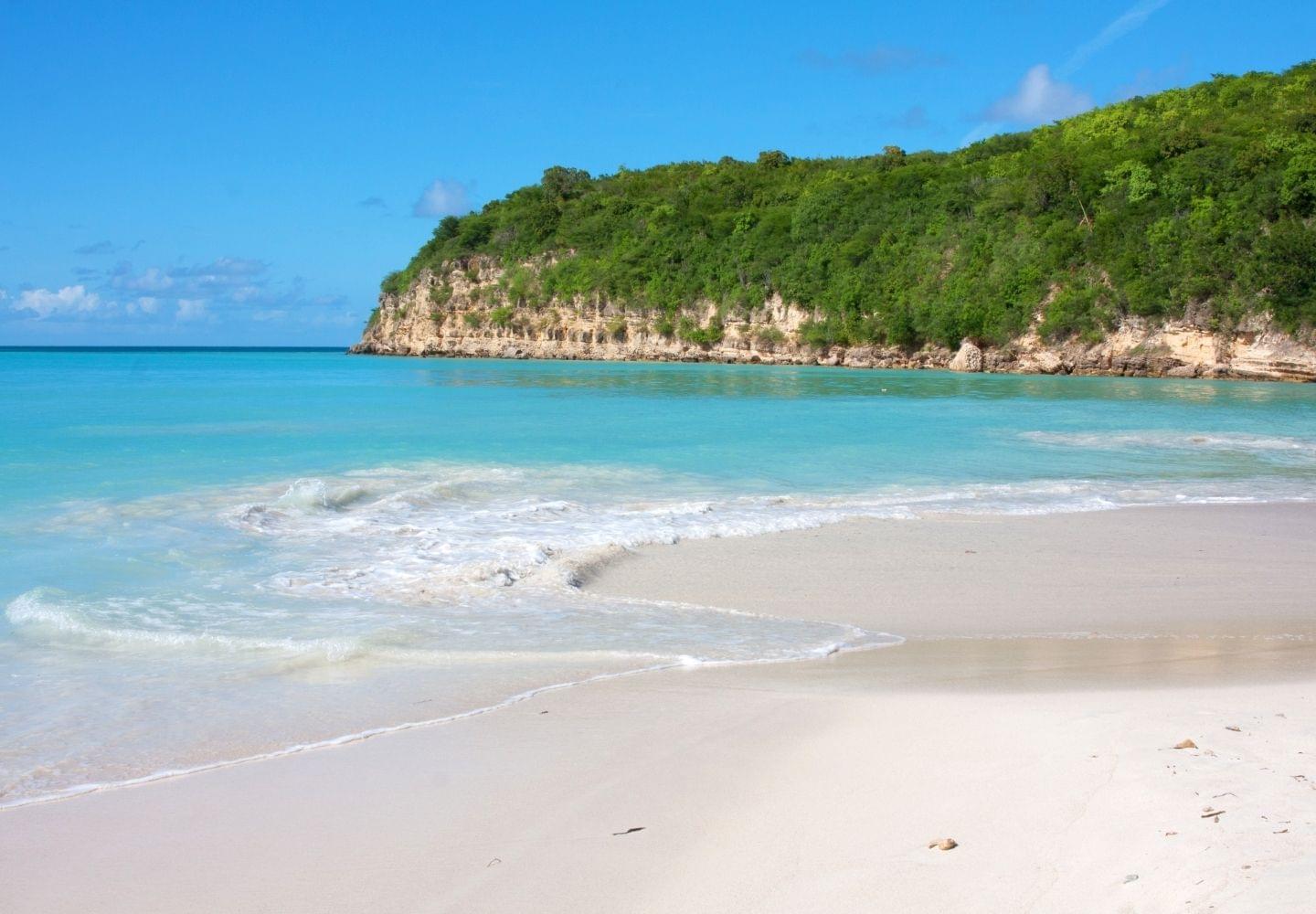
Dickenson Bay is the resort mile — calm, developed, water-sports flags everywhere. Swim it, parasail it, drink on it. The 2021 version of this page told you to paddle from here to a reef; no operator runs that trip today, and nobody’s Antigua snorkeling memory was made at Dickenson Bay.
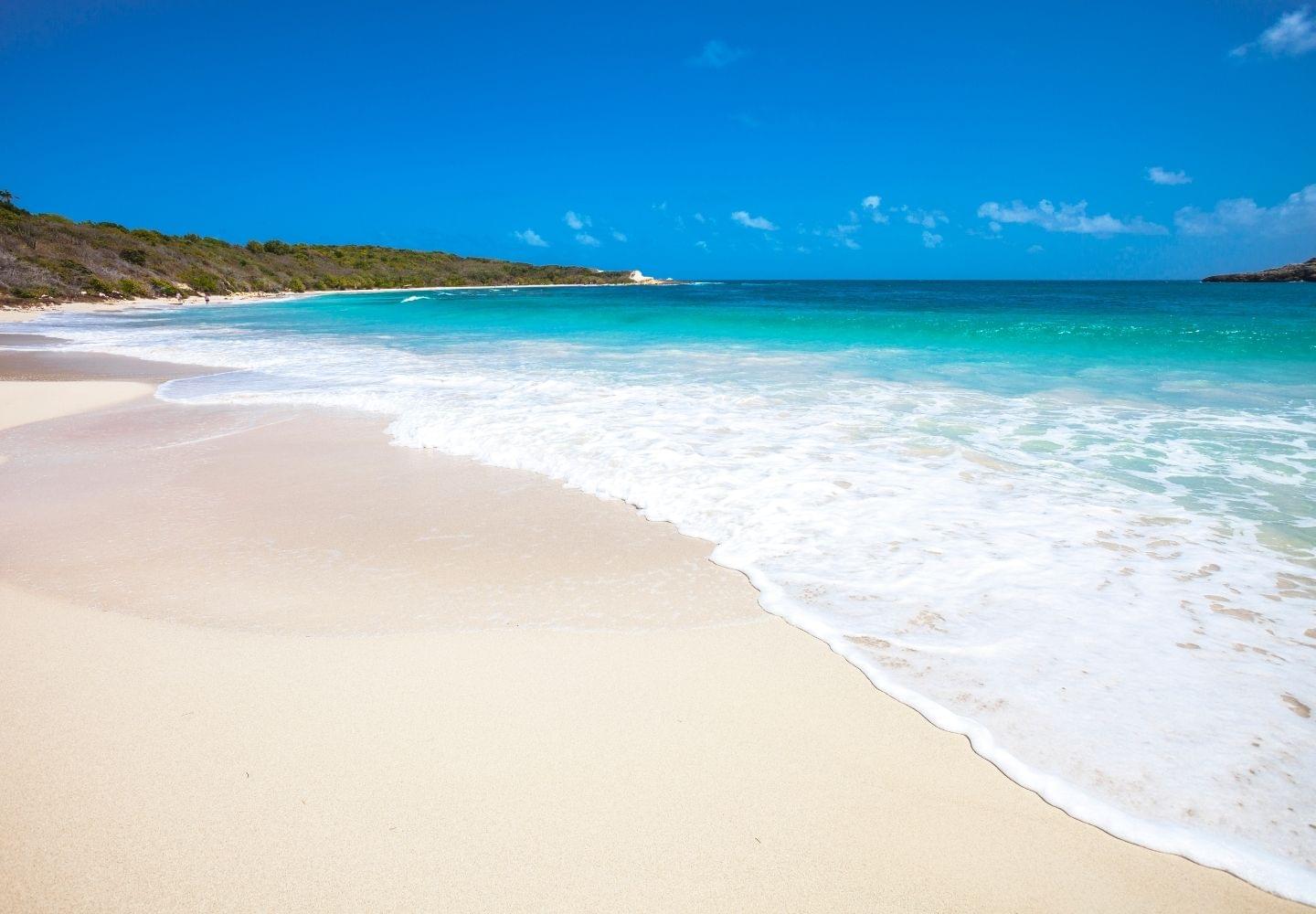
Half Moon Bay is the island’s most beautiful beach and an Atlantic one — the crescent takes real swell most of the year. Go for the beach, and swim the calmer corners when the sea is down. It is a place I would sail past slowly, not a place I would plan fins around.
Whatever you walk in from, bring your own mask: beach rental gear is a fit lottery, and a leaking mask costs you the site. Our travel snorkel gear guide covers sets that pack flat, and what to wear snorkeling settles the wardrobe for 80°F water: rash guard, because the sun matters more than warmth here.
The cruise day
Ships berth in the middle of town — off the gangway and onto St John’s streets in five minutes, no tender.2 I watched a decade of cruise mornings from the other side of the rail in Key West, and the arithmetic is universal: the day dies in the transfers, not the water. So spend yours by the clock.
With four hours: taxi to Deep Bay, snorkel the Andes, climb Fort Barrington, taxi back. No operator, no schedule, the island’s best effort-to-reward ratio.
With six: Stingray City — 35 minutes out, three fixed departures, an operator practiced at ship timetables — or the Cades Reef catamaran, which checks in at 10 a.m. on Lower Redcliffe Street a few minutes’ walk from the gangway but runs six hours;8 book it only against a late all-aboard, and book the operator’s own morning confirmation, not a street tout’s.
Not on a ship day: English Harbour and Galleon Beach. You can taxi the length of the island, pay the dockyard, cross the water and touch the Pillars — but you will do it all at a trot, and this corner of Antigua punishes hurry. Save it for a land stay.
One habit from the wheelhouse side: before you book anything for a ship day, ask the operator what happens if the ship cancels the call. The good ones answer without a pause.
When to go
Water temperature is never the question in Antigua; the sea runs 79°F in its February trough to 84°F at its September peak.22 The question is wind, rain and storm risk, and they sort the calendar cleanly:
| Months | Water | Weather | Verdict |
|---|---|---|---|
| Feb – Apr | 79–81°F | Driest months of a dry year; trades settling | Go. Clearest water, no storm risk |
| Dec – Jan | 81°F | Dry, but the winter trades blow freshest | Next best; the lee coast carries it |
| May – Jun | 81–82°F | Warming, still settled; season opens 1 June | Fine, and quieter |
| Jul – Aug | 82–84°F | Storm risk building through August | Watch the forecast, buy insurance |
| Sep – Oct | 84°F | Wettest weeks, peak hurricane risk | The months to skip |
| Nov | 82°F | Rain tailing off; season ends 30 Nov | Improving week by week |
The hurricane sentence, plainly: the Atlantic season runs 1 June to 30 November and concentrates its danger in August, September and October.23 On 6 September 2017 Hurricane Irma’s eye passed directly over Barbuda — Antigua’s sister island — at Category 5 with 185 mph winds, damaging or destroying 81% of its buildings and forcing the island’s evacuation, while Antigua, one island south, escaped with comparatively minor damage.24 That is what September here can do, and also how local the dice are. Book the autumn only with refundable everything.
Two crowding notes worth money: late April fills English Harbour for Sailing Week (22–26 April in 2026)14 — glorious to watch, hopeless for a quiet Galleon Beach — and winter cruise season makes St John’s-side sites busiest on multi-ship mornings. The month grid above says February to April; within it, midweek days with no ship in are the island at its best.
Where to stay
For a snorkeling week the island has two right answers, and they are not St John’s.
Jolly Harbour is the working base: the marina the Reef Riders run from,10 charter desks on the dock, Darkwood and Turner’s ten minutes down the coast road, and the Cades Reef lee a short run south. Self-catering villas around the harbor make it the value play for families.
English Harbour is the character base: the dockyard, the yachts, Shirley Heights on Sunday, Galleon Beach and the Pillars across the water. Sleeping inside a Georgian dockyard is its own argument — The Copper and Lumber Store Historic Inn puts you in the Georgian building the Galleon Beach water taxi leaves from.
Split a week between the two and you have covered every site on this page without a single long transfer — which, on an island whose roads are slower than its boats, is the whole trick.
Antigua snorkeling FAQ
Frequently asked questions
Is the snorkeling in Antigua good?
It is good at specific things, and knowing which things is the whole game. The island's strengths are calm, clear leeward water, one genuinely large reef at Cades, a shipwreck you can reach from a beach, and boat days that suit families and first-timers. Its weakness is the same as the rest of the region's: the Caribbean has lost roughly half its hard coral since 1980, and Antigua's reefs were never the lush end of the spectrum. Come for fish, rays, turtles and structure rather than wall-to-wall coral, and pick sites from this page rather than the beach nearest your hotel — the two lists barely overlap. For how Antigua stacks up against its neighbors, see our Caribbean snorkeling guide.
Can you snorkel in Antigua without a boat?
Yes, at four places worth planning around. Deep Bay has the wreck of the Andes in about 30 feet of water, a short swim off the sand and ten minutes from St John's. Galleon Beach in English Harbour has the rocks running out toward the Pillars of Hercules. Darkwood Beach on the southwest coast has coral heads off its rocky end. Long Bay on the east coast is flat, shallow water behind a wave-breaking reef — the beginner entry. Everything else on the island is either a swimming beach or a boat trip.
How much does Stingray City Antigua cost?
US$70 per person, children the same price, with hotel transfers extra. The tour runs about an hour and a half from the operator's base at Seatons village on the east coast — roughly 35 minutes by taxi from St John's — with departures at 9 a.m., 11 a.m. and 1 p.m. A combination tour adding Laviscount Island's giant tortoises runs US$104 and about two hours. Book ahead on cruise-ship days; the morning slots fill first.
What is the best snorkeling to do from the cruise port?
Ranked by reliability against back-on-board time: Deep Bay is the self-directed move — a short taxi from the berth, the Andes wreck off the sand, no schedule but your own. Stingray City runs three fixed departures a day and the operator is practiced with ship passengers. The Cades Reef catamarans leave from Lower Redcliffe Street, a few minutes' walk from the quay, but they are six-hour days — only book one against a late all-aboard. Skip English Harbour on a short call; it is the far corner of the island and deserves more time than you will have.
When is the best time to snorkel in Antigua?
February through April. The water is at its clearest — February and March are the driest months on an already dry island — the winter trades are settling, and the whole window sits outside hurricane season, which runs June through November and concentrates in August, September and October. Late April brings Antigua Sailing Week and full hotels around English Harbour, so book that corner early. September and October are the months to avoid: the wettest weeks, the warmest water and the peak of storm risk arrive together.
Where to go next
- Deciding between islands: snorkeling in the Caribbean — where Antigua’s calm-water profile fits among its neighbors
- The next island north: snorkeling in St. Maarten and St. Martin
- The next island south: snorkeling in Guadeloupe
- Trading sand for volcanic drama: snorkeling in St. Lucia
- A wreck coast next door: snorkeling in St Kitts and Nevis
- Packing: travel snorkel gear that fits a carry-on
Sources
Footnotes
-
“Beaches.” Visit Antigua & Barbuda, the tourism authority’s 365-beaches line, checked 8 August 2026. ↩
-
“Saint Johns Antigua Cruise Port Guide.” Whatsinport. Alongside berthing at Heritage and Redcliffe Quays in central St John’s, rare tendering, and the Deep Water Harbour overflow berth 1.5 km out. ↩ ↩2
-
“Status and Trends of Caribbean Coral Reefs: 1970–2024.” Global Coral Reef Monitoring Network, 9 December 2025. Hard coral cover down 48% since 1980; 2023 the sharpest single-year fall on record at −16.9%. ↩
-
“NOAA confirms 4th global coral bleaching event.” NOAA, 15 April 2024, with the event’s extent updated through 2025 by Coral Reef Watch. ↩
-
Camacho, R., et al. “Status of coral reefs in Antigua & Barbuda: using data to inform management.” PeerJ, 2020. AGRRA surveys 2017–2019: island-wide live coral cover 9%; NEMMA 13%, Nelson’s Dockyard National Park waters 6%; fleshy macroalgae 23%; commercial fish biomass rising 2015–2019. ↩ ↩2
-
“Climate — Antigua and Barbuda.” Climates to Travel. About 1,000 mm of rain a year at St John’s; February and March the driest months, September to November the wettest; northeast trades steadiest January to mid-April. ↩
-
“Cades Bay Marine Reserve.” International Coral Reef Initiative, SocMon site record. Declared 1999 under the Fisheries Act; 18.11 km²; managed by the Fisheries Division; protects Cades Reef, seagrass beds and wetlands. ↩
-
“Mystic Cades Reef Sail & Snorkel Tour.” Tropical Adventures Antigua, checked 8 August 2026. US$110, six hours, 10:00 check-in, departing Lower Redcliffe Street, St John’s. ↩ ↩2
-
Wadadli Cats, checked 8 August 2026. Cades Reef and Great Bird Island cruises and the three-day-a-week circumnavigation, on catamarans of 47 to 66 feet. ↩
-
Antigua Reef Riders, checked 8 August 2026. US$265 per two-seat boat or US$212 single including the 6% online booking fee; 2.5 hours with about 45 minutes snorkeling at Cades Reef; departures 10:00 and 13:00 daily except bank holidays from Jolly Harbour Marina; drivers 18+, passengers from age 5. ↩ ↩2
-
“Scuba Diving Deep Bay, Antigua.” Xtremespots. The Andes upright at 9.1 m / 30 ft after her 1905 pitch-cargo fire; worked by snorkelers and beginner divers; Deep Bay about 7 km from St John’s. ↩
-
“Stingray & Snorkel Tour.” Stingray City Antigua. The Seatons land base, the five-minute speedboat run, the unenclosed free-swimming rays, the floating-platform entry with standing depth, and the reef snorkel after the encounter. ↩
-
Tour pricing: Book Island Tours (US$70 adult and child, transfers not included) and Exploring Antigua (1.5-hour duration, US$104 Laviscount combination, 9/11/1 departures, ~35 minutes from St John’s), both checked 8 August 2026. ↩
-
“About ASW 2026.” Antigua Sailing Week. Founded 1967; 57th edition 22–26 April 2026, English Harbour. ↩ ↩2
-
“How Is The Snorkeling In Antigua?” Tropical Snorkeling, reports through January 2024. Galleon Beach and Freeman’s Bay rated the island’s best, with rays and turtles; Darkwood’s coral heads and critters at the rocky end; Turner’s thinner in-water interest; and the island-wide “average” verdict this page’s honest sort agrees with. ↩ ↩2 ↩3
-
“Nelson’s Dockyard to Galleon Beach.” Rome2Rio, checked 8 August 2026. On-demand water taxi from the Copper and Lumber Store jetty, about 10 minutes, US$9–12. ↩
-
“Nelson’s Dockyard National Park: History & Visitor’s Guide.” Mini Adventures, updated 10 February 2025, corroborated by U.S. News Travel. US$15 entry including Shirley Heights, Dow’s Hill Interpretation Centre and Clarence House. ↩
-
“The Incredible Pillars of Hercules in Antigua (from Galleon Beach).” The Culture Map, updated 16 October 2024. The 20-minute shoreline scramble from the south end of Galleon Beach. ↩
-
North East Marine Management Area Management Plan and the DOPA Explorer record. Declared 2005 under the Fisheries Act; 108.5 km²; the country’s largest marine protected area. ↩
-
“The Eco Tour.” Adventure Antigua, checked 8 August 2026. US$125 with 10% off booked online; two guided snorkel sessions with lesson; lunch aboard at Bird Island; Hell’s Gate stop. ↩
-
“Long Bay Beach Review.” Exploring Antigua. The offshore reef that flattens the Atlantic swell, the wade-out shallows and reef channels, the November–April crowds, and the ~35-minute run from St John’s. ↩
-
“Saint John’s (Antigua and Barbuda) Water Temperature.” Seatemperature.net, monthly averages, checked 8 August 2026. February 26°C/79°F low to September 29°C/84°F high. ↩
-
“Tropical Cyclone Climatology.” National Hurricane Center, NOAA. Season 1 June – 30 November, concentrated in August, September and October. ↩
-
“Antigua and Barbuda and Saint Kitts and Nevis: Hurricane Irma — Emergency Appeal Final Report.” IFRC via ReliefWeb, with the OCHA humanitarian snapshot of 11 September 2017. Irma’s eye over Barbuda on 6 September 2017 at Category 5 with 185 mph winds; 81% of buildings destroyed or severely damaged; the island evacuated; Antigua comparatively spared. ↩

Nick Brisson — Co-founder, OutsiderView
Nick was born in Florida and grew up in Puerto Rico. He spent over ten years in Key West working in the boat charter industry, put four to five years into snorkeling and spearfishing the Florida Keys reef, and lives in Jacksonville Beach now, where he surfs year-round.