Scuba diving
Scuba diving for beginners: what your first course asks
You have booked a first dive and nobody said what it involves. The age, medical and swimming gates as agencies write them, and what goes wrong on a descent.
On this page
Almost everyone who books a first dive books it before finding out what it involves. That is the right order — the trip comes first, the reading comes at eleven at night a fortnight later — but it does leave you looking for the rules with money already spent.
I have been on the receiving end of this. I did the course as an adult who had never worn a regulator, and the two things I wanted to know were whether I would be allowed, and what it would feel like when something went wrong. Nobody wrote the second one down. Every page I found was published by an organization that wanted to sell me the course.
So here is both halves.
Which of these are you?
Four situations, four different pages’ worth of answer. Find yours.
- You have a Discover Scuba Diving session booked on holiday. One supervised dive, no certification at the end, minimum age 10 and a maximum depth of 12 meters.1 The gates section below still applies to you in full — the medical form does not care that it is only a taster.
- You have signed up for the Open Water Diver course. The whole of this page is for you. Do the theory before you fly if the option is offered.
- You are still deciding whether to bother. Read snorkeling versus scuba diving first. For a lot of holidays, on a lot of reefs, the honest answer is that snorkeling shows you more.
- You are working out what this costs. That is a whole page of its own, and this one deliberately quotes no prices: how much does scuba diving cost.
The three gates
Age
The minimum age to learn to dive is 10, for both a Discover Scuba Diving experience and the Open Water Diver course.12 SSI sets the same minimum for its Open Water Diver certification.3
Divers under 15 are certified as Junior Open Water Divers, and the difference is depth and supervision rather than the training itself. At 10 and 11 a junior diver is limited to 12 meters (40 feet) and must dive with a dive professional or a certified parent or guardian. From 12 to 14 the limit is 18 meters (60 feet) with a certified adult. A full Open Water Diver certification is also limited to 18 meters.2
That last line surprises people who assumed the qualification opens the whole ocean. It does not. Eighteen meters is the recreational entry level, and nearly everything a beginner actually wants to look at is above it.
The medical form
This is the gate people worry about most and understand least, so it is worth walking through as a process.
Before any recreational course you complete the Diver Medical Participant Questionnaire, a standard form used across the industry — the current version is dated 2022-02-01 and carries the logos of DAN, the World Recreational Scuba Training Council, the RSTC, the Undersea and Hyperbaric Medical Society and CMAS.4
Page one is ten questions. They cover lungs, breathing, heart and blood; being over 45; whether you struggle with moderate exercise; eyes, ears and sinuses; recent surgery; loss of consciousness and neurological history; psychological treatment; back problems, hernia, ulcers or diabetes; stomach and intestinal problems; and prescription medication.4
Then the branching, which is the part nobody explains:
- No to all ten, and you are finished. The form says so in terms: “If you answered NO to all 10 questions above, a medical evaluation is not required.”4 You sign it and hand it in.
- Yes to questions 3, 5 or 10, or to any question on page two, and all three pages of the form go to a physician. The form is blunt about what follows: “Participation in a diving course requires your physician’s approval.”4
- Yes to any of the others — 1, 2, 4, 6, 7, 8 or 9 — and you are directed to a lettered box on page two with more detailed questions. Plenty of people clear the form at that stage without ever seeing a doctor.
Two things follow that catch first-timers out. Question 2 is simply “I am over 45 years of age.” Ticking yes is not a problem; it routes you to page two, and page two asks about blood pressure, smoking, cholesterol and family history rather than about your age. And the form’s note to women is unambiguous: “If you are pregnant, or attempting to become pregnant, do not dive.”4
Fill it in honestly, and fill it in at home rather than at a counter with fins in your hand. If it sends you to a doctor, you want that appointment two weeks out, not the night before. If you have a condition you are unsure about, see a physician who understands diving medicine — and read our page on scuba diving with asthma if that is the one. We cannot tell you whether you are fit to dive, and neither can a dive shop. Only a doctor can.
The swim test
You will be asked to demonstrate basic water skills. PADI’s requirement is to swim 200 meters or yards, or 300 meters or yards in mask, fins and snorkel, without stopping, and to float and tread water for 10 minutes.1 SSI states its prerequisite as “fit to swim”, with a swim assessment and survival float before open water training.3
Three things about that, all of which reduce the dread.
No stroke is specified and nothing is timed for speed. Two hundred meters of unhurried breaststroke counts. So does a slow, ugly, entirely successful crawl.
The mask-fins-snorkel option is easier than the bare swim despite being 50% longer, because fins do the work. If you are a weak swimmer, take it.
It happens during the course, not as an entrance exam. PADI’s FAQ places it among the skills your instructor will have you demonstrate before you complete the certification.1 Nobody is going to turn you away at the door on day one.
If you are genuinely not comfortable in deep water, that is worth addressing before you go — and it is addressable. Half an hour a week in a pool, floating rather than swimming lengths, does more for a first dive than any amount of fitness work.
What actually goes wrong on a first dive, and in what order
This is the section the agency pages do not write, and the omission is structural rather than lazy: an organization selling you a course cannot lead with the four things that will probably annoy you. None of these is dangerous under supervision. All of them are ordinary, and knowing the order takes most of the sting out.
First, your ears. This is not a close contest. DAN reports that nearly 50% of calls to its emergency hotline relate to ear problems, and that middle-ear barotrauma is the most common pressure-related ear injury among divers.5 It is also the thing most likely to end your first descent early — not with an injury, just with an instructor signalling you both back up because you cannot clear.
The mechanics are simple and the technique is taught in the first hour: pinch your nose and blow gently, or swallow, or work your jaw. What is not always taught clearly enough is the timing. DAN’s guidance is to “equalize early, before your head dips below the water, and equalize often — don’t wait until you feel pressure”, because without adequate equalization pressure injury “can occur as shallow as seven to 10 feet (1-3m)”.5 By the time it hurts you have left it too late; go back up a meter and start again.
If you have a cold, blocked sinuses or an ear infection, do not dive that day. Decongestants that wear off at depth are a worse idea than rescheduling.
Second, your mask. Water gets in. Not might — will, on almost every dive, usually because you smiled at a fish. Clearing it is one breath out through the nose while you press the top of the frame, and it is taught in confined water precisely because everybody’s first instinct is to stand up and take it off. Practising it in a pool until it is dull is the single most useful hour you can spend before an open-water dive.
Mask fit matters more than anything else you rent. If the seal leaks on the surface it will not improve at eight meters. Try three of them.
Third, buoyancy. This one is not a problem, it is a skill, and it is the last one to arrive. Every new diver spends the first dives sinking to the sand and then rising too fast — inflating, over-inflating, deflating, over-deflating. It clicks somewhere around dive ten, and the day it clicks is the day diving starts being enjoyable rather than absorbing. Nobody’s first dive has good buoyancy. It is not a sign you are bad at this.
Fourth, air. New divers breathe faster than experienced ones, and a nervous new diver breathes faster still. You will surface with less air left than everyone else in the group and it means nothing except that you are new. The one thing that helps in the moment is slowing the out-breath rather than trying to breathe less; the thing that helps overall is a few more dives.
What the instructor is watching for
Rescue training is, more than anything, training in noticing. Here is what a rescue-trained diver is looking at when they watch a beginner, because it explains a lot of the small things that happen around you.
Your breathing rate, read off your bubbles. Fast, shallow bursts say anxious. Long, spaced clouds say settled. It is the most visible signal you produce and you have no idea you are producing it.
Your eyes. Wide and fixed on a single point is the classic look of someone about to reach for their mask. Moving and curious is fine.
Your hands. Divers who are comfortable let their hands hang. Divers who are not grip things — a hose, their own arms, a rock, occasionally a stranger’s fin.
Where you are in the group. Drifting to the back, or drifting up, is usually the first physical sign of trouble before anyone signals anything.
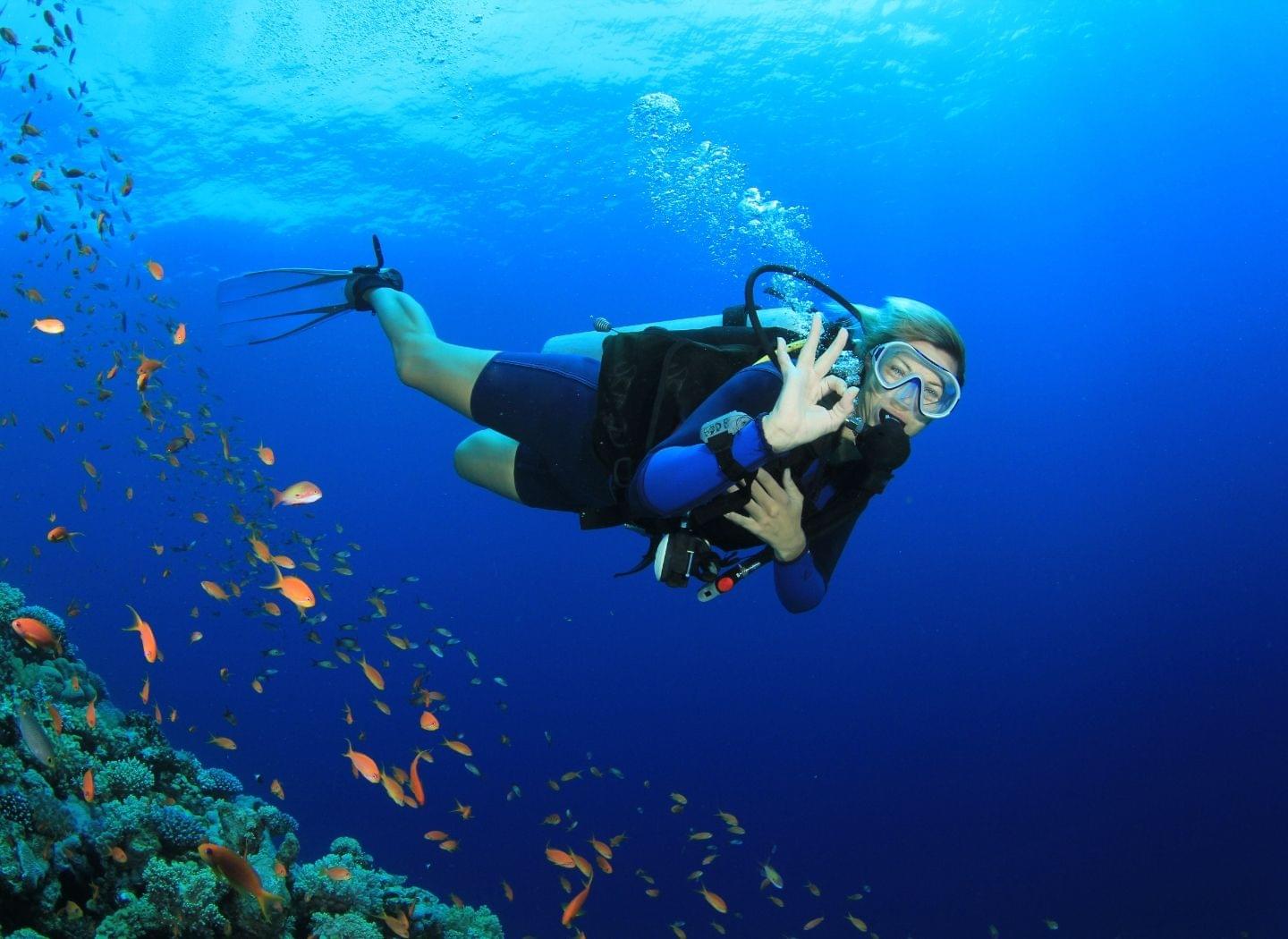
How you answer the OK sign. A crisp OK back means fine. A hesitation, or a hand that wobbles level, is a request for attention and every dive professional treats it as one.
None of that is a test you can fail. It is a reason to say something rather than tough it out — the signal for “not right” is taught in the first briefing, it exists because it gets used constantly, and an early ascent costs nothing but a few minutes.
The week before, and the morning of
Most preparation advice is invented, so here is only what holds up.
Do the theory first. PADI describes the Open Water Diver course as performance based rather than fixed to a timetable, and says the confined and open water dives can be done in three or four days if the knowledge development is completed beforehand through eLearning.1 SSI’s suggested duration for the same certification is 16 to 32 hours.3 Doing the reading at home turns a holiday into diving instead of a classroom.
Sleep, and skip the drink. Dive shops set their own rule on alcohol before diving and they enforce it; turn up hung over and you may not get in the water. This is not a rule worth testing on a day you have paid for.
Do not try to get fit in a week. It does not work and it makes you tired on the day. Being rested beats being trained.
Try anything you have bought. New gear that has never been in water is a bad surprise at depth. If you have bought a mask, get it wet at home first.
Check the flight home before the last dive, not after it. There is a required interval between diving and flying and it constrains which dives you can do at the end of a trip. The numbers, and where the agencies differ, are on our page about flying after diving — do not guess at them.
On the morning: eat something small, drink water, and arrive early enough to be fitted properly rather than quickly. Ill-fitting rental gear is the most common avoidable misery of a first dive.
After the first dive
If it was a Discover Scuba session, you have not been certified — but the dive normally counts toward the Open Water course if you continue with the same agency, which is worth asking about before you pay twice.
If it was the course, you are now certified to 18 meters, with a buddy, in conditions similar to those you trained in.2 That is a deliberately conservative envelope and it is the right one. The next certification adds depth, and it will feel far more like an extension of what you already know than the first course did.
The thing nobody warns you about is how much of the first dive you will not remember. There is a lot happening — new equipment, new pressure, new everything — and the memory takes a hit. That is why the second dive is the one people fall in love with. If the first is only fine, go again before deciding.
Frequently asked questions
What are the requirements to start scuba diving?
Three gates, and they are lower than most people expect. You must be at least 10 years old for a PADI course, with under-15s certified as Junior Open Water Divers on shallower depth limits (PADI). You must complete the Diver Medical Participant Questionnaire, ten questions, and most people answer no to all ten and need nothing further (Diver Medical). And you must show basic water skills during the course, not before it.
Do you have to be a good swimmer to scuba dive?
No, but you do have to be comfortable and self-sufficient in water. PADI asks you to swim 200 meters or yards, or 300 in mask, fins and snorkel, without stopping, and to float and tread water for 10 minutes. Neither is timed for speed and neither requires a particular stroke (PADI). SSI states the prerequisite simply as being fit to swim (SSI).
How old do you have to be to scuba dive?
Ten. That is the minimum age for both a PADI Discover Scuba Diving experience and the Open Water Diver course, and it is SSI's minimum too. Divers under 15 certify as Junior Open Water Divers, with a 12 meter limit at ages 10 to 11 and 18 meters from 12 to 14, and an adult requirement in both cases (PADI, SSI).
What is the difference between Discover Scuba Diving and an Open Water course?
One is a taster and one is a qualification. Discover Scuba Diving is a single supervised experience in a pool or calm water, minimum age 10, maximum depth 12 meters, and it certifies you for nothing. The Open Water Diver course is the entry-level certification, takes you to 18 meters, and PADI describes it as completable in three or four days if the theory is done beforehand online (PADI, PADI).
Will I need a doctor's note to scuba dive?
Probably not, and the form tells you rather than the dive shop deciding. If you answer no to all ten questions on the Diver Medical Participant Questionnaire, no medical evaluation is required. If you answer yes to question 3, 5 or 10, or to any question on page 2, you take all three pages to a physician, and the form states plainly that participation then requires your physician's approval (Diver Medical). We are not able to tell you how your own condition will be assessed, and neither is a dive shop.
What usually goes wrong on a first scuba dive?
Ears, then the mask, then buoyancy, then air. Ear problems are the most common by a distance. DAN reports that nearly half of the calls to its emergency hotline relate to ears, and that pressure injury can occur as shallow as seven to 10 feet if you do not equalize (DAN). None of the four is dangerous under supervision. All four are worth expecting.
How long does it take to learn to scuba dive?
PADI describes the Open Water Diver course as performance based rather than fixed, and says the confined and open water dives can be completed in three or four days if the knowledge development is done first through eLearning (PADI). SSI gives a suggested duration of 16 to 32 hours for the same certification (SSI). A Discover Scuba Diving experience is a single session.
References
Footnotes
-
“Become a Certified Scuba Diver FAQs.” PADI, padi.com. ↩ ↩2 ↩3 ↩4 ↩5
-
“PADI Scuba Diving Restrictions.” PADI Blog, blog.padi.com. ↩ ↩2 ↩3
-
“Open Water Diver.” SSI, divessi.com. ↩ ↩2 ↩3
-
“Diver Medical | Participant Questionnaire.” Version date 2022-02-01, © 2020. Developed by the Diver Medical Screen Committee with DAN, the World Recreational Scuba Training Council, the RSTC, RSTC Europe, the Undersea and Hyperbaric Medical Society and CMAS, padi.com. ↩ ↩2 ↩3 ↩4 ↩5
-
“Ear Equalization Guidelines for Scuba Divers.” Divers Alert Network, dan.org. ↩ ↩2

Liz Meyer — Travel writer
Liz is a full-time traveler and a PADI Rescue Diver. She loves to explore new places in and out of the water and share her experiences with others.