Snorkeling
Prescription snorkel masks: what you are actually buying
Nearly every prescription snorkel mask ships with clear lenses and sells the correction separately. What each listing includes, and when to use a dive shop.
We earn a commission on purchases made through links on this page, at no extra cost to you. It never affects which products we recommend.
On this page
- What I found when I opened the listings
- What I would buy, and for whom
- Three different products, one phrase
- The masks, and what each one ships
- What each ASIN actually buys
- Adding up the real cost
- When to skip Amazon and go to a dive shop
- Full-face masks with prescription lenses
- Living with a corrected mask
- Looking after the lenses
- Frequently asked questions
Search for a prescription snorkel mask and you will find plenty of masks described as one. Open the listings and something becomes obvious: almost none of them include a prescription.
What I found when I opened the listings
I went through the four masks that come up most often under this heading and read what each Amazon page actually says it ships. All four sell a bare mask with clear lenses. The correction, which is the entire reason anyone is on that page, is a second purchase. Sometimes it comes from the same manufacturer, sometimes from a lab, and in one case from a different website altogether.
I do not think that is a scam, and it is worth saying why. A lens has to match your eyes, so it cannot sit finished in a warehouse. The category works this way for a good reason.
What I object to is the gap between that and how the listings read. The Cressi page says “Optical Lenses Available,” which is honest and takes about a second to skim past. The Seaview mask most people find on Amazon is not the prescription one at all. An earlier version of this very page recommended the TUSA Freedom HD as the pick for astigmatism, which is a bare single-lens scuba mask that cannot take a drop-in lens of any kind. We got that wrong and I have rewritten it.
So the price you see is never the price you pay, and this page is organized around fixing that: what each mask ships, and what finishing the job costs.
What I would buy, and for whom
If your prescription is a straightforward minus number in both eyes, buy a mask built to take drop-in lenses and buy the lenses separately. The Cressi Focus at Amazon is the cheapest complete version of that at roughly $100 to $160, and when your eyes shift you replace a $50 lens instead of a whole mask. If you have astigmatism worth correcting, eyes that differ a lot, or you want to read a camera screen underwater, I would not buy this on Amazon at all. Find a mask that fits your face, have a lab or a dive shop bond lenses into it, and plan on $350 to $550. And if you have your heart set on a full-face mask, know before you order that the corrected version is made to order, with the narrowest prescription range in the category.
Everything below is the detail behind that paragraph.
Three different products, one phrase
The phrase “prescription snorkel mask” covers three genuinely different purchases, and which one you are making decides your cost, your options and how long you wait.
Drop-in lenses clip into a mask built with retainers for them, in place of the clear lens. The range is limited and spherical only, but the lenses are cheap, swappable and sitting on a shelf. Replaceable lenses typically run −1.0 to −8.0 in 0.5 diopter increments1.
Bonded or laminated lenses are ground to your prescription and fixed to a mask you supply. This route corrects anything: sphere, cylinder for astigmatism, prism for double vision, bifocal reading segments2. It is permanent and expensive.
A dive shop fitting is the same as bonded work with someone measuring your face and standing behind the result.
One number tells you which column you are in, and it is the CYL value on your prescription. At 0.75 or below a spherical stock lens will usually serve you well underwater. Above that it will not23. The numbers, the ranges and the rounding are all in prescription snorkel masks and astigmatism, which is the page to read with your prescription in front of you.
The masks, and what each one ships
Cressi Focus

Cressi Focus
Cressi
A standard twin-lens mask sold with clear lenses. Cressi makes drop-in corrective lenses for it separately, covering nearsightedness from −1.0 to −8.0 in 0.5 diopter steps. No plus lenses and no astigmatism correction.
Check pricePros
- Pro: Lenses are a separate, swappable purchase, so a prescription change costs you a lens rather than a mask
- Pro: Lenses are not handed, so ordering a different strength for each eye is straightforward
- Pro: Tempered glass, in a twin-lens shape that can take a bifocal reading segment
- Pro: The same lenses fit Cressi's Prisma, so the mask is not a dead end
Cons
- Con: This ASIN buys the mask only; the corrective lenses are a second purchase
- Con: Nearsighted correction only, roughly −1.0 to −8.0, with nothing for farsightedness
- Con: No astigmatism correction at any strength
The Focus is a conventional twin-lens mask that arrives with clear lenses, and Cressi sells corrective ones for it separately.
Those lenses cover myopia only, −1.0 to −8.0, in 0.5 diopter steps, in tempered glass, and they fit both the Focus and Cressi’s Prisma4. They are not handed, so if your eyes need different strengths you simply order two different lenses.
My read on it: this is the cheapest honest answer for a nearsighted person with little or no astigmatism. It is also the most forgiving if your prescription is still moving, since you replace glass instead of a mask. It does nothing for farsightedness and nothing for astigmatism, and no amount of careful ordering changes that.
TUSA M-1001 Freedom HD
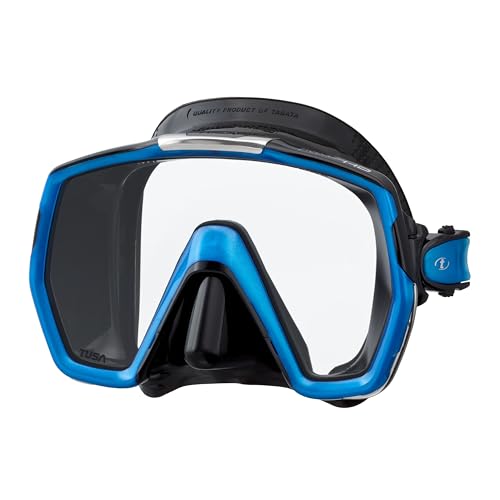
TUSA M-1001 Freedom HD
TUSA
A single-lens scuba mask with a wide field of view. It takes no drop-in lenses at all, so correction means sending it to a lab to have lenses bonded on, which is exactly why any prescription becomes possible, astigmatism included.
Check pricePros
- Pro: Custom bonded lenses can correct any prescription, including cylinder and prism
- Pro: Wide, uninterrupted single-lens field of view
- Pro: Rated for diving as well as surface snorkeling
- Pro: A common base mask at prescription labs, so the fitting is well understood
Cons
- Con: The ASIN buys a bare mask, and bonded lenses add $289 to $399
- Con: No drop-in option, so there is no cheap way to correct this mask
- Con: Bonded lenses are permanent, so a prescription change means new lenses
- Con: Made to order, with roughly three weeks standard turnaround
Single-lens masks accept no drop-in lenses, because there is no second lens position to clip anything into. Correcting one means sending it to a prescription lab to have lenses bonded on.
That is a genuinely good route and the one that makes astigmatism, prism and reading segments possible. It is also a $289 to $399 job on top of the mask, it takes weeks, and it cannot be undone.
The mask itself is a sound choice: wide field of view, rated for depth as well as the surface, and familiar enough to the labs that the fitting is routine. It is simply not a prescription mask until somebody makes it one, and the listing should not be read as though it were.
Seaview 180° V3
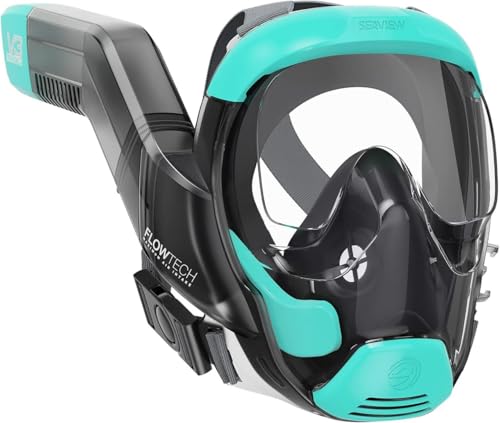
Seaview 180° V3
Seaview 180
A full-face snorkel mask. This Amazon listing is the clear-lens version. The corrected mask has lenses ground to prescription and bonded into the frame, ordered from the manufacturer and made to order, and it is built for snorkeling at the surface rather than diving.
Check pricePros
- Pro: Full-face design suits people who dislike a mouthpiece
- Pro: Prescription lenses bond into the same wide viewport, so correction does not shrink the field of view
Cons
- Con: This ASIN is not the prescription version; the corrected mask is a separate made-to-order purchase from Seaview
- Con: Surface snorkeling only, and not rated for diving or prolonged submersion
- Con: Full-face lens ranges are the narrowest of any mask type, typically minus only around −1.0 to −4.0
- Con: Made to order, so neither cheap nor returnable once fitted
Two corrections to what this page used to say about the Seaview, both material.
This ASIN is the clear-lens mask. Seaview’s prescription version has lenses ground to prescription and bonded into the frame, ordered from Seaview directly and made to order5. Buying the Amazon listing does not get you a corrected mask, and the old “budget pick” label was wrong on both counts, because made to order is not budget.
The limit that matters more than the price is depth. The Seaview 180 is built for recreational snorkeling at the water’s surface, not for diving or prolonged submersion5. If you duck-dive to look at things, or there is any chance of a try-dive on the same holiday, this is the wrong mask to have several hundred dollars of prescription bonded into. That is the caveat I would most want a first-time buyer to see, and it appears nowhere near the buy button.
Atomic Aquatics Venom

Atomic Aquatics Venom
Atomic Aquatics
A high-end frameless scuba mask, and a frequent choice as the base for custom bonded lenses including reading segments. Like the TUSA, the listing is a bare mask with clear lenses.
Check pricePros
- Pro: Excellent optics and low internal volume
- Pro: Widely used at prescription labs, including for custom reading lenses
- Pro: Frameless build packs flat for travel
Cons
- Con: Premium price before any correction is added
- Con: Bare mask, so custom lenses are a separate $289 to $399
- Con: No drop-in lens option
Same story as the TUSA at a higher price and a lower weight. The Venom is a frameless single-lens mask with very good optics, and it turns up often as the base for custom bonded lenses, including reading lenses. The listing is a bare mask.
It earns a place here for one reason. If you are about to spend $300 having lenses ground and bonded, the mask underneath should be one you will still want in five years. Those lenses are never moving to another mask.
What each ASIN actually buys
| Mask | The listing ships | Correction route | Range covered | Astigmatism |
|---|---|---|---|---|
| Cressi Focus | Bare twin-lens mask, clear lenses | Drop-in lenses, sold separately | −1.0 to −8.0, in 0.5 steps | No |
| TUSA Freedom HD | Bare single-lens mask | Custom bonded lenses only | Any, made to order | Yes, custom |
| Seaview 180° V3 | Bare full-face mask, clear lens | Bonded, ordered from Seaview | Narrow, minus only | Effectively no |
| Atomic Venom | Bare frameless mask | Custom bonded lenses only | Any, made to order | Yes, custom |
Adding up the real cost
Drop-in route, simple myopia. Mask $60 to $90, plus a pair of corrective lenses at roughly $40 to $70. Call it $100 to $160 complete, then a lens every few years as your prescription drifts.
Custom bonded lenses. The lens work alone runs $289 to $359 for single vision and $359 to $399 for bifocals. One dive shop publishes its tiers openly: stock reader $248, single vision $294, see-under $294, bifocals 28mm $353, bifocals 35mm $379, high-index single vision $4656. Add a mask and you are at $350 to $550.
Two things make that easier to swallow. Astigmatism is frequently not a surcharge at all: one lab charges nothing for cylinder corrections under 3.00, then a $30 lab fee above that, plus $30 for sphere powers beyond ±4.007. And standard turnaround is 15 to 20 business days with rush options at $90 to $1407, so booking late costs you a rush fee instead of the trip.
One thing does not get easier. Prescription lenses are normally non-returnable once fitted to a mask3. Check your numbers, then check them again.
When to skip Amazon and go to a dive shop
There is a real category of person for whom buying this online is the wrong decision. Saying so costs us a commission, and I would rather lose it than have somebody spend $400 on lenses that come back wrong.
Go if your cylinder is 1.00 or more. No off-the-shelf lens will correct it, and the custom work benefits from a professional measurement instead of you transcribing numbers off a card. Go if your two eyes differ substantially, since drop-in lenses can handle different strengths but a large gap deserves a fitting. Go if you want a bifocal or reading segment, because where the segment sits relative to your pupil is the whole point and a chart cannot answer it. Go if one mask has to serve for both snorkeling and diving, since bonded surface-mask lenses are not depth-rated and a shop will talk you out of that mistake. And go if you simply want it right first time, given that these lenses cannot be returned.
Searching for a prescription snorkel mask near you is a perfectly good instinct, and for those cases it is the better one. Specialist labs and dive centers do this work every week, and several publish their lens pricing openly, so you can walk in with a fair idea of what you ought to be quoted.
Full-face masks with prescription lenses
Demand for this is real, and the answer is usually no. The reasons are specific enough to be useful.
Full-face masks appeal because you breathe through your nose and there is no mouthpiece, which genuinely suits some people, especially nervous first-timers. As a platform for corrective lenses they are the most constrained option available. The stock range is the narrowest of any mask type, typically minus only and roughly −1.0 to −4.03, so a farsighted snorkeler or anyone beyond about −4.0 has nothing to buy. Reading segments are a twin-lens feature3, and a single-viewport full-face mask has nowhere to put one. The masks are surface-only, so the correction cannot follow you into diving. And the corrected version is made to order and non-returnable.
If a full-face mask is the only way you will be comfortable in the water, it is the right choice and the correction is worth paying for. If you are choosing it for the field of view, a twin-lens mask with drop-in lenses gives you more prescription options, a lower price and a mask you can dive in.
Living with a corrected mask
This section and the ordering notes above are the writer’s own experience.
I wear contacts some days and a prescription mask on others, and I ended up preferring the mask for reasons that have very little to do with optics.
What the mask removed was a category of low-level worry. In contacts I was always faintly aware that a flooded mask was a problem to be managed: eyes shut, sort it out, hope. With the correction in the lens there is nothing to lose, so a leak is just a leak. On a boat, in a bit of chop, with other people waiting, that turned out to matter far more than I expected it to.
Three things I wish I had known before ordering, in the order they cost me time.
The mask is a mask first. I spent a long stretch comparing lens specifications and almost none of it checking whether the mask fitted my face. A leaky mask with perfect lenses is worse than a well-sealed mask with slightly rounded-off correction, because you will spend the swim clearing it instead of looking at anything. Fit comes first and lenses come second.
Slightly weak beats slightly strong. Rounding my sphere toward zero instead of away from it gave a more comfortable result than I expected, which is what the retailers advise and what the water’s magnification would predict anyway.
Two masks is not a silly idea. If you already own one you get on with, bond lenses into a second and keep the first as a clear-lens spare. That is much cheaper than regretting what you did to your only mask.
Fit is the one variable that is yours alone. Do the suction test with your own face — mask on, strap out of the way, breathe in gently through the nose and let go — before you commit lenses to any frame, because a mask that will not hold itself there is not going to seal once there is a prescription bonded into it. A beard or mustache can also break the seal, and mask leaks from facial hair have simple fixes.
Looking after the lenses
Corrective lenses are glass with a coating and often a bond, and they are the expensive part of the mask.
Rinse in fresh water after every use, including after a pool. Use mild soap and a soft cloth, never an abrasive, and keep solvents away from a bonded edge. Store the mask in a rigid case out of direct sun, because heat is what kills a bond and a skirt. Skip the toothpaste trick on a coated prescription lens and use a proper defog solution instead. Replace lenses when they scratch or when your prescription changes. That is a cheap sentence with drop-ins and an expensive one with bonded lenses, which remains the best argument for drop-ins if your eyes are still moving.
Treated reasonably, a mask and its lenses will last years. That is what makes the custom route defensible for people who snorkel often, and what makes it very hard to justify for a single holiday.
Frequently asked questions
Frequently asked questions
Does a prescription snorkel mask come with the prescription lenses?
Usually not. Of the four masks most often sold under this heading, every Amazon listing ships a bare mask with clear lenses. The correction is a second purchase, either drop-in lenses from the mask's own maker or custom lenses bonded to the mask by a lab.
What does a prescription snorkel mask cost in total?
For a simple nearsighted prescription, roughly $60 to $90 for the mask plus $40 to $70 for a pair of drop-in lenses. For astigmatism, uneven eyes or a bifocal segment, custom bonded lenses add $289 to $399 on top of the mask, so a realistic total is $350 to $550.
Can I get a prescription snorkel mask for astigmatism?
Only through custom lenses ground to your prescription. Drop-in and premade lenses are spherical and correct nothing but near or farsightedness. At a cylinder of 0.75 or below you probably will not notice underwater, and at 1.00 or above you will. See our astigmatism guide.
Are full-face prescription snorkel masks any good?
They work, within real limits. Full-face stock lens ranges are the narrowest of any mask type, typically minus only and around −1.0 to −4.0, and full-face masks are built for surface snorkeling rather than diving. If you are farsighted or strongly nearsighted, a twin-lens mask is the better bet.
Should I buy from Amazon or a dive shop?
Amazon is fine for a mask plus drop-in lenses when your prescription is a straightforward sphere in both eyes. For astigmatism, a big difference between your eyes, or a bifocal segment, a dive shop or specialist optician is the right channel. They measure, they fit, and they carry the responsibility if it comes back wrong.
How long do prescription lenses take to arrive?
Drop-in lenses ship like any other stock item. Custom bonded lenses are made to order, with standard turnaround around 15 to 20 business days and rush options between $90 and $140. They are also normally non-returnable once fitted, so check your numbers before ordering.
References
Footnotes
-
“Choosing a Prescription Scuba Mask.” SCUBAPRO, scubapro.johnsonoutdoors.com. ↩
-
“Prescription Dive Masks.” Alert Diver, Divers Alert Network, dan.org. ↩ ↩2
-
“Prescription Dive Mask Guide: Find Your Perfect Fit.” Mike’s Dive Store, mikesdivestore.com. ↩ ↩2 ↩3 ↩4
-
“Optical Lens for Focus & Prisma.” Cressi, cressiamerica.com. ↩
-
“Seaview V3 Full Face Snorkel Mask.” Seaview 180, seaview180.com. ↩ ↩2
-
“Prescription Dive Mask Custom Lens.” Riverside Scuba, riversidescuba.com. ↩
-
“Frequently Asked Questions.” Prescription Dive Masks, prescriptiondivemasks.com. ↩ ↩2
Greg Eisman — Contributor
Greg wears contacts some days and a prescription mask on others, having worked through most of the alternatives. He snorkels on holiday rather than for a living.