Scuba diving
Prescription dive masks: depth, gauges and losing your mask
A prescription dive mask is a different purchase from a snorkel mask, and depth is the least of it. Reading a computer is close work, and masks come off.
On this page
- Why this is a safety question rather than a comfort one
- A corrected snorkeling mask is not a dive mask
- Your computer is close work
- Your correction leaves with the mask, and that cuts both ways
- Which means a backup mask, and its price depends on your route
- The routes, honestly priced
- Doing a course with a prescription
- What this page is and is not
- Frequently asked questions
- Where to go next
Search for a prescription dive mask and most of what comes back is really about snorkeling. The products overlap, the lens catalogues overlap, and a good deal of the advice is written as though depth were the only variable.
Depth is a difference. It is not the interesting one.
Why this is a safety question rather than a comfort one
Divers Alert Network puts the case without drama. Not being able to read your gauges, or to find the boat again after a separation, is a hazard rather than an inconvenience1.
That is the sentence that makes vision correction a dive-planning matter, and it is the reason this page exists separately from our snorkeling guides. A snorkeler who cannot see well has a worse afternoon. A diver who cannot see well has fewer options at the moment options matter, and the Rescue Diver syllabus is largely a catalogue of what happens next.
Three things change once the mask goes under. The mask itself has to be rated for it. Your instruments are close work, not distance work. And your correction now leaves with the mask.
A corrected snorkeling mask is not a dive mask
This is the cheapest mistake to avoid and the most expensive one to make.
A great deal of prescription work is sold on masks built for the surface. The Seaview 180 is the example that comes up most often: the corrected version has lenses ground to prescription and bonded into the frame, and the mask is built for recreational snorkeling at the water’s surface rather than for diving or prolonged submersion2. Bond correction into it and you have spent several hundred dollars on a mask that cannot follow you down. Full-face masks generally sit in the same category, and they also carry the narrowest stock prescription range of any mask type.
The failure is not the lens. Dive mask lenses are tempered glass, which is precisely why they are safe to take to depth — specialist retailers stress the material for that reason, and put their corrected masks well beyond recreational limits3. What is not rated is everything around the lens: the frame, the skirt, the seal and the volume.
So the order of operations is the opposite of what shopping habits suggest. Choose a mask you would happily dive without any correction at all, prove it fits and seals on your face, and only then decide how to get lenses into it. A well-sealed mask with slightly rounded-off correction beats a leaky mask with perfect optics every time, because you will spend the dive clearing the leaky one.
Your computer is close work
This is the part the snorkeling advice cannot cover, because a snorkeler has nothing to read.
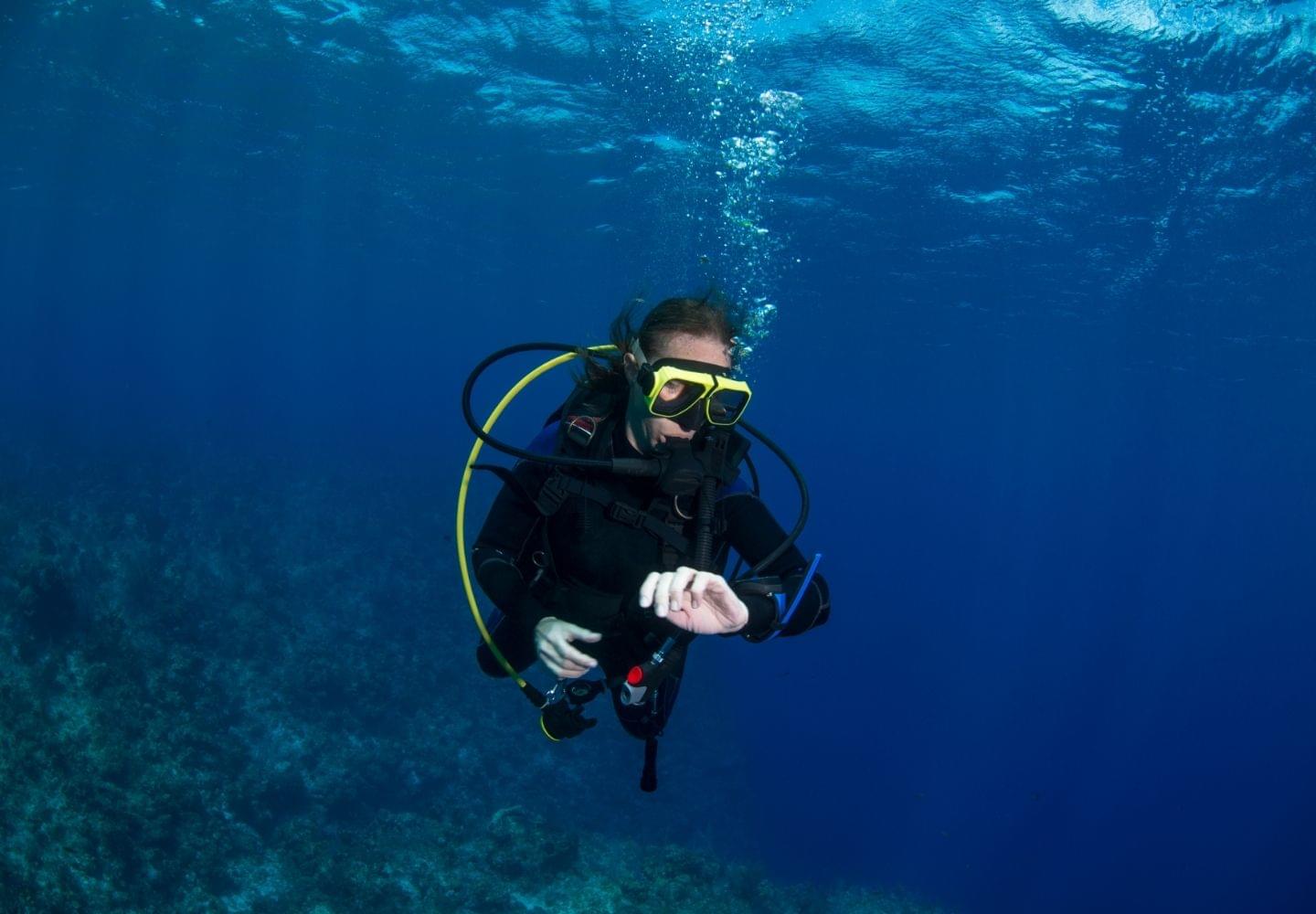
A dive computer at arm’s length, a submersible pressure gauge tucked against your body, a compass bezel, a camera screen — these are near-vision tasks performed in poor contrast while you are also doing something else. A single-vision distance correction fixes the reef and leaves the numbers exactly as blurred as they were. For anyone over about forty this is usually the actual complaint, arriving in the form of a computer that used to be legible.
What you want is a near-vision zone low in the mask rather than more correction overall. The options, in ascending order of commitment:
- A stick-on magnifier. A few dollars, peels off without damage, and the cheapest possible way to find out whether you like reading through a segment before you pay for one.
- A gauge reader. A premade lens with a near-vision portion and a plain upper section, for divers whose distance vision is fine.
- A bifocal segment, roughly +1.0 to +4.0, in a twin-lens mask. A single-lens mask has nowhere to put one.
- Franklin bifocals, the expensive end: two separate segments per eye, with the proportions chosen to order. DAN’s own illustration is a diver giving 70 percent of the lens over to near vision, which is a reasonable thing to want if your dives revolve around a camera1.
If your computer is the whole problem, start with the magnifier and our guide to choosing a dive computer — display size and contrast vary enough between models that the cheapest fix is sometimes a different screen.
Your correction leaves with the mask, and that cuts both ways
Every entry-level course teaches you to flood the mask, clear it, take it off, put it back on and swim without it. PADI’s own description of the Open Water course includes learning to swim underwater without your mask4. It is a required skill because the situation is a real one, and PADI notes plainly that a prescription mask can affect your vision when the mask is removed5.
Read that quickly and it sounds like a reason to choose contacts. It is more interesting than that, and the optics are worth knowing before you decide.
Your eye does most of its focusing at the front surface of the cornea, and it can only do that because there is air on the other side. Put water there instead and almost all of that power disappears: the cornea loses about 41 diopters, some 87 percent of its refracting power, and the eye ends up so severely farsighted that nothing focuses on the retina at all6. Accommodation cannot begin to make that up.
So a mask-off diver sees very little regardless of prescription. The no-mask swim is not appreciably worse for someone in a corrected mask than for anyone else, because at that moment everybody is effectively blind. Where the difference actually bites is the minute afterwards: on the surface, on the ladder, on the boat, reading a computer to log a profile or finding your own kit bag. A contact lens wearer still sees all of that. Someone whose only correction was bonded into a mask that is now on the bottom does not.
This is also the point where our own snorkeling advice inverts, and it is worth saying so rather than leaving the two pages to disagree quietly. On the surface a corrected mask is the calmer choice precisely because a flood costs you nothing — that is the conclusion of our snorkeling with glasses guide and we stand by it. Diving adds a mask-off skill, a decompression obligation and a boat to find, so the same trade lands differently.
Which means a backup mask, and its price depends on your route
DAN’s advice is that divers need backup options matched to their diving and their correction1. On a liveaboard or a trip built around photography, a single corrected mask is a single point of failure with a holiday attached.
Here is the part that is genuinely per-prescription, and it is the strongest argument in the category:
A premade corrected mask can be doubled cheaply. A bonded one cannot. If your prescription is a straightforward sphere and a stock power covers you, a second corrected mask costs roughly what the first one did. If your lenses were ground to your prescription and bonded to a mask by a lab, a spare means paying for the lens work twice — several hundred dollars, again, with the same three-week wait.
That does not mean the custom route is wrong. If you have real astigmatism it is the only route. It does mean the backup cost belongs in the decision at the start, rather than arriving as a surprise when you are packing.
The routes, honestly priced
| What it is | Prescriptions covered | Rough cost | Backup cost | |
|---|---|---|---|---|
| Premade corrected dive mask | A finished mask bought by power | Sphere only, no astigmatism | Mask plus a modest premium | The same again |
| Drop-in lenses | Stock lenses clipped into a compatible mask | Sphere only, 0.5 diopter steps | Mask plus lenses | A second set of lenses |
| Custom bonded lenses | Ground to prescription, fitted by a lab | Anything, astigmatism and prism included | $350 to $550 all in | The full lens cost again |
| Dive shop or specialist optician | Custom work with a fitting attached | Anything, measured in person | As above, sometimes more | As above |
Two details worth having, because they are the ones the snorkeling market does not share.
The dive side reaches further into strong prescriptions off the shelf. Promate’s Scope, sold as a prescription-ready dive mask, lists optical options from −1.0 to −10.0 in half-diopter steps, plus +1.0 to +4.0, and a bifocal gauge reader over the same plus range7. That is two diopters deeper on the minus side than the premade snorkeling lenses we found. Unlike almost everything on the snorkeling money page, masks like this are commonly sold as a finished corrected mask chosen by power rather than as a bare mask with a second purchase attached — but read the listing rather than the product name, because the same mask is also sold bare.
Custom work has published prices, and astigmatism is usually not the expensive part. One lab lists single vision from $254, bifocals from $344 or $379 depending on segment width, and readers from $210, with standard turnaround of 15 to 20 business days and rush options between $70 and $125. It advertises any prescription — nearsighted, farsighted, astigmatic or prismatic — with a $30 surcharge for spheres beyond ±4.00 or cylinder beyond ±3, and puts its strongest job to date at −278. Figures read on 30 July 2026.
If you are holding a prescription with a cylinder value on it, read prescription masks and astigmatism before you shop: one number on that card decides which row of the table above you are in. For what each mask listing actually ships, our prescription snorkel mask guide opens the listings one by one.
Doing a course with a prescription
PADI’s advice to contact lens wearers is to tell the instructor, so they can plan for it and help if something goes wrong5. The same courtesy is worth extending if your correction is in the mask — that is our reasoning rather than a standard, but an instructor who knows will position themselves differently during mask skills.
Two practical points follow from the course content rather than from any rule. Borrow or rent before you commit: the syllabus will have you remove and replace the mask several times, and it is much better to discover you dislike a particular mask before a lab bonds lenses to it. And if you already own a mask you get on with, corrected or not, keep it. Bonding lenses into a second mask and retaining the first as a clear spare is far cheaper than regretting what you did to your only one.
What this page is and is not
We have not dived in a prescription mask, and this page does not pretend otherwise.
What it is built from is published specification — manufacturers’ own lens ranges, the price lists of labs that do this work, and dive-industry guidance from Divers Alert Network and PADI — read against a diver’s understanding of which of those details actually change a dive plan. The safety reasoning is ours and rests on training rather than on product experience: mask removal, buddy separation and the order in which small problems become large ones are the substance of the Rescue Diver course, and they are the reason the mask-off case is treated here as the center of the decision rather than a footnote.
Two things stay yours. Fit is individual, so do the suction test with your own face before committing lenses to a frame; and how a given correction feels at depth is a conversation with the lab or the dive shop that will make them.
Frequently asked questions
Frequently asked questions
Can I use a prescription snorkel mask for scuba diving?
Only if the mask underneath the lenses is rated for diving. Plenty of corrected snorkeling masks are not — the Seaview 180 is the common example, built for recreational snorkeling at the surface rather than for depth. Check what the base mask is rated for before you pay to have lenses put into it, because the lens is rarely the part that gives up first.
Do prescription lenses hold up under pressure?
Dive mask lenses are tempered glass, which is what makes them safe to take down, and corrected dive masks are commonly rated far deeper than recreational limits. The pressure question is really a question about the mask, the skirt and the frame, not about the correction.
What happens if I lose my mask and I need correction?
Underwater it makes surprisingly little difference — without an air space in front of your eyes, nobody sees much, corrected or not. It matters at the surface and afterwards, where a contact lens wearer can still read a boat name or a computer and a prescription mask wearer cannot. That is the argument for carrying a second corrected mask.
Can I do my Open Water course in a prescription mask?
Yes, and it is worth telling your instructor either way, which is what PADI advises for contact lens wearers. Bear in mind the course includes removing your mask, replacing it and swimming without it, so borrow or rent before you have several hundred dollars of lenses bonded into a mask you have never dived.
Contacts or a prescription mask for diving?
Contacts keep working when the mask comes off and cost almost nothing, but the guidance on getting lenses wet is stricter than most divers realize, and rigid or gas-permeable lenses are a poor idea at any depth. A corrected mask removes the lens problem entirely and replaces it with a single point of failure worth backing up.
I am over 40 and cannot read my dive computer. What do I need?
A near-vision zone low in the mask rather than a full correction. That means a gauge reader, a bifocal segment of roughly +1.0 to +4.0 in a twin-lens mask, or a stick-on magnifier for a few dollars to find out whether you like reading through a segment before you pay for one.
What does a prescription scuba mask cost?
A premade corrected mask in a stock power runs like an ordinary mask plus a modest premium. Custom lenses ground to your prescription and bonded to a mask you supply start around $254 for single vision and $344 to $379 for bifocals, before the mask, so budget $350 to $550 all in.
Where to go next
- What each listing actually ships: prescription snorkel masks, and what you are really buying
- Holding a prescription with a cylinder value: prescription masks and astigmatism
- Weighing contacts against a mask: snorkeling with glasses and can you snorkel with contacts?
- If the computer is the problem: choosing a dive computer
References
Footnotes
-
“Prescription Dive Masks.” Alert Diver, Divers Alert Network, dan.org. ↩ ↩2 ↩3
-
“Seaview V3 Full Face Snorkel Mask.” Seaview 180, seaview180.com. ↩
-
“Prescription Dive Masks 101 (F.A.Q.).” GetWetStore, getwetstore.com. ↩
-
“Mastering Your Mask Skills.” PADI Blog, blog.padi.com. ↩
-
“Scuba Diving If You Wear Contacts or Glasses.” PADI Blog, blog.padi.com. ↩ ↩2 ↩3
-
“Underwater Vision.” ScubaGeek, scubageek.com. ↩
-
“Scope Mask (Rx-Able) — MK245.” Promate USA, promateusa.com. ↩
-
“Prescription Dive Masks.” Prescription Dive Masks, prescriptiondivemasks.com. ↩

Liz Meyer — Travel writer
Liz is a full-time traveler and a PADI Rescue Diver. She loves to explore new places in and out of the water and share her experiences with others.